
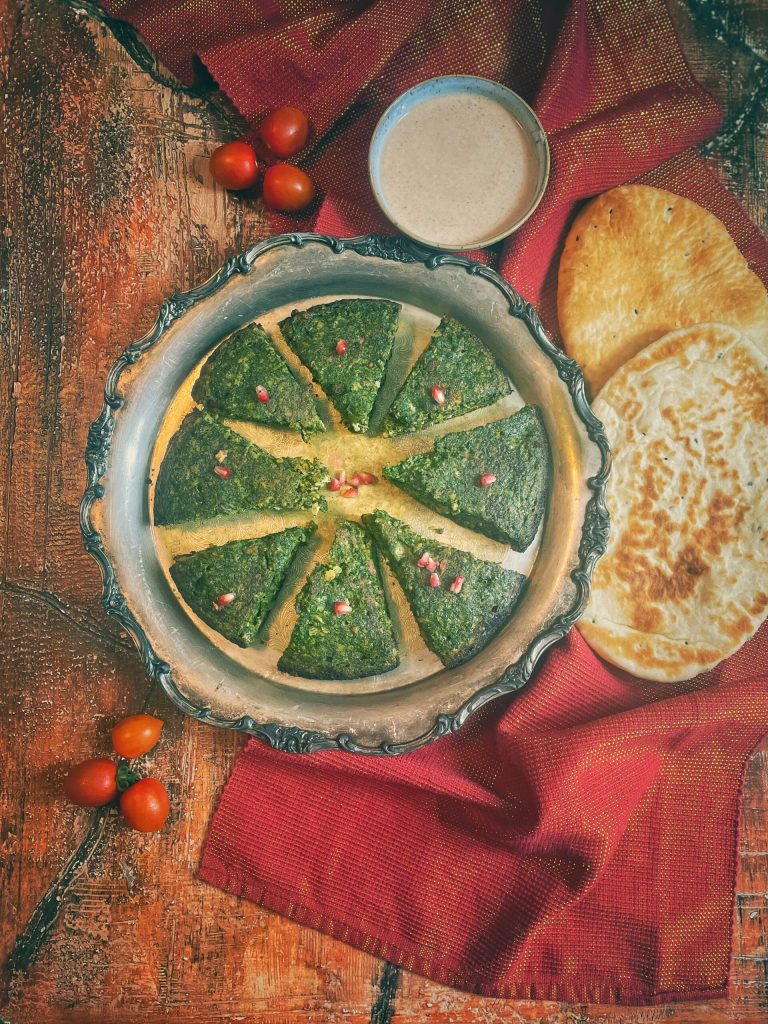
Kuku Sabzi is not a simple omelette, but a cornerstone of Iranian culinary tradition.
Unlike Western versions, where the egg is the absolute protagonist, in this dish the balance is reversed: the eggs serve solely as a binder for an explosion of fresh aromatic herbs that make up over 90% of the preparation.
The term Kuku (or Kookoo) in Farsi (Persian) refers to a specific category of Iranian dishes that could be described as a cross between an omelette, a flan and a savory tartlet.
Historically, Kuku Sabzi is the emblematic dish of Nowruz, the Persian New Year that coincides with the spring equinox. The vibrant green of the herbs (parsley, cilantro, dill and chives) represents the rebirth of nature, fertility and prosperity for the year ahead. It is a recipe that carries millennia of history and the scent of ancient Persian gardens.
Beyond the very fine chopped herbs, the most authentic version stands out for a refined balance of flavors and textures:
The tangy note: given by Zereshk (barberries), which create small peaks of acidity.
The crunchy note: provided by chopped walnuts, which break the softness of the mixture.
The warmth of the spices: with turmeric that gives a golden color to the crust and a deep aroma.
Whether served warm as an appetizer or cold for a picnic, accompanied by yogurt and lavash bread, Kuku Sabzi remains one of the most elegant examples of how Middle Eastern cuisine can transform simple ingredients into a dish with surprisingly complex aromas.
- Difficulty: Easy
- Cost: Affordable
- Preparation time: 5 Minutes
- Cooking time: 15 Minutes
- Portions: 4 Servings
- Cooking methods: Stovetop
- Cuisine: Middle Eastern
- Seasonality: All seasons, Spring
Ingredients
- 6 eggs
- 7 oz parsley
- 5 oz cilantro (coriander leaves)
- 4 oz dill
- 5 oz chives or green part of scallion (or the green part of a spring onion)
- 1 tablespoon dried fenugreek (Shanbalileh)
- 1/2 cup walnuts
- 3 cloves garlic
- 2 tablespoons barberries (or pomegranate seeds)
- 1 teaspoon turmeric
- 1/2 teaspoon baking powder for savory preparations
- to taste salt and pepper
- 1/2 tablespoon flour
- as needed vegetable oil
Tools
- 1 Pan 9.5/10.25 in
Steps
Obsessive drying: After washing the herbs, dry them completely. If they remain damp, the Kuku will become soggy and won’t form a crust. Chop them very finely by hand (avoid the food processor, which turns them into mush).
The egg mix: In a large bowl, beat the eggs with the salt, pepper, turmeric, baking powder and flour until there are no lumps.
Combining: Add the chopped herbs, garlic, fenugreek, walnuts and barberries to the egg mixture. Mix well: it should look like a “herb salad” held together by very little egg.
The first cooking: Heat a generous amount of oil in a nonstick pan (about 9.5–10.25 in). When the oil is hot (but not smoking), pour in the mixture and level it with the back of a spoon.
The steam trick: Cover with a lid and cook over medium-low heat for about 10 minutes. The steam will help cook the inside and make it puff up.
The final touch: When the base is firm and golden, cut the omelette into 4 or 8 wedges directly in the pan. Turn each wedge carefully.This time cook without the lid for another 5–10 minutes, adding a drizzle of oil if needed, to crisp up the other side as well.
FAQ (Questions & Answers)
What are the kuku variations?
Beyond the famous Kuku Sabzi (herbs) and Kuku Sibzamini (potatoes), Persian cuisine offers an incredible variety of Kuku. In Iran, this technique is applied to almost every vegetable or seasonal ingredient.
Here are the most famous and interesting variations:
1. Kuku-ye Gol-e Kalam (Cauliflower)
The cauliflower is blanched and then chopped or mashed. It is often enriched with saffron and turmeric, giving it an intense golden-yellow color. It has a very delicate texture and a nutty flavor.
2. Kuku-ye Kadoo (Zucchini)
Very similar to our zucchini omelette, but with the addition of garlic and sometimes a pinch of flour to make it firmer. Zucchinis are often coarsely grated.
3. Kuku-ye Morgh (Chicken)
A more protein-rich and substantial version. Boiled and finely shredded chicken is used, mixed with eggs, saffron and sometimes lime juice. It is almost halfway between an omelette and a croquette.
4. Kuku-ye Loobia Sabz (Green Beans)
Typical of the Tabriz area. It is made with green beans cut into small pieces, diced carrots and sometimes ground meat or nuts. It is one of the most colorful and structured variants.
5. Kuku-ye Bademjan (Eggplant)
Eggplants are roasted or fried and then mashed. The flavor is very rich and “smoky”, especially if the eggplants are charred over a flame before being mixed with the eggs.
6. Kuku-ye Maghz (Brains)
A gourmet and very traditional variant, prepared with lamb brains. It is considered a delicacy for special occasions, noted for its incredibly creamy texture.
7. Kuku-ye Ghandi (Sweet)
A rarity from Isfahan. It is a Kuku made with eggs and potatoes that is then covered with a sugar syrup, rose water and saffron. It is served as a dessert or an energy-rich breakfast.
8. Kuku-ye Do-Rang (Two-colored)
It is the dramatic union of two recipes: one layer of Kuku Sabzi (green) and one layer of Kuku Sibzamini (yellow) stacked in the same pan. Stunning when sliced.Does Kuku Sibzamini, the potato variant, resemble the Spanish tortilla?
Kuku Sibzamini is the “close cousin” of the Spanish tortilla de patatas, but with the unmistakable character of Persian spices. While Kuku Sabzi focuses entirely on herbs, this one celebrates the potato (sibzamini in Farsi means “earth apple”).
There are two traditional ways to prepare it, which change the texture completely:
1. The version with boiled potatoes (Soft and dense)
It is the most common in Iran. Potatoes are boiled, peeled and mashed (a rough purée).
Ingredients: Boiled potatoes, 3-4 eggs, plenty of turmeric (for the golden color), salt, pepper and often a pinch of saffron dissolved.
Result: A tall omelette, soft inside and with a crispy crust outside. Very similar to a baked flan.
2. The version with raw grated potatoes (Crispy)
More similar to a rösti or a Jewish latke.
Ingredients: Raw grated potatoes (wrung out very well to remove the starch), eggs and often a grated onion (also well squeezed).
Result: Thinner and much crispier.
In the Spanish tortilla the potatoes are fried in slices in oil before being combined with the eggs. In Kuku Sibzamini they are almost always boiled or grated, and the presence of turmeric is mandatory for that vibrant yellow color.
