
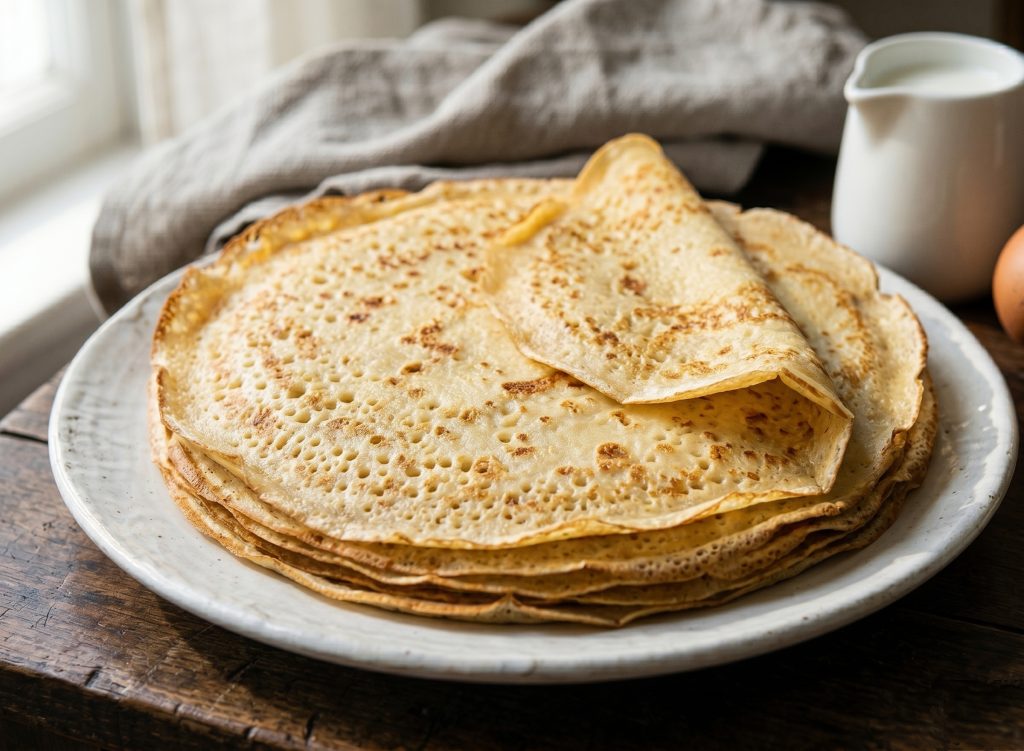
Basic crêpes recipe for two: perfect quantities for 8 sweet or savory discs
The main issue when looking for recipes online is that they are almost always calibrated for squads of 4 or 6 people, forcing us to perform complicated conversions or end up with piles of leftovers.
Not to mention the annoying risk of lumps: how many times have we obtained an irregular batter that ruins the cooking? I confess that even I, during my slow breakfasts or impromptu dinners for two, struggled to find the right balance between milk and flour without dirtying a thousand bowls, ending up giving up.
I scaled this basic recipe specifically for 2 people, yielding about 8 crêpes of 8 2/3 in. In this version I’ll show you how to obtain a batter that is first thick and then fluid, able to glide onto the pan like silk, guaranteeing that elastic and thin bite that is the hallmark of French crêpes.
Whether you want to fill them with glossy jam or melting cheese, by following my tips you’ll turn ingredients you already have in the pantry into a versatile and refined dish. No more waste, just the right amount for shared pleasure.
- Difficulty: Very easy
- Cost: Very cheap
- Preparation time: 10 Minutes
- Cooking time: 10 Minutes
- Portions: 2
- Cooking methods: Stovetop
- Cuisine: Italian
Ingredients – Basic Crêpes Recipe for 2
- 2 eggs (medium)
- 1 cup 00 flour
- 3/4 cup whole milk (about 7 fl oz (200 ml))
- 1 tbsp + 1 tsp butter (melted plus a little for the pan (about 20 g))
Tools
- Bowl
- Hand whisk
- Crepe maker
How to make crêpes for two: the secret to a smooth, silky batter
In a bowl, break the eggs and start whisking them by hand. Pour in the melted butter (let it cool slightly first) and incorporate the sifted flour little by little. At this stage you’ll get a very thick and almost sticky mixture: don’t be alarmed — this helps break up flour lumps more easily.
Continue stirring and stream in the milk bit by bit until the batter becomes fluid and light. Grandma’s secret: take another bowl and strain the mixture through a fine sieve. This step ensures that silky texture by removing any trace of unslaked flour.
Heat a nonstick pan (ideal diameter: 8 2/3 in). Lightly butter the bottom and remove the excess with a paper towel. Pour a small ladleful of batter, rotating the pan to cover the whole surface. Cook over medium heat for about one minute: when the edges start to lift, flip the crêpe and cook the other side for another minute until golden.
Ingredient notes and substitutions
Lactose-free: You can use lactose-free milk and butter. If you prefer, replace the butter with 1½–2 tbsp of neutral oil for an even lighter version.
Flour: “00” flour is ideal, but for a rustic touch you can replace a small portion with buckwheat flour.
Sugar or Salt? Being a neutral base, we don’t add either sugar or salt to the batter so you can choose the filling freely.
Storing crêpes
If you want to get organized ahead of time, you can make them the day before and store them in the fridge covered with plastic wrap. If you want to freeze them, stack them with a sheet of parchment between each one (so they won’t stick) and seal well: they keep up to 2 months!
Recipe variations
Quick Crêpe Suzette: Add a bit of orange zest and orange liqueur to the batter.
Gratinated crêpes: Fill them with ham and béchamel, fold like a fan and bake at 392°F for 5 minutes for an irresistible crust.
Tea’s Tips
My trick for impeccable cooking? The pan must be hot but not scorching, otherwise the batter will set immediately without spreading. If you’re going to eat them “on the plate” with Nutella or jam, leave them on the heat a few extra seconds to form that crispy edge that makes them divine.
FAQ (Questions & Answers)
Can I prepare the batter in advance?
Absolutely yes! The batter can rest in the fridge for up to 12 hours. In fact, resting helps the flour proteins relax, making the crêpes even more elastic.
Why is the first crêpe always bad?
It’s almost a law of physics! It helps “set” the pan temperature and the thin layer of fat. Don’t get discouraged — the second one will be perfect.
Can I use a gluten-free flour?
Yes, but keep in mind that gluten-free flours absorb liquids differently. You may need a splash more milk to maintain the necessary fluidity.
