
Homemade Tzatziki Sauce: tricks, mistakes to avoid and the chef’s tips
Perfect tzatziki: why your sauce becomes watery (and how to fix it)
Have you ever made tzatziki dreaming of that velvety texture you tasted in Greece, only to end up with a kind of “soup”?
It’s a classic. The main problem with homemade tzatziki isn’t the flavor but handling the moisture. Many people make the mistake of underestimating the cucumber’s water or of using an inappropriate yogurt, obtaining a sauce that separates after a few minutes in the refrigerator.
I confess that years ago I was skeptical too: the idea of a savory sauce based on yogurt and cucumbers (which I didn’t particularly love) didn’t convince me.
I had to change my mind as soon as I found the magic proportions and, above all, the correct technique.
To solve the annoyance of a watery sauce and get a result worthy of a Mykonos taverna, the secret is all in the “wringing” and in choosing strained Greek yogurt.
In this guide I’ll show you how to transform a few simple ingredients — Greek yogurt, cucumbers, garlic, lemon and extra virgin olive oil — into a dense, fragrant emulsion.
We’ll see together why you should never use plain yogurt and how to treat the cucumbers so they release all the liquid before meeting the yogurt.
Once you learn the mechanics, this sauce will become your ace for appetizers, barbecues or to replace mayonnaise in sandwiches in a lighter, healthier way. Trust me, follow these steps and you won’t do without it!
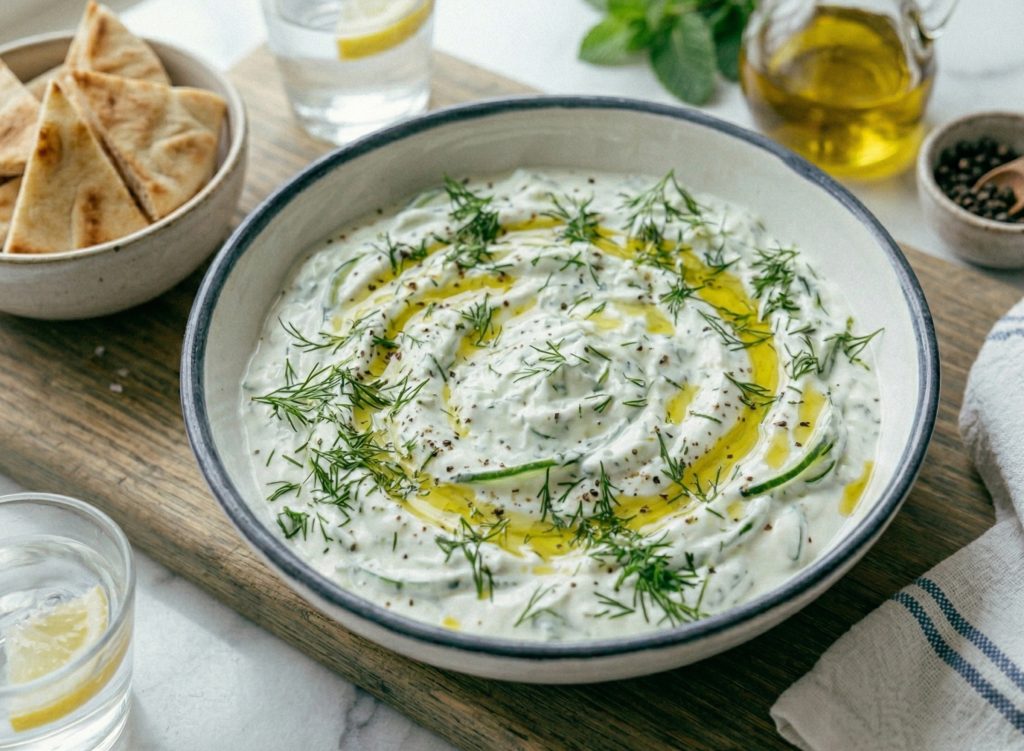
- Difficulty: Very easy
- Cost: Budget-friendly
- Rest time: 1 Hour
- Preparation time: 15 Minutes
- Portions: 6
- Cooking methods: No-cook
- Cuisine: Greek
- Energy 104.45 (Kcal)
- Carbohydrates 6.40 (g) of which sugars 5.07 (g)
- Proteins 4.30 (g)
- Fat 7.27 (g) of which saturated 2.15 (g)of which unsaturated 0.01 (g)
- Fibers 0.48 (g)
- Sodium 226.48 (mg)
Indicative values for a portion of 70 g processed in an automated way starting from the nutritional information available on the CREA* and FoodData Central** databases. It is not food and / or nutritional advice.
* CREATES Food and Nutrition Research Center: https://www.crea.gov.it/alimenti-e-nutrizione https://www.alimentinutrizione.it ** U.S. Department of Agriculture, Agricultural Research Service. FoodData Central, 2019. https://fdc.nal.usda.gov
Tzatziki Sauce Ingredients
- 2 cups Greek yogurt
- 2 cucumbers (about 5.3 oz (150 g))
- garlic (1 or 2 cloves, to taste)
- 3 1/3 tbsp extra virgin olive oil
- 2 tsp lemon juice (or white wine vinegar)
- to taste salt
- A few leaves mint
- 1 pinch black pepper (optional)
Tools
- Grater
- Bowl
- Fine-mesh strainer
How to make dense and creamy Greek Tzatziki sauce: the original recipe and tricks
Wash the cucumbers, trim the ends and, if you prefer a finer texture, peel them partially. Cut them in half lengthwise and remove the central seeds. Grate them using the large holes of a grater. Now the key step: place the pulp in a fine-mesh strainer, lightly salt and let drain for at least 15-20 minutes. After this time, squeeze them firmly by hand or inside a clean kitchen towel until no more water comes out.
While the cucumbers are draining, finely chop the mint (or dill). Peel the garlic, remove the inner shoot to make it easier to digest and crush it with a garlic press or reduce it to a paste with a knife until you obtain a very fine paste.
In a large bowl, combine the Greek yogurt, garlic, extra virgin olive oil and lemon juice (or vinegar). Mix well to create a silky emulsion. Add the squeezed cucumbers and the aromatic herbs. Adjust with salt and pepper. Mix gently and refrigerate for at least one hour: this time allows the garlic to infuse its aroma without becoming too sharp.
Notes on ingredients and substitutions
YOGURT: For this recipe you must use full-fat strained Greek yogurt. Regular plain yogurt is too watery and would ruin the texture.
LEMON JUICE: In some recipes white wine vinegar is used instead of lemon juice. If you want to use it, use the same quantity (about 2 tsp).
CUCUMBERS: Use firm cucumbers. If they have a lot of seeds, remove them with a spoon before grating. Do not skip the step where grated cucumbers are left to drain their excess liquid, you could compromise the result of the recipe.
SALT: Start by adding half a teaspoon of salt, then taste and adjust to your preference.
PEPPER: optional. You can try with 1 pinch but it is not necessary.
HERBS: Mint gives freshness, but if you want the authentic flavor of Greek taverns, use dill. You can also mix them.
STORAGE
Tzatziki keeps perfectly in the refrigerator for 2-3 days in an airtight container. In fact, the second day it is often better because the flavors have had time to meld together.
Recipe variations
Vegan Tzatziki: Replace the Greek yogurt with plain soy yogurt (unsweetened), making sure to strain it in a cheesecloth for a few hours to thicken it.
Tzatziki with Walnuts: In some Balkan areas chopped walnut kernels are added for a crunchy note.
Tea’s Tips
If you want a truly “wow” tzatziki, serve it by creating a swirl on the surface with the back of a spoon, pour a generous drizzle of extra virgin olive oil into the grooves and garnish with a Taggiasca or Greek olive in the center. Serve it with warm pita bread or use it to dress a tomato and feta salad: it will turn a simple dish into a gourmet experience!
FAQ (Questions & Answers)
Can I make tzatziki without garlic?
Garlic is the soul of this sauce, but if you really can’t tolerate it you can omit it or use a minimal amount (half a clove) with the inner shoot removed. The flavor will be less authentic but still fresh.
Why did my tzatziki become watery after a night in the fridge?
Probably the cucumbers were not squeezed enough. Even a small amount of residual water can separate from the yogurt over time. Just stir well before serving, but next time squeeze more firmly!
Can I use low-fat yogurt instead of full-fat?
Yes, as long as it’s strained Greek yogurt. The texture will be similar, but the full-fat version is decidedly creamier and balances the lemon’s acidity and the garlic’s strength better.
WHAT DOES TZATZIKI ACCOMPANY?
You can serve tzatziki as a dip in a bowl with raw vegetables or breadsticks, spread it on toasted crostini, use it instead of mayonnaise to enrich a sandwich, serve it with grilled meat or fish, or to dress a salad.
WHAT IS TZATZIKI?
Tzatziki is a typical sauce of Greek cuisine, widespread in the Balkans and the Middle East, much like hummus, now famous and loved worldwide. There are many versions, but what unites them is the presence of Greek yogurt, cucumbers, garlic, oil and salt. Some use white wine vinegar, others prefer lemon juice, and some recipes even include onion. Fresh mint leaves are often added to give that unmistakable aroma. A super versatile sauce served from appetizers (typical in Greece with pita bread), as a dip or as an accompaniment to meat, fish or vegetable dishes. It can also be a lighter and healthier way to dress a salad or replace mayonnaise or other sauces in your sandwiches.
