
WHOLE ROAST CHICKEN RECIPE
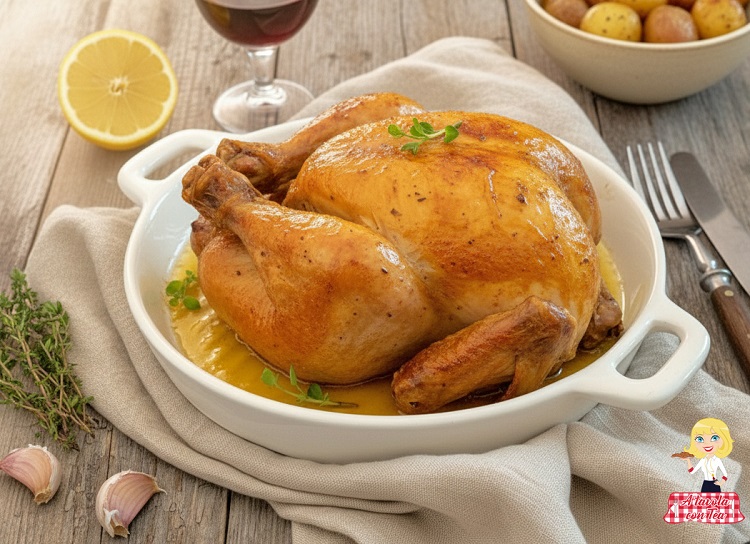
The roast chicken is a timeless classic of Italian cuisine, loved for its simplicity and irresistible flavor. Not surprisingly, October 2 has been designated Roast Chicken Day, a testament to its popularity. In this recipe, I will guide you step by step to prepare a perfect whole roast chicken, with tips and tricks to obtain juicy meat and crispy skin.
The key to a mouthwatering roast chicken lies in the marinade and the cooking. I will reveal the secrets for an aromatic marinade based on garlic, herbs and spices that will enhance the chicken’s flavor. You will also learn how to adjust oven times and temperatures according to the size of the chicken, for even, error-free cooking.
You can serve your roast chicken with potatoes, grilled vegetables or a fresh salad, creating a complete and delicious meal. I will also give you useful tips on how to clean and carve the chicken, and suggest some marinade variations to personalize the recipe to your taste.
Whether you are an experienced cook or a beginner, this guide will allow you to prepare a perfect roast chicken that will win over all your guests. And maybe you can celebrate the next Roast Chicken Day in style!
- Difficulty: Easy
- Cost: Low cost
- Preparation time: 20 Minutes
- Cooking time: 1 Hour
- Portions: 4
- Cooking methods: Oven
- Cuisine: Italian
- Energy 301.83 (Kcal)
- Carbohydrates 3.42 (g) of which sugars 0.11 (g)
- Proteins 32.14 (g)
- Fat 18.21 (g) of which saturated 6.03 (g)of which unsaturated 11.70 (g)
- Fibers 1.30 (g)
- Sodium 750.96 (mg)
Indicative values for a portion of 150 g processed in an automated way starting from the nutritional information available on the CREA* and FoodData Central** databases. It is not food and / or nutritional advice.
* CREATES Food and Nutrition Research Center: https://www.crea.gov.it/alimenti-e-nutrizione https://www.alimentinutrizione.it ** U.S. Department of Agriculture, Agricultural Research Service. FoodData Central, 2019. https://fdc.nal.usda.gov
Ingredients
- 2.2 lb chicken (whole)
- 1 3/4 tsp coarse salt
- 2 cloves garlic
- 2 leaves bay leaves
- 1 tsp oregano
- 2 sprigs rosemary
- 5 leaves sage
- 1 pinch black pepper (optional)
- as needed extra virgin olive oil (for massaging the chicken)
Tools
- Bowl
- Food processor
- Baking dish
PROCEDURE
First of all, the chicken should be tied so it keeps its shape during cooking. To do this, take an oven-safe roasting tie or cooking elastic and wrap it around the ends of the drumsticks, then pull it around behind the chicken’s breast to hold everything in place.
Put into the food processor: bay leaves, coarse salt, sage, rosemary, fresh oregano and 2 peeled garlic cloves and pulse everything until chopped, then transfer the mixture to a small bowl. Take the tied chicken and place it in a roasting pan, then rub the entire surface with extra virgin olive oil to help the spice mix adhere. At this point cover the chicken with the aromatic mixture and rub lightly to help absorption. Insert a little of the mixture also inside the cavity of the chicken.
Place the chicken in a preheated static (conventional) oven at 356°F and roast for about one hour, occasionally basting it with its cooking juices. After 30 minutes (of the total 60 minutes) take it out of the oven and turn it so the cooking is even on both sides. Continue for the remaining 30 minutes, continuing to baste from time to time. When it is cooked (if you have a thermometer the internal temperature of the meat should be 162°F) remove it from the oven and serve hot.
STORAGE
Once cooked, roast chicken can be stored in a closed container in the refrigerator for one full day. With leftover chicken, if you want to make it even more appetizing you can prepare a CAESAR SALAD (recipe link HERE), the famous American salad of roast chicken, croutons, Parmesan and bacon dressed with Caesar dressing.
TIPS
CHICKEN: The chicken can be a free-range type or the classic one you find at the butcher or supermarket; however, be sure to choose a good chicken with firm meat and not too lean.
COOKING TIMES: The cooking times in the recipe are based on a chicken of about 2.2 lb (1 kg). Obviously these change according to the weight of the chicken. If you use a larger chicken, for example about 3.3 lb (1.5 kg), consider 1.5 hours of cooking and also increase the amount of salt (about 2 1/2 tsp) and aromatic herbs.
VARIATIONS: If you want an even juicier result you can place small knobs of butter under the skin, trying to keep the skin as intact as possible so the meat does not dry out in cooking. Another method is to inject the chicken, i.e. inject a little melted butter, especially into the breast, using a syringe.
TYPES OF MARINADE FOR ROAST CHICKEN:
Marinating is a fundamental step for the success of a whole roast chicken because it enhances the flavor and the meat acquires an aromatic taste. You can choose the flavors to use based on your personal preference or the aromatic note you want to achieve. The most traditional choice is thyme and rosemary; if you love strong and spicy flavors you can opt for paprika, garlic and chili pepper. For an oriental taste try curry or a marinade made with ginger, soy sauce and lime.
HOW TO MARINATE THE CHICKEN
First, prepare the marinade with the spices and aromatics you have chosen, then add a generous amount of extra virgin olive oil, salt and pepper. Put the chicken in a roasting pan and coat it with the marinade, making sure to wet all the meat well. You can also massage the chicken to help the absorption of the aromatic mix. It is recommended to let the chicken rest in the marinade overnight in the refrigerator.
HOW TO CLEAN A WHOLE CHICKEN
Start cleaning the chicken externally by removing any remaining pin feathers from the skin: you can singe them off briefly over a flame and then remove them with kitchen tweezers. Then remove the gland located at the tail end of the chicken. Also make sure the chicken is clean inside and rinse it well under running water, both inside and out. After washing, dry it thoroughly with kitchen paper, including the cavity.
HOW TO CARVE A WHOLE CHICKEN
If you prefer to cook the chicken in pieces rather than whole, but are faced with a whole bird and don’t know where to start, don’t worry — here’s how to clean and carve a chicken in a few simple steps. You don’t need particular skills, just some rules and a bit of practice. First, wash the chicken under cold running water, including the cavity, then pat dry with absorbent paper and singe any remaining feathers over the stovetop flame. Now proceed to cutting: a properly sectioned chicken can be divided into 8 parts: 2 wings, 2 thighs, 2 breasts and 2 halves of the rib cage. With a sharp chef’s knife remove the tail and the fat around the cavity. Cut both wings at the joint where they meet the breast; you can remove the wing tips if you wish. Pull one thigh outward and position the knife at the joint, then gently cut through the skin and push the knife firmly to separate the thigh. While pulling the thigh with your hand, continue cutting along the back until the thigh detaches completely. Repeat for the other thigh. Now move on to the breast: separate it from the rest of the bird with the knife and divide it into two pieces. Now the carved chicken is ready to be cooked!
CURIOSITY
Did you know that since 2021 Roast Chicken even has a specific day on the calendar to celebrate it? It falls on October 2 every year and is called “Roast Chicken Day.” On this occasion chefs, influencers and bloggers compete to post photos and recipes of their best versions of roast chicken. The reason for this celebration comes from statistics that indicate this is one of the most loved main dishes in Italy. Are you part of this fan club too?
FAQ (Questions and Answers)
How do you clean and carve a whole chicken?
Cleaning and carving a chicken do not require special skills, just a few rules and some practice. First, wash the chicken under cold running water, including the cavity, then pat it dry with kitchen paper and singe any remaining feathers over the stovetop flame. To carve: a correctly sectioned chicken can be divided into 8 parts: 2 wings, 2 thighs, 2 breasts and 2 halves of the rib cage. With a sharp chef’s knife remove the tail and the fat around the cavity. Cut both wings at the joint where they meet the breast; you may remove the wing tips. Pull one thigh outward and cut at the joint, then separate the thigh by cutting along the back until it detaches. Repeat for the other thigh. Separate the breast from the rest of the bird and divide it into two. The chicken is now ready to be cooked!
Roast chicken: do you eat it with your hands or a fork? What does etiquette say?
According to a Doxa survey, 53% of respondents eat roast chicken with their hands, especially when at home with family; the other half would be willing to do so if etiquette allowed it. Good news: the Italian Academy of Etiquette has recently rewritten the rules to allow enjoying roast chicken without cutlery in informal contexts. So at home among friends, yes — but in a fine dining restaurant it’s better to stick to utensils.
Roast chicken: is the skin bad for you?
Many of us were told as children to discard the chicken skin because “it’s unhealthy” or “it’s fatty”, yet it is often the tastiest part, especially when crispy. Is that really true? The answer is “it depends.” It also depends on how the chicken is cooked: if we use an excessive amount of oil the skin will absorb much of it. A lighter cooking method, like on a rotisserie, can let you enjoy the skin in moderation. So occasionally, under the right conditions, it can be part of a balanced diet.
What is the perfect side for Roast Chicken?
One of the most classic pairings with roast chicken is potatoes, although nutritionally it might be preferable to choose a vegetable side. In any case, roast potatoes are a timeless match for chicken. For a lighter option, consider steamed potatoes which are healthier and less caloric than oven-roasted ones!
