
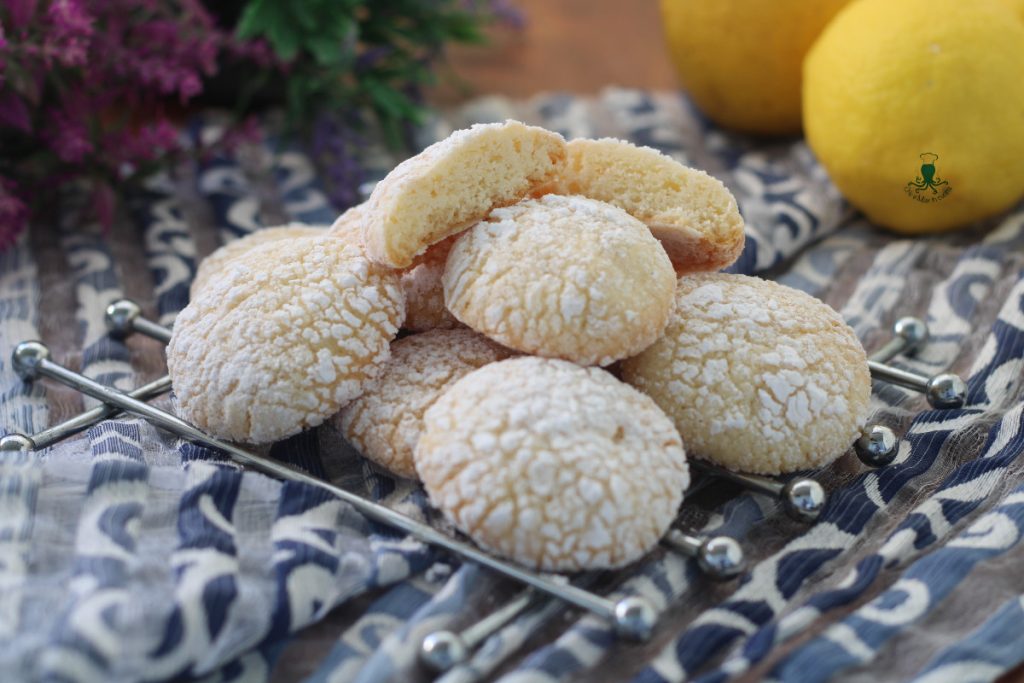
Lemon oil cookies, fragrant and butter-free, are one of those simple recipes that win you over at the first bite. Soft, crunchy and incredibly aromatic, they release all the lemon scent already during baking, filling the kitchen with an irresistible fragrance.
This is the butter-free version, ideal for those looking for a lighter alternative without sacrificing flavor. If you prefer a more classic preparation, I invite you to discover the lemon cookies made with butter: an equally simple and indulgent variant, perfect for any occasion.
Using oil in the dough makes these cookies soft and pleasant to the palate, with a delicate texture that remains even on subsequent days. They are perfect for breakfast, to accompany a tea, or for a sweet break at any time of day.
The preparation is easy and quick, suitable even for those with little kitchen experience: a few ingredients, simple steps and a result that never disappoints. You can also easily personalize them by replacing the lemon with orange or adding a touch of vanilla to make them even more fragrant.
This lemon oil cookie recipe struck me for its simplicity and surprisingly good final result, and it was shared on Facebook by the Urban Kitchen school – cooking school page, from which I drew inspiration to make it.
- Difficulty: Very easy
- Cost: Budget-friendly
- Rest time: 30 Minutes
- Preparation time: 10 Minutes
- Cooking time: 20 Minutes
- Portions: 30 cookies, about 0.6 oz (16 g) each
- Cooking methods: Oven
- Cuisine: Italian
- Seasonality: All seasons
Ingredients for the oil-based, fragrant and butter-free cookies:
- 2 cups all-purpose flour
- 1 tsp baking powder (for sweets)
- 3/4 cup granulated sugar
- 1 organic lemon
- 1 large egg (about 50 g / 1.8 oz) egg
- 5 tbsp neutral vegetable oil (about 70 g)
- pinch fine salt
- tsp vanilla extract
- as needed granulated sugar (for coating)
- as needed powdered sugar (for coating)
Tools for the oil-based, fragrant and butter-free cookies:
- 1 Bowl
- Spoons
- 2 Plates
- 2 Non-stick baking sheets
Steps for preparing and baking the oil-based, fragrant and butter-free cookies:
In a bowl put the sugar, the juice and grated zest of one lemon, the melted butter, the vanilla and the eggs. Mix well until you get a homogeneous mixture.
Then add the flour, the baking powder and a pinch of salt. Combine all the ingredients until you obtain a soft and uniform dough.Cover the dough with plastic wrap and let it rest in the refrigerator for at least 30 minutes.
After resting time, take small portions of dough (about 0.6 oz / 16 g each) and form balls. Roll them first in granulated sugar and then in powdered sugar.
Place the cookies on a non-stick baking sheet, spaced well apart, because they will spread during baking.
Bake in a preheated convection oven at 329°F for about 20 minutes. The cookies will be soft when just removed from the oven, but they will firm up as they cool.
Helpful tip
The dough will be quite soft: this is normal. After resting in the refrigerator it will be easier to work with. If while forming the balls it is still slightly sticky, you can help yourself with lightly floured hands.
FAQ (Questions and Answers)
How do I get the classic cracked surface?
The double roll — first in granulated sugar and then in powdered sugar — is essential. During baking the typical cracks will form on the surface.
Can I prepare the dough in advance?
Yes, you can prepare it in advance and store it in the refrigerator for several hours, well covered. Before using it, let it sit at room temperature for a few minutes.
Can I use only powdered sugar instead of granulated sugar?
It’s better not to: granulated sugar helps create a base that allows the powdered sugar to adhere better and form the cracked effect.
Why do lemon cookies come out hard instead of soft?
Cookies can become hard if they are baked too long or at too high a temperature. It’s important to respect the baking times and remember that they should still be soft when just removed from the oven: they will firm up as they cool, maintaining the right texture.
Why don’t lemon cookies crack on the surface?
If the cookies do not crack, it may be due to an insufficient layer of powdered sugar or because the dough is too cold or too dry. It’s important to roll them first in granulated sugar and then generously in powdered sugar, without removing the excess, to obtain the classic cracked effect during baking.
