
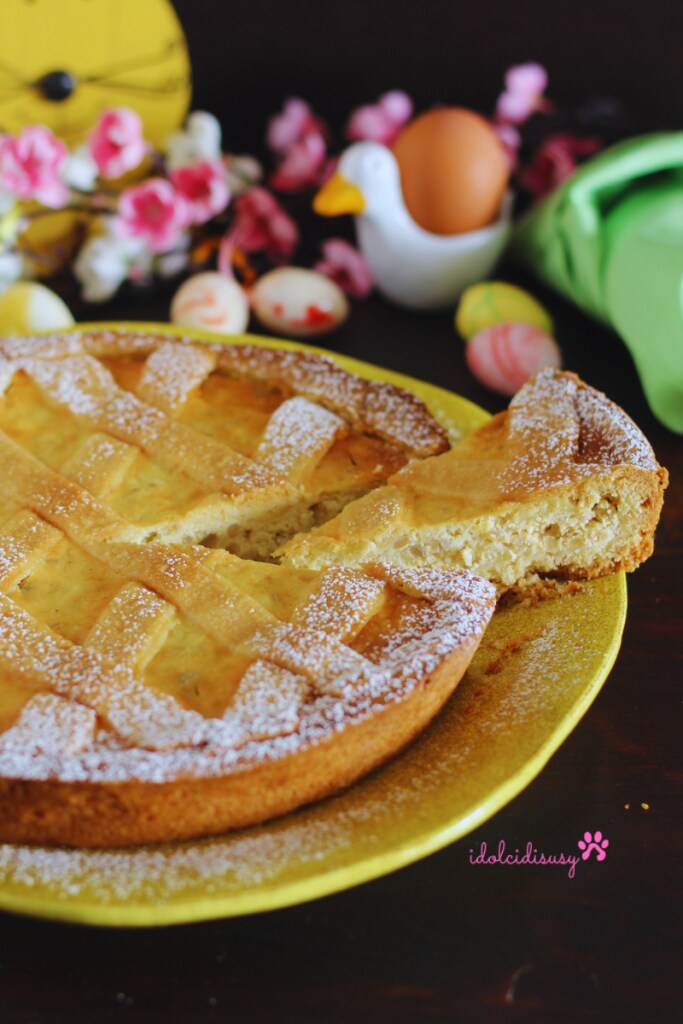
The Neapolitan pastiera is one of the emblematic Easter desserts: aromatic, creamy and steeped in tradition. If you love homemade holiday treats, on my blog you’ll also find the jam tart and the grandma’s apple cake, perfect to prepare alongside the pastiera.
It is a shortcrust tart filled with a cream based on ricotta, cooked wheat, eggs, candied fruit and aromas such as orange blossom water and cinnamon. The result? A dessert with an intense perfume, creamy and with a truly unique texture that captivates from the very first taste.
It is a fairly elaborate recipe and requires time, but it’s well worth it. According to tradition, the Neapolitan pastiera should be prepared on Holy Thursday to rest for at least three days so it can be enjoyed at its best on Easter Sunday.
Every Neapolitan family has its own version of the pastiera, handed down through generations. A dessert that encloses the whole history of Naples, made of intense aromas and a deep love for cooking.
For me, making the pastiera is not just following a recipe, it’s a true ritual. I make it every year for my family and give some to friends, along with Easter cookies. It’s one of those desserts that immediately creates atmosphere and makes any moment special.
Absolutely a must! If you try it, let yourself be embraced by its aromas and its magic. Now let’s discover together the traditional Neapolitan pastiera recipe.
See you soon
Susy
Also try 👇
- Difficulty: Medium
- Cost: Medium
- Rest time: 2 Days
- Preparation time: 1 Hour
- Cooking time: 1 Hour 30 Minutes
- Portions: 10 people
- Cooking methods: Electric oven
- Cuisine: Italian
- Energy 569.30 (Kcal)
- Carbohydrates 77.90 (g) of which sugars 43.95 (g)
- Proteins 11.57 (g)
- Fat 25.01 (g) of which saturated 11.37 (g)of which unsaturated 12.44 (g)
- Fibers 2.25 (g)
- Sodium 133.87 (mg)
Indicative values for a portion of 154 g processed in an automated way starting from the nutritional information available on the CREA* and FoodData Central** databases. It is not food and / or nutritional advice.
* CREATES Food and Nutrition Research Center: https://www.crea.gov.it/alimenti-e-nutrizione https://www.alimentinutrizione.it ** U.S. Department of Agriculture, Agricultural Research Service. FoodData Central, 2019. https://fdc.nal.usda.gov
Ingredients for the Neapolitan Pastiera: Traditional Recipe
With these amounts I make 2 pastiere: one 26 cm (about 10 1/4 in) and a smaller one 22 cm (about 8 2/3 in), perfect to enjoy with family or to give away.
- 4 cups 00 flour (or all-purpose flour)
- 1 cup granulated sugar
- 7 oz lard (or butter)
- 2 eggs (medium)
- 1 egg yolk
- 2 drops orange blossom extract (drops)
- 1 lemon zest (grated)
- 2 cups cooked wheat
- 1/2 cup whole milk
- 1 1/2 tbsp butter
- 1 1/2 tbsp sugar
- 1 lemon zest
- 1 2/3 cups sheep ricotta
- 1 cup sugar
- 3 eggs
- 1/2 teaspoon ground cinnamon
- 1/4 cup candied citron
- 1/4 cup candied orange
- 1 tbsp orange blossom water
- 1 lemon zest (grated)
- 1 orange zest (grated)
- powdered sugar
Useful Tools
- Aluminum pan 10 1/4 in diameter and 1 9/16 in high (pastiera pan)
- Hand whisk
I prepare the Neapolitan Pastiera: Traditional Recipe
On the work surface, pour the flour and arrange it in a well. In the center put the lard (or slightly softened butter), the orange blossom extract, the grated lemon zest, a pinch of salt and the sugar. Start working quickly with your hands, trying to blend all the ingredients well.
At this point add the whole eggs and the yolk and continue kneading until you obtain a homogeneous, smooth and elastic dough.
Wrap the shortcrust pastry in cling film and let it rest in the refrigerator for at least 1 hour. This step is fundamental: resting makes the dough more elastic and easier to roll out.
Once ready, roll it out with a rolling pin and use it to line the pastiera pan. This is an easy-to-handle pastry: it doesn’t break and molds easily, perfect for achieving a nice regular shell.Meanwhile, in a non-stick saucepan pour the well-drained cooked wheat, add the milk, a tablespoon of sugar, the lemon zest and the butter.
Place over low heat and cook for about 20 minutes, stirring often so the mixture doesn’t stick and becomes creamy. The milk should be completely absorbed, but the result must not be dry: the mixture should remain soft and slightly creamy, similar to a thick cream.
If you use a large piece of lemon zest, I recommend removing it at the end of cooking so the aroma will remain delicate and not too intense.
Remove from heat and let it cool completely at room temperature before adding it to the ricotta cream.Put the fresh ricotta in a fine-mesh sieve and let it drain so it loses excess liquid and becomes firmer.
Transfer it to a large bowl and add the sugar, the grated lemon and orange zest, a tablespoon of orange blossom water and a pinch of cinnamon. Start blending with a hand whisk until you obtain a smooth mixture, making sure the sugar dissolves well.
At this point add the eggs, one at a time, continuing to whisk and making sure each is fully incorporated before adding the next.
Finally add the candied fruit and mix gently with a spatula. Also add the now-cooled wheat cream and mix everything well.
Cover the bowl and let it rest in the refrigerator for a few hours: this step is important because it allows the flavors to meld perfectly and the cream to become even more fragrant and creamy.Take the shortcrust pastry from the refrigerator and roll it out on a lightly floured surface with a rolling pin. Transfer it to the 26 cm pan (about 10 1/4 in), press it well and trim the edges, removing excess dough.
Prick the base with the tines of a fork and pour the filling inside, distributing it evenly.
With the leftover pastry make the classic pastiera strips. Tradition calls for seven strips arranged in a lattice to form diamonds: according to popular tradition they represent the seven decumani of Naples, the ancient main streets of the Greco-Roman city.
Once assembled, put the pastiera in the refrigerator for a couple of hours. This step helps prevent it from puffing up too much during baking and keeps a perfect shape.
After the resting time, bake in a conventional oven at 338°F for about 1 hour and 30 minutes.
The baking must be slow and gentle: the pastiera is ready when the surface is slightly golden.
Turn off the oven and let it rest inside for at least 20 minutes with the door slightly open so it settles without sudden temperature changes.Finally our Neapolitan pastiera is ready. It’s a long recipe, true, but I assure you it’s well worth it: the aroma it releases and its unique taste repay every step.
Before tasting it, however, there is one last essential step: let it rest and dry well at room temperature. This waiting time is precious because it allows all the flavors to meld and release the many nuances of aroma and taste.
Only then dust it lightly with powdered sugar.
And here comes the best moment: the first taste.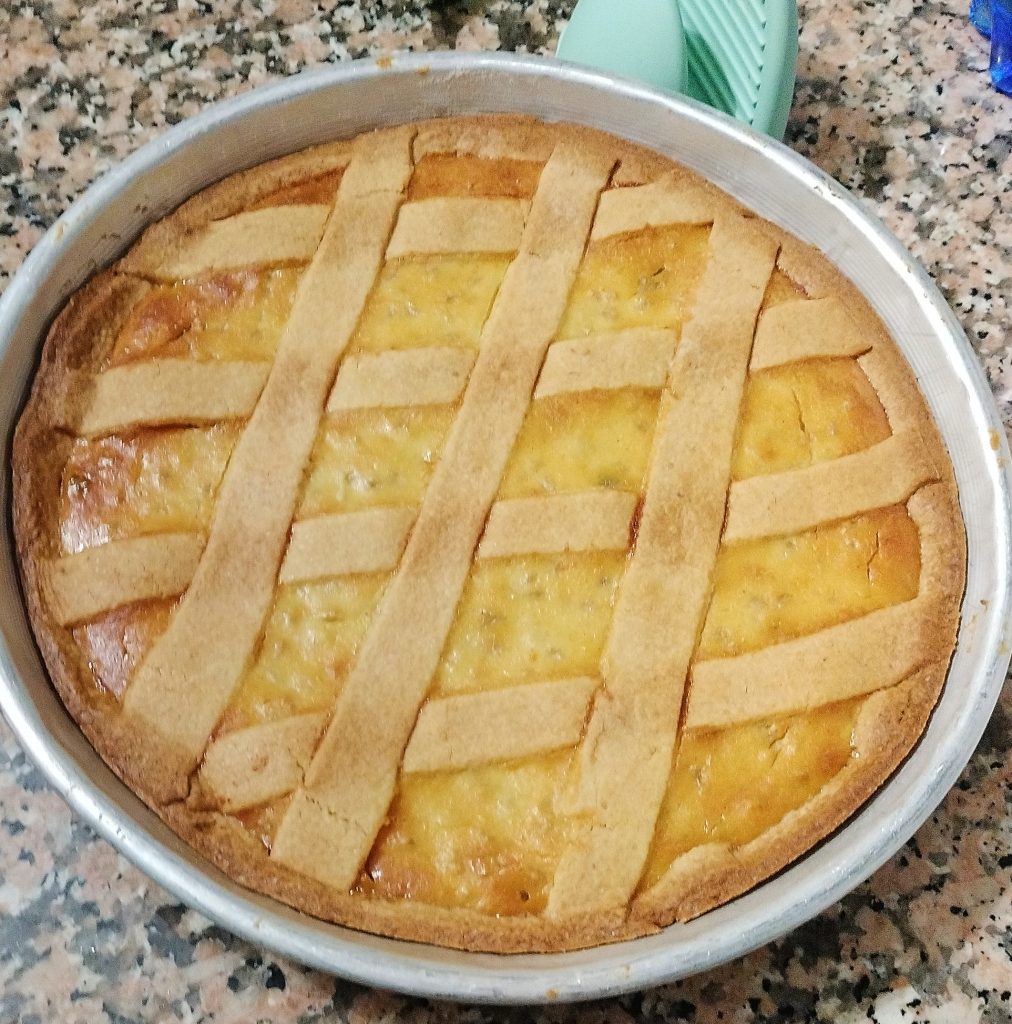
Storage and Useful Tips
The Neapolitan pastiera can be stored at room temperature in a cool, dry place away from heat sources for about 2 days. This is actually when it shows its best: the aromas intensify and the flavor becomes even more harmonious and enveloping.
If any is left over, you can store it in the refrigerator for another 2 days, well covered, so it will remain soft and pleasant to eat. I recommend taking it out a few minutes before serving so it regains its fragrance.
If you want to prepare it in advance, even better: the pastiera is one of those desserts that improve with rest, becoming even more delicious the next day.
With these amounts I make 2 pastiere: one 26 cm (about 10 1/4 in) and a smaller one 22 cm (about 8 2/3 in), but you can also choose to make single-portion pastierine, perfect to give away or serve already ready.
But the pastiera is not only a dessert, it is also history, tradition and a pinch of magic.
The legend says that one night the fishermen’s wives left baskets on the beach containing ricotta, candied fruit, eggs, wheat and orange blossoms as an offering to the sea, asking protection for their husbands. The next morning, returning to the shore, they found a wonderful surprise: the waves had mixed all those ingredients, creating something unique. Thus, according to tradition, the Neapolitan pastiera was born.
An enchanting tale that makes this dessert even more special, because it contains not only flavors and aromas, but also emotions, hope and love.
