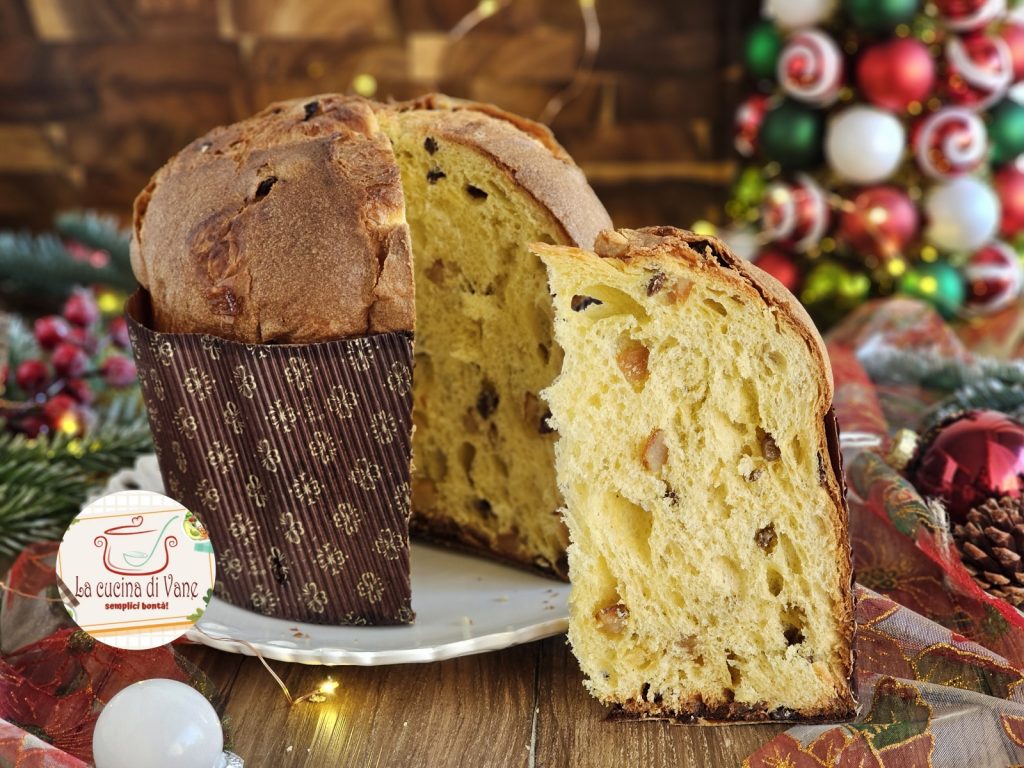
Making homemade panettone is one of the most beautiful little miracles of the Christmas season. It’s a dough that requires time and love, but when you take it out of the oven, tall and fragrant, you truly understand why it’s worth the effort.
Panettone is one of those aromas that wraps around your heart. As soon as you start kneading it, you already feel that magic that only homemade recipes can give. It’s the symbol of Christmas: a substantial dough that requires time and patience, but gives immense satisfaction when you see it rise, brown, and pull apart with stringy crumbs.
In this guide I’ll walk you step by step through making artisanal homemade panettone with the Pagani method—the procedure I use in my kitchen. You’ll find precise quantities, timings, tips, and all the fundamental steps for a perfect result.
Why you’ll love this recipe:
– Soft, stringy panettone
– Proven, reliable method
– Clear explanation, suitable even for beginners using liquid starter (licoli) or sourdough
– Intense aroma thanks to a homemade aromatic mix
Follow me in the recipe for the super-soft homemade panettone—you’ll taste how good it is! If you try it, let me know: tag me on Instagram @lacucinadivane so I can see your wonders!
- Difficulty: Medium
- Cost: Very economical
- Portions: 2 panettoni of 1 kg (about 2.2 lb) each
- Cooking methods: Oven
- Cuisine: Italian
- Seasonality: Christmas
Ingredients for 2 panettoni (about 2.2 lb / 1 kg each)
- 14.1 oz (about 3 1/4 cups) oz strong flour (W320-380)
- 5.3 oz oz liquid sourdough starter (licoli) (about 4 oz (112 g) if you use regular sourdough starter)
- 5.3 oz (about 8–9 large egg yolks) oz egg yolks
- 5.3 oz (about 2/3 cup) oz centrifuged butter (soft)
- 4.2 fl oz (about 1/2 cup) fl oz water (use 5.8 fl oz (about 165 g) if using regular sourdough starter)
- 4.4 oz (about 2/3 cup) oz sugar
- 5.3 oz (about 8–9 large egg yolks) oz egg yolks
- 5.3 oz (about 2/3 cup) oz centrifuged butter (soft)
- 3.5 oz (about 3/4 cup) oz strong flour (W320-360)
- 1.8 oz (about 2 1/2 tbsp) oz acacia honey
- 1.8 oz (about 1/4 cup) oz sugar
- 0.9 oz (about 2 tbsp) oz aromatic mix (blended candied orange, citron and lemon)
- 0.7 fl oz (about 1 1/3 tbsp) fl oz water
- 0.35 oz (about 2 tsp) oz malt
- 0.3 oz (about 1 1/3 tsp) oz fine salt
- 1 teaspoon vanilla extract
- 7.1 oz (about 1 1/4 cups) oz candied orange
- 7.1 oz (about 1 1/4 cups) oz raisins
Steps
Procedure for artisanal panettone with sourdough
The evening before, soak the raisins in lukewarm water for at least one hour, changing the water at least once.
Dry them with paper towels and let them finish drying completely between two kitchen towels overnight. This step prevents the raisins from drying out or burning during baking.
Refresh your sourdough starter and use it when it reaches about 1.5 times its volume.
In a stand mixer fitted with the paddle (or the K-hook), add the flour, the water, the egg yolks and the liquid starter. Start at low speed, then increase: in about two minutes the dough should start wrapping around the hook.
Add the sugar and the soft butter in three additions, always waiting for them to be absorbed.When the dough is smooth and well developed (5–6 minutes), turn it out onto the bench, perform a few folds and set it to rise.
It should quadruple in volume. It will take about 12 hours at room temperature; if you let it rise in a switched-off oven with the light on, it will take about 6–8 hours.
When the first dough has quadrupled, chill it in the fridge for 2 minutes, then place it in the stand mixer bowl with the dough hook; add the flour, the malt and the salt. Mix until the dough develops, then add the next ingredients in this order:
a. 1/3 of the egg yolks + 1/3 of the BUTTER + half the sugar
b. Repeat the same step a second time
c. Last third of butter and yolks, then the honey and vanillaAdd the aromatic mix, then the water. When the dough is well supported, incorporate the raisins and candied fruit and mix them in thoroughly.
Turn the dough out, do a couple of folds, shape into a tight round (pirla) and let it rise until it has increased by about 3/4 inch (about 2 cm).
Take the dough and divide it into two equal parts (about 1 kg and 100 g each).
For each portion perform quick folds—important to incorporate air into the dough—then shape and place into panettone molds.
Leave to proof until the dome reaches the rim and the sides are about 5/8 inch (1.5 cm) from the edge.
Score a cross on the surface and add little knobs of butter.
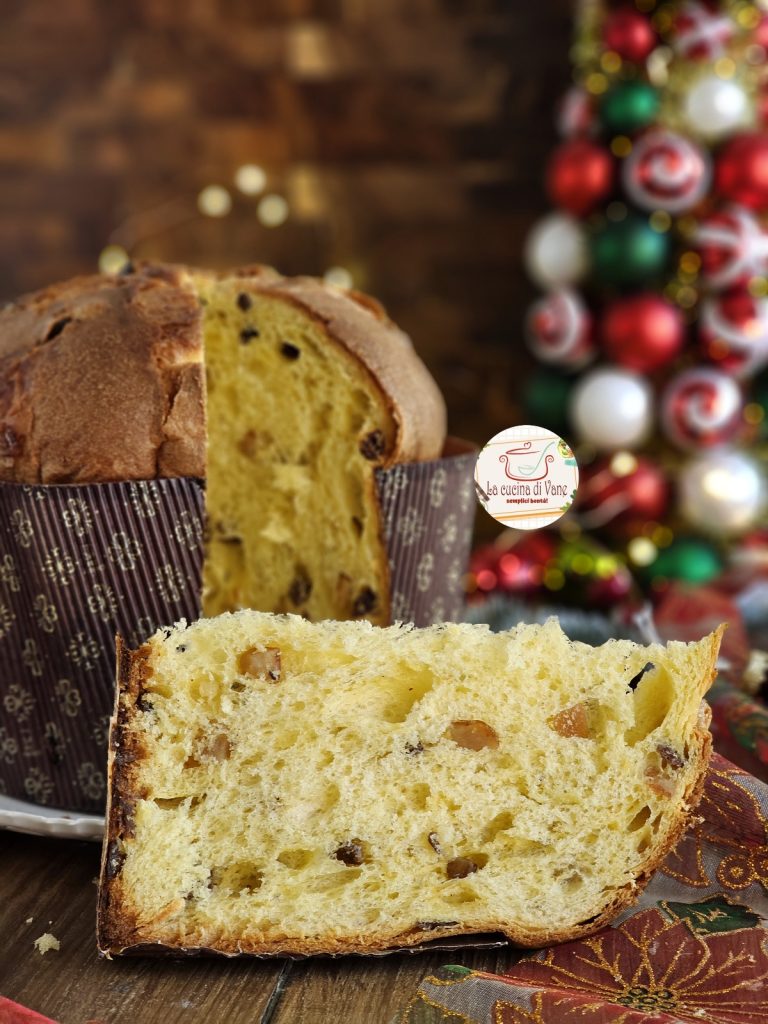
Bake in a static (conventional) oven preheated to 320°F for 30 minutes, then at 338°F for another 30 minutes—for a total of 60 minutes. The panettone is done when the internal temperature reaches 201°F; I used a thermometer to check.As soon as the panettoni are baked, immediately pierce them with the proper skewers and invert them upside down for 8 hours, until they are completely cold. This is a fundamental step to obtain a tall panettone that does not collapse.
You can store your panettoni in suitable food bags. Spray some food-grade alcohol (the one used for liqueurs), put the panettoni inside and close tightly. They will stay soft for up to two weeks.
… Vane’s tips
Use strong flour with W320-380 and protein 13.5%–15% for an elastic structure that won’t collapse.
The sourdough starter must be mature, active and well refreshed. If your licoli isn’t at its best, do one or two extra refreshments.
Always maintain the correct dough temperature, between 75°F and 79°F (24°C–26°C). If it gets too warm, stop and put the bowl in the fridge for a few minutes.
Use centrifuged (churned) butter, soft but not melted: it should incorporate without making the dough greasy or breaking the gluten network.
Don’t rush—proofing is essential. If the dough isn’t ready, wait!
It’s better to use a kitchen thermometer to check panettone doneness: the center should reach 201°F (94°C).
It is crucial to cool the panettone upside down to prevent the dome from collapsing.