
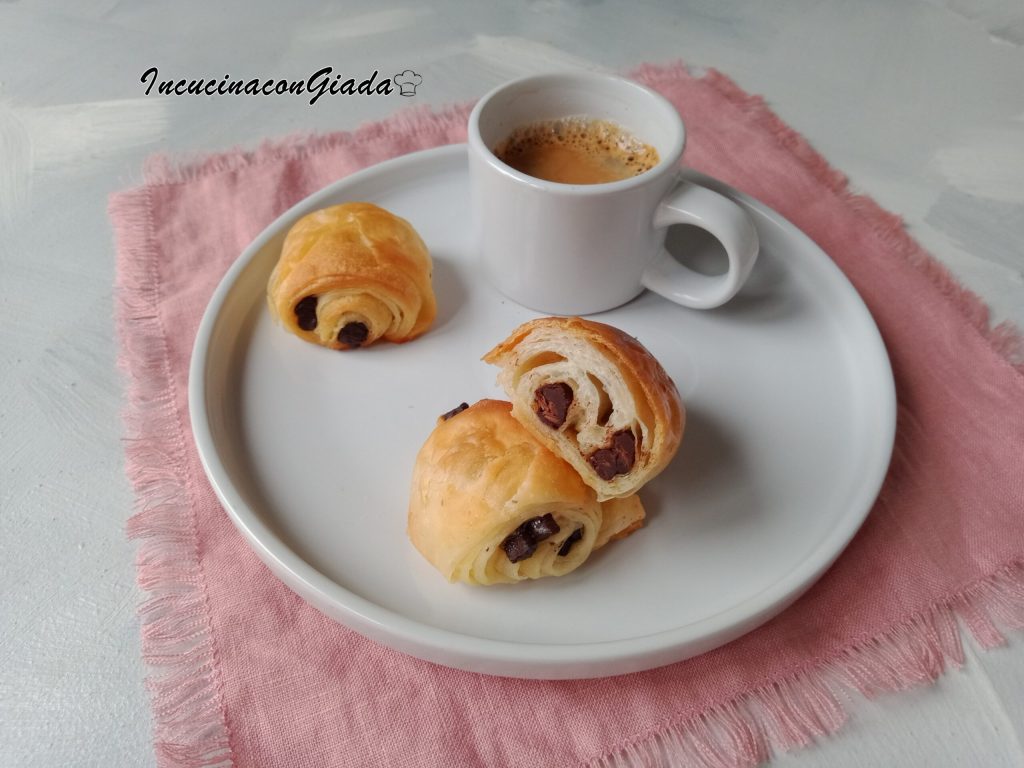
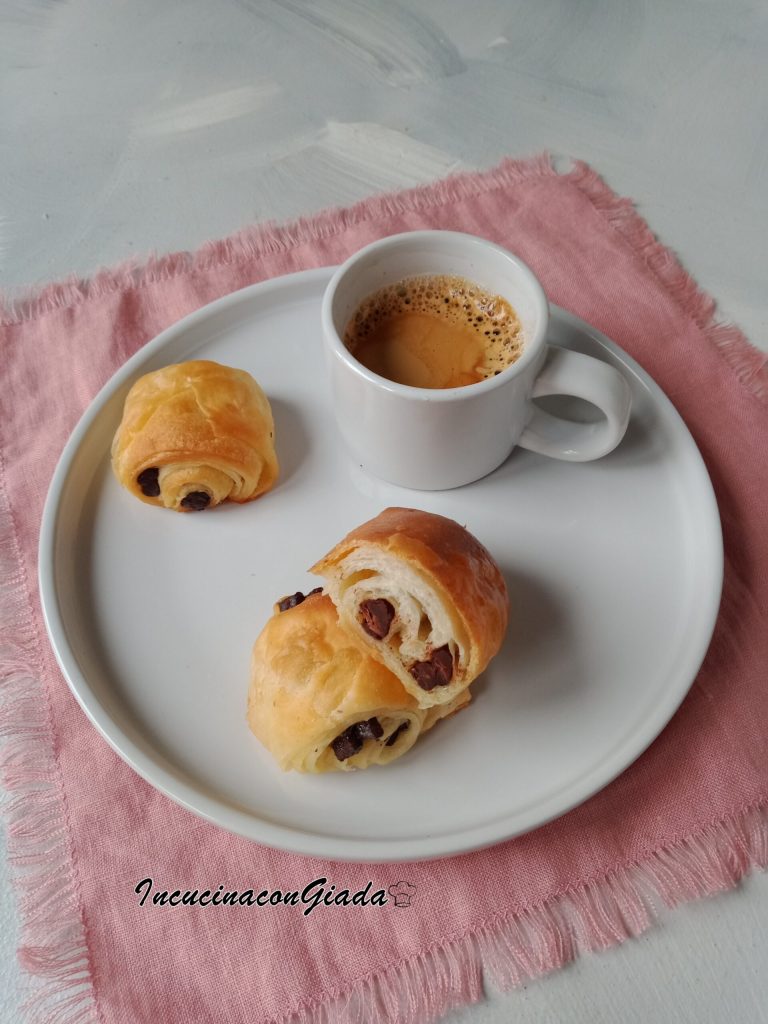
Mini pains au chocolat, delicious, the aroma of butter will fill your home during baking… Making them requires time and patience, especially for the proofing times, but believe me, the result will reward you 😋
I love experimenting with new leavened doughs, try my cream horns or the delicious brioches with potato flakes or my simple brioches without lamination 😋
Take a look at these recipes to make great leavened doughs directly at home 😋😉👇
- Difficulty: Medium
- Preparation time: 40 Minutes
- Portions: About 20 pieces
- Cooking methods: Oven
- Cuisine: Italian
- Seasonality: All seasons
MINI PAIN AU CHOCOLATE
- 2 cups flour (W300)
- 1/2 cup water
- 1 tbsp fresh baker's yeast
- 2 tbsps liquid fresh cream
- 2 tsp butter
- 3 tbsps sugar
- 1 tsp salt
- 1 bean vanilla
- 2/3 cup butter (For the lamination)
- sticks dark chocolate
MINI PAINS AU CHOCOLAT
Pour the flour, water, crumbled fresh yeast, and cream into the bowl of the mixer.
Begin kneading with the dough hook.
Halfway through kneading, add the sugar.
Subsequently add the butter and salt. Continue kneading.
Place the dough on the work surface, shape it into a ball, and place it in the bowl to rise.
Cover with plastic wrap and let rest in the fridge for 12 hours.
After the resting time, I usually knead in the evening and let it rise overnight, prepare the butter for lamination.
Place the butter between two sheets of parchment paper and, using a rolling pin, roll it into a rectangle approximately 1/3 inch thick.
If the butter softens too much during this step, put it back in the fridge for a few minutes and then continue.
Take the dough out of the fridge and roll it into a rectangle that is twice the size of the butter, about 1/4 inch thick.
Place the butter in the center of the dough rectangle.
Fold the dough over without overlapping the two sides and seal the closures in the center.
Turn the dough 90°, so one of the two openings is facing you, and gently tap with the rolling pin to roll it out to a thickness of 1/3 inch (it’s crucial to maintain the thickness). This way, the butter won’t break and won’t get absorbed by the dough, avoiding tearing with butter leakage. It’s important that both the dough and butter are cold. Lightly dust the dough with flour for rolling.
Keep a rectangular shape by trimming any excess dough.
At this point, we need to make the turns, usually one 4-fold and two 3-folds… this time I decided to do 3 3-fold turns.
To make the 3-fold turn, fold the top flap of dough towards the center and overlap it with the bottom flap. Wrap in plastic wrap and let rest in the fridge for 30 minutes. After 30 minutes, take the dough out and, lightly dusting with flour, roll it out again maintaining the rectangular shape and repeat the 3-fold turn.
Place back in the fridge to rest, always covered with plastic wrap, for 30 minutes.
Take our dough and place the side opening to our right, and always tapping with the rolling pin, start rolling out. Repeat the 3-fold turn.
After the final fold, place in the fridge for 2 hours.
Take the dough out of the fridge and roll it to a thickness of 1/6 inch, delicately, being careful not to tear the dough, this is the moment when it can happen more easily.
Trim the sides of your rectangle well to form a straight and precise rectangle.
Cut strips 4 inches long and 1 inch wide (I made them really mini but you could also make them larger if you wish).
Place a chocolate stick at the base, at the start of the rectangle. Roll to completely cover it, pressing lightly.
Then add another stick and roll completely. Try to place the seam of the Pain au chocolat underneath so it doesn’t open during baking.
Repeat this operation for each strip and arrange the Pains au chocolat on a baking sheet with parchment paper.
Spray a little water on your pains au chocolat and let them rise in the turned-off oven with the light on for about 3/4 hours until doubled.
Lightly brush the surface with egg yolk beaten with a tablespoon of milk.
Bake in the preheated fan oven at 340°F for about 20 minutes. Always check as baking time may vary depending on your oven.


TIPS
Choose the ideal butter for lamination.
* Roll the flat butter to about 1/3 inch to give the right temperature and plasticity.
* Make 3 folds: one 4-fold and two 3-folds.
* During the folding phase, the dough should have a thickness of 1/4 – 1/3 inch. A thinner dough makes the butter warm up faster, tending to stick instead of layering, while a thicker one makes butter distribution less homogeneous.
* Respect the resting times in the refrigerator before the final lamination (at least 1 hour in summer and 15 minutes in winter). Do not over-cool the dough (even in summer) before the final lamination to avoid the butter, being too cold, breaking and cracking inside the dough.
* Proofing temperature: 79°F, max 82°F. A higher temperature would promote butter fusion.
