Fellata Neapolitan Easter appetizer
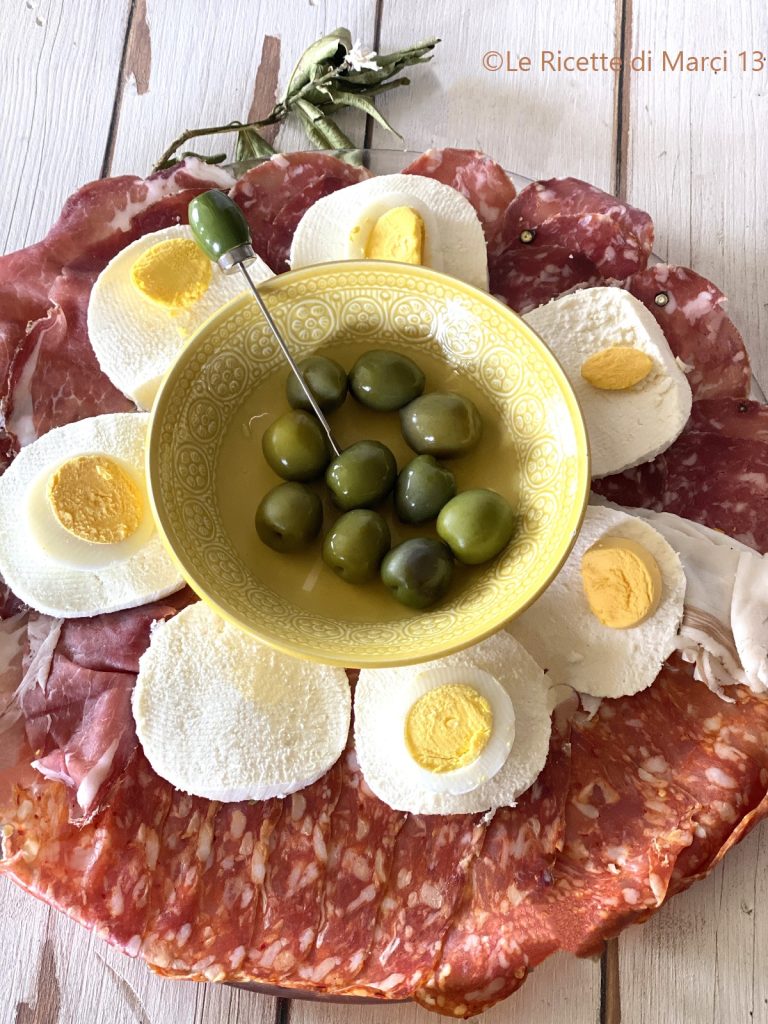
The “fellata” Neapolitan is a mixed board of cold cuts and cheeses, the classic Neapolitan Easter appetizer, simple and quick to prepare. It is usually eaten together with casatiello (or tortano or pizza chiena) and typically starts on Saturday evening and lasts until Easter Monday.
In short, in Naples the “fellata” is the traditional Easter starter that is never missing on the table during the Easter festivities.
The term “fellata” derives from fella which in Neapolitan means “slice” and indicates precisely the composition of the board, which appears as a rich assortment of slices of cold cuts and cheeses.
Although the types of ingredients that make up the dish can vary widely, there are some considered “essential”, such as: salami, eggs and salted ricotta.
These three ingredients also carry a particular religious symbolism. Eggs in ancient culture represent life and rebirth, salami represents rural abundance, while salted ricotta, a dense and compact cheese, symbolizes family unity and the congregation, the religious communion.
Furthermore, the Easter fellata is considered a “blessed” dish since it is eaten immediately after the head of the family has blessed the diners with holy water.
If you’re looking for other Easter recipes (savory and sweet), click on my: “Special Easter menu“.
You might also be interested in:
- Difficulty: Very easy
- Cost: Medium
- Preparation time: 5 Minutes
- Portions: 4 servings
- Cooking methods: No-cook
- Cuisine: Italian Regional
- Region: Campania
- Seasonality: Easter, All seasons
Ingredients for the Fellata Neapolitan Easter appetizer
- 7.1 oz salted ricotta
- 7.1 oz Neapolitan salami (sliced)
- 5.3 oz soppressata (or spicy Calabrian 'spianata', sliced)
- 4 hard-boiled eggs
- 3.5 oz capocollo (sliced)
- 5.3 oz provolone (preferably Provolone del Monaco)
- 5.3 oz dried sausage (optional)
- 7.1 oz green olives (optional)
Tools for the Fellata Neapolitan Easter appetizer
- Kitchen scale
- Bowls various sizes
- Cutting board with two integrated side trays for scraps
- Mezzaluna sharp, with double blade
- Serving plate serving platter
Steps for the Fellata Neapolitan Easter appetizer
Gather the selected cold cuts and cheeses on a single serving platter (or on a cutting board), preferably already thinly sliced and portioned.
Peel the hard-boiled eggs and cut them in half or quarters (it’s better to cut the hard-boiled eggs in half just before placing the plate on the table; otherwise the yolks may darken).
Place the serving platter in the center of the table and accompany the cold cuts and cheeses with rustic bread or with casatiello (or tortano) or pizza chiena and a good red wine.
Shopping tips!!!
To slice foods I use this convenient and practical cutting board with integrated side trays (one for the sliced food, the other for scraps) and this very sharp mezzaluna with double blade.
FAQ (Questions & Answers)
What is the Neapolitan Easter fellata?
The “fellata” Neapolitan is a dish that opens the Holy Saturday dinner and continues until Easter Monday. Essentially it is an Easter appetizer of mixed cold cuts (including soppressata and capocollo), hard-boiled eggs and cheeses (typically salted ricotta and Provolone del Monaco).
It is called so because the cold cuts are presented sliced into “felle” = slices, arranged on a cutting board or a large serving platter and eaten together with casatiello (or tortano) or Neapolitan pizza chiena, which act as a rich bread.