The classic Milanese Panettone is not just a Christmas dessert; it’s a family story of patience and repeated gestures over time.
Born in the heart of Milan, this large leavened cake has represented Italian Christmas for centuries, with its aroma of butter and citrus.
Until the early 1900s, the city had hundreds of bakers and pastry chefs who prepared panettone according to tradition, respecting lengthy processes and careful crafting.
Today, although industrial production is widespread throughout Italy, artisanal Milanese panettone remains an indispensable reference point.
This is evidenced by the 2005 regulation that protects panettone as a typical Italian product, establishing mandatory ingredients and precise minimum percentages, including quality butter, fresh eggs, raisins, candied citrus peels, and long natural leavening.
Without these elements, it cannot be called true panettone.
The recipe I propose arose from years of trials, errors, waiting, and improvements.
It’s a technically solid recipe, based on the use of sourdough and proper management of temperatures, folds, and leavening. At the same time, it is an emotional recipe because it rewards every effort with a soft, fragrant, and stringy crumb.
I used brewer’s yeast, but certainly, it’s better to use sourdough.
The taste is authentically that of traditional panettone, even cleaner and more intense because it is preservative-free.
This is the panettone I have been making for my family for a long time, the one that scents the kitchen and marks the start of the holidays.
If you try making it, share your photos with me, and I will happily publish them, citing your name.
Share your experience in the comments; panettone is also about sharing. Happy baking… and Merry Christmas.
To make the photo even cuter and remove some distracting flaws, I got help from my friend chat gpt, but the photo and the recipe remain mine!
Approx. 380 kcal per 100 g

- Difficulty: Medium
- Cost: Medium
- Preparation time: 1 Hour
- Portions: 2 panettones 1 kg + 1 of 750g
- Cooking methods: Electric oven
- Cuisine: Italian
- Seasonality: Christmas, New Year
Ingredients for making the classic Milanese Panettone
Recipe for 2 panettones, 1 of 750g and 1 of 500g
- 3/4 cup flour w 350 – 400
- 3/4 cup water
- 2 tsp dry brewer's yeast (or 18g fresh)
- 1 cup all-purpose flour (minimum 11g protein)
- 2 pcs eggs (whole)
- 1/4 cup butter (medium)
- 1/8 cup sugar
- prefermented dough
- 2 3/4 cups all-purpose flour (minimum 11g protein)
- 1/2 cup butter
- 1/2 cup sugar
- 1 egg (medium)
- 4 egg yolks
- first dough
- 2 tsp honey
- grated zest of one orange
- grated zest of one lemon
- 1 tsp liquid vanilla
- 3/4 cup raisins
- 3 tbsp rum
- 3/4 cup candied orange
- 1 Mold panettone mold
- 1 Mold panettone mold
Preparation of Classic Milanese Panettone
Before starting to make the panettone, I recommend preparing the aromatic mixture; the earlier we prepare it, the better it will taste.
Mix 2 teaspoons of honey with the orange and lemon zest and the vanilla, store it in a small jar in the fridge until it is needed to add to the panettone dough.
Preparation of the Pre-ferment
In a bowl, put the yeast and add the warm water, mix well, and add the flour, mix again, and let the pre-ferment activate for about 30/45 minutes.
First dough
In a bowl, place the softened butter, sugar, and mix everything quickly with a whisk, add the 2 whole eggs, and mix always by hand with a whisk. Finally, add the pre-ferment and blend well.
Finally, add the flour and mix everything for a couple of minutes, until all the ingredients are well incorporated.
Cover the bowl and let the dough rest outside the fridge for about 4 hours until it quadruples in volume, or put it in the fridge for about 12 hours overnight and continue the leavening the following day.
The next morning, take it out of the fridge and let it triple if it hasn’t done so in the fridge.
In the morning, when you take the dough from the fridge, prepare the raisins with the rum in a container and occasionally mix it to ensure the raisins are well hydrated.
Second dough
In a stand mixer, insert the paddle attachment, put the sugar with the softened butter at medium speed, add the yolks, the egg, and mix for about 2 minutes. At this point, add the aromatic mixture prepared beforehand and mix at medium speed for another 1 minute.
Add the first dough and mix at speed 5 always with the paddle attachment until the mixture is well worked for about 2 minutes.
Now remove the paddle and use the dough hook, add all the sifted flour at speed 2, work for about 8 minutes, then stop and let the dough rest for 5 minutes well covered in the bowl.
Resume working the dough for another 8 minutes at speed 3, then let it rest for another 10 minutes, this time in the fridge.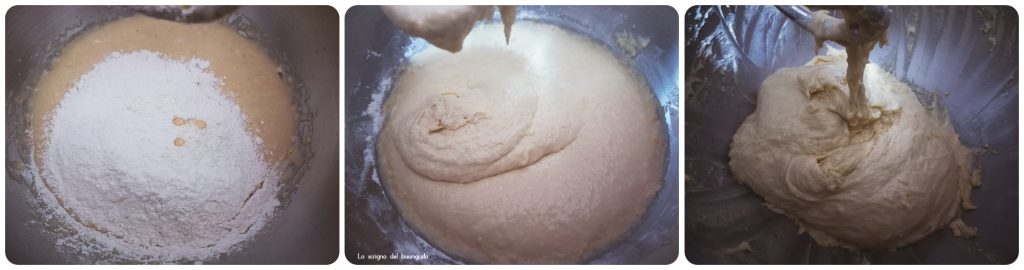
We will do the same for the last and third time; at this point, add the candied fruit and the drained raisins and slowly incorporate them into the dough.
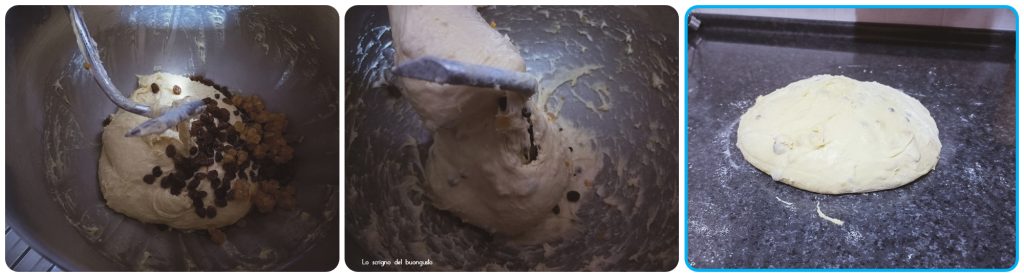
Place the dough in a buttered bowl and give two three-fold turns, after 15 minutes, do the second three-fold turn and let the dough double in the bowl.
Flip the dough onto a buttered work surface, divide it into two parts by weighing them. I got one dough of 750g and one of 500g, but adjust based on mold capacity.
Give the two dough pieces a round shape (rounding: form a dough piece in a circular motion on the work surface), put them in molds of 750g and 500g respectively, the 750g paper mold is about 15 cm in diameter and 11 cm in height.
Let them rise in the oven with only the light on, covered for about 1 1/2 hours with cling film, then remove it once the dough has almost reached the edge of the mold.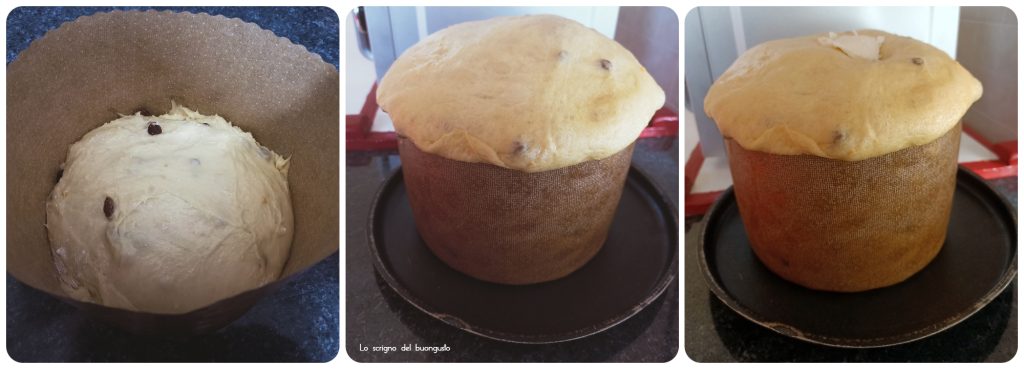
Before baking, make a cross-cut on the surface of the panettone, add a knob of butter, and bake in a preheated oven at 338°F, placing a pan with water in the oven for moisture, for 45-50 minutes, and a few minutes less for the smaller panettone.
When baking is complete, if you have a thermometer to measure temperature, insert the probe, and it should read 201°F at the core of the panettone. In the absence of this tool, insert a large wooden skewer and ensure it is dry.
Once baking is complete, it is recommended to let them cool for at least 6 hours upside down, suspended and skewered with skewers.
I help myself with two pots to support the skewers, or inside the pot always supporting the skewers, but it receives less air this way… I let them cool like this.