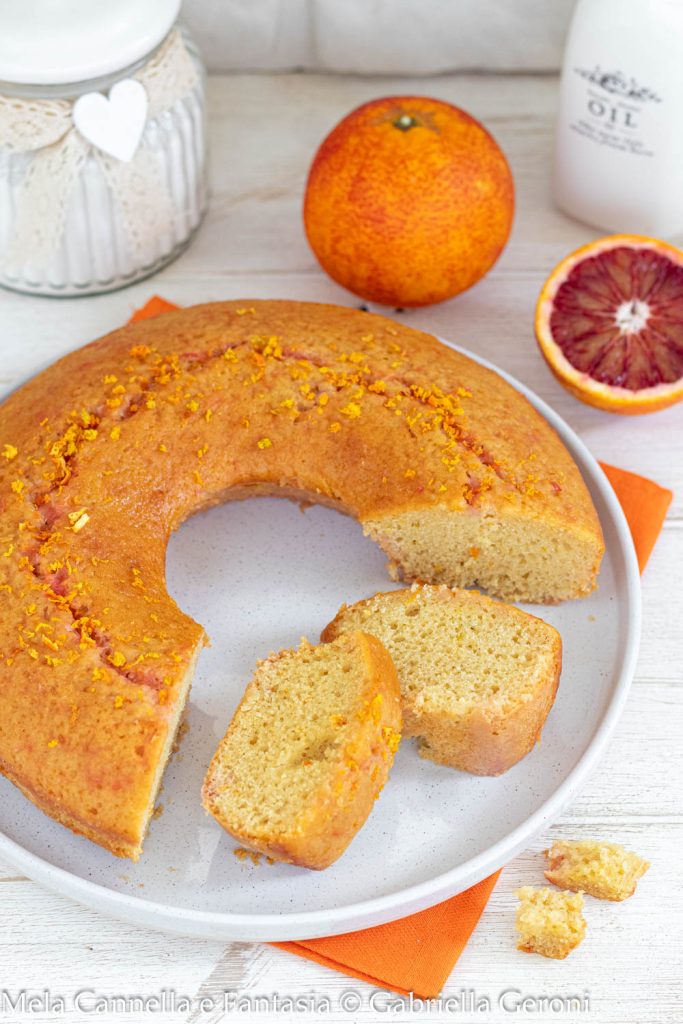
If, like me, you love having breakfast at home with healthy, wholesome products, this soft, fragrant and indulgent orange ring cake is just the thing for you!
No butter and no milk so, if like me you are lactose intolerant, you can treat yourself at breakfast and beyond!
In fact this cake made with fresh organic oranges is perfect for snacks, for kids and adults alike.
It’s prepared in no time, stays soft for several days and, if you like, can even be frozen, so you have breakfast ready for the whole week.
This orange ring cake also has a special touch: once it comes out of the oven it is soaked with orange juice, which slowly seeps through making it incredibly moist and fragrant.
When you taste it it practically melts in your mouth and it’s a real pleasure to eat!
I hope I’ve made you want to try it with me!
Please read to the end because you’ll find my tips for perfect results, variations to adapt it to different tastes, answers to common doubts and a wine pairing box to serve this wholesome cake even after a meal!
Are you ready to turn a simple ring cake into a dessert that wins everyone over? 🍊✨
But first, here are a few more delicious orange-based recipes ❤
- Cost: Affordable
- Cooking time: 35 Minutes
- Portions: about 10 people
- Cooking methods: Electric oven
- Cuisine: Italian
- Seasonality: Autumn, Winter and Spring, Spring, Summer
Ingredients
- 3 eggs (medium whole)
- 3/4 cup sugar
- 6.5 tbsp vegetable oil (neutral-flavored (about 6 1/2 tbsp, approx. 98 ml))
- 1 1/4 cups orange juice (ripe oranges (about 300 ml / 300 g))
- orange zest
- cups all-purpose flour ((approx. 260 g))
- 1 packet baking powder for cakes
Tools
- Bowl
- Citrus juicer
- Grater
- Hand mixer
- Sieve
- Spatula
- Ring cake pan
- Small saucepan
Steps
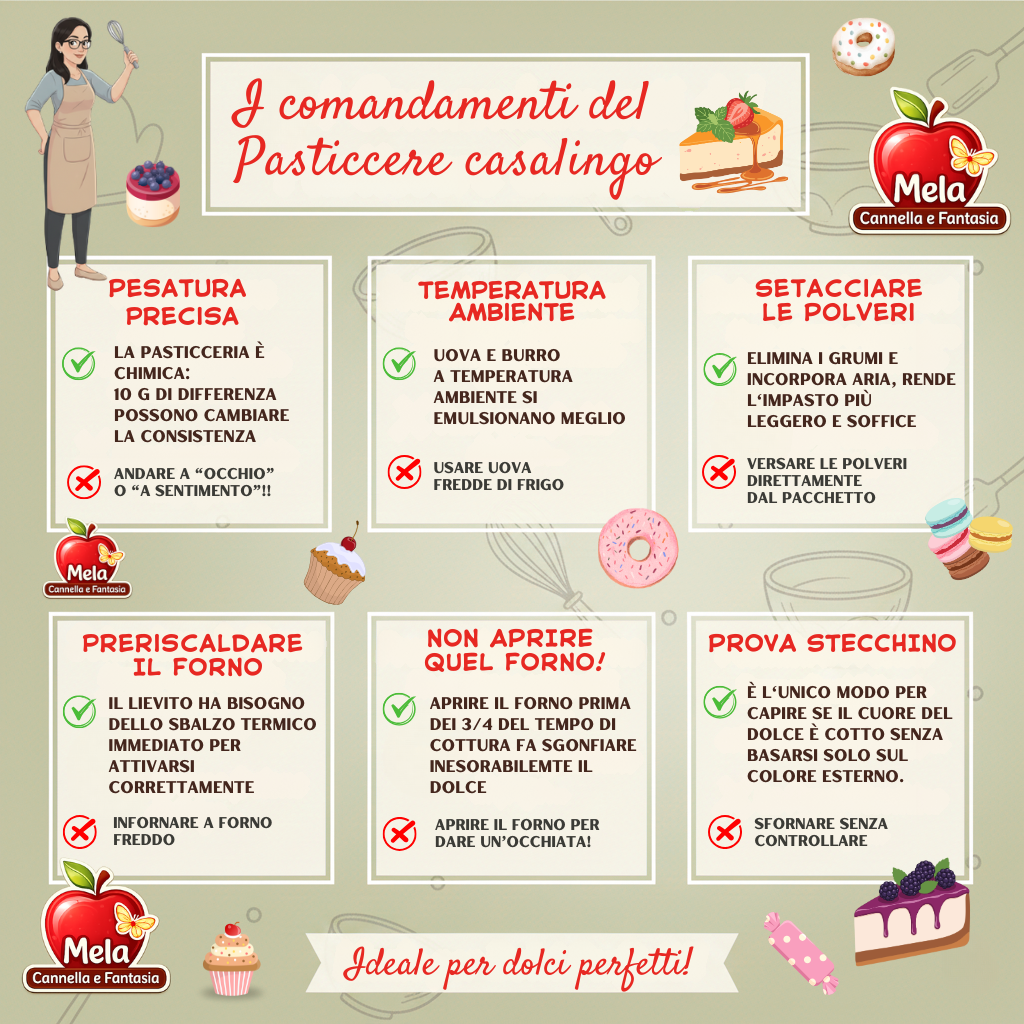
Before we start I’d like to give you this guide with 6 tips you can apply every time you bake a cake like this.
PLEASE save it and always keep it with you ❤
✅ WHAT TO DO
❌ WHAT NOT TO DO
Now that I’ve revealed the little tricks to get a perfect cake, let’s prepare our soft orange ring cake!
Let’s start with the oranges which, needless to say, should be organic if we want to eat a healthy and genuine product.
Those who follow me on social media know that for a year I’ve been buying from a Sicilian farm that grows citrus and whenever I can I get my supply from them, shipped straight from Palagonia.
These are excellent quality citrus fruits that I love to eat with my family and with which I prepare many tasty dishes, like this one!
The great thing about oranges is that they keep very well in the refrigerator, so you can buy them in large quantities and keep a good supply on hand.
You can even freeze them whole or sliced to use later in various recipes: for a simple tea, a dessert or savory dishes.
This way I can enjoy oranges even when they are out of season and they still retain all their goodness!
So take the oranges, wash them under running water, dry them well and grate the zest. Then squeeze the juice until you have 1 1/4 cups (about 300 ml) and set it aside.
Now take a bowl, crack in the medium whole eggs and add the sugar (white or cane).
With a hand mixer whip well the eggs for about ten minutes until you obtain a light, voluminous and frothy mixture.
Then pour the oil in a thin stream while continuing to beat with the electric whisk. I usually recommend a neutral vegetable oil that doesn’t leave any aftertaste and keeps the cake soft. More info below.
At this point add a little grated zest (store any extra in the freezer well covered) and add about 3/4 cup + 2 tbsp of orange juice (use 200 ml now).
Put aside the remaining roughly 6 3/4 tablespoons (about 100 ml) for later. Mix with a simple whisk by hand to avoid liquids splashing out of the bowl!
Sift the flour and baking powder and add them little by little to the batter. Start to incorporate them with the mixer off so the dry ingredients don’t fly around the kitchen!
When the liquids are absorbed by the flour, turn on the electric mixer and blend for just a few minutes.
We’re ready! Grease and flour a ring cake pan, pour in all the batter and bake in a preheated static oven at 338°F (170°C) for about 45 minutes.
I rarely bake breakfast cakes at higher temperatures to avoid excessive browning on the surface.
A gentler bake without fan is better. If you only have a fan oven, cover the surface with foil for the first 20 minutes and then remove it.
With the fan on it will take about 5–10 minutes less, but you should still do the toothpick test.
When baked, remove from the oven and leave in the pan for just 5–10 minutes. Then turn out carefully and immediately pour the reserved orange juice (about 100 ml) over the entire surface — which you should have slightly warmed over the lowest heat.
Let it cool and then you can finally enjoy this fantastic orange ring cake that melts in your mouth!
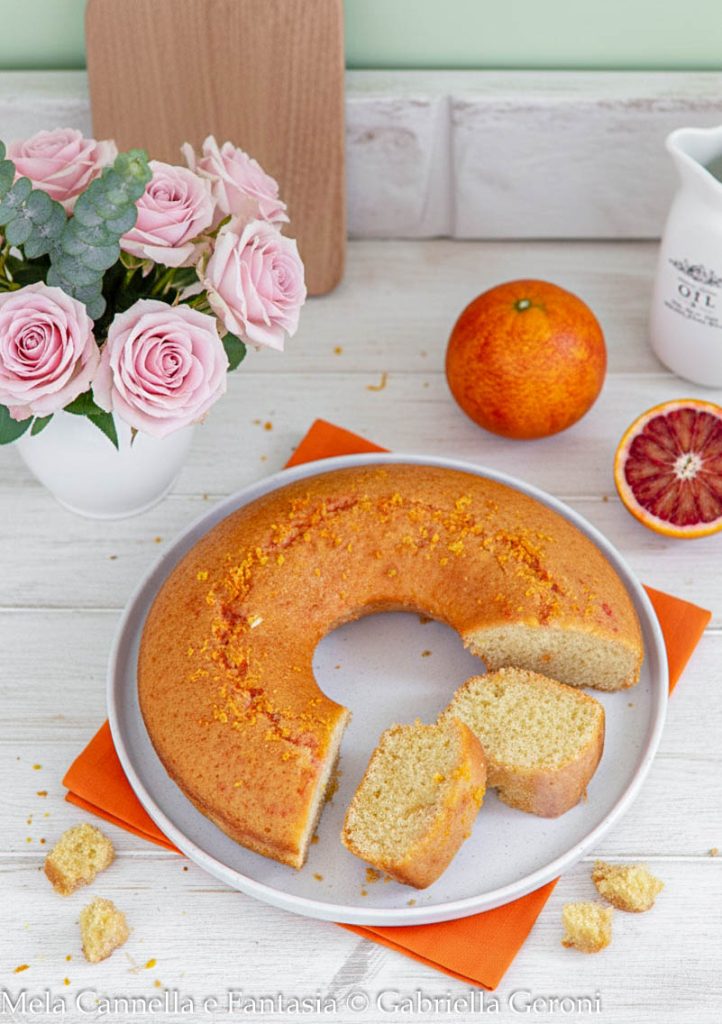
As mentioned, for this cake I chose organic oranges from Agrumi Faro, a company located in the heart of Sicily.
I invite you to take a look at their site to discover the wonderful products you could bring to your table.
If you have any questions, ask in the comments and I’ll be happy to answer 💛🍊
#productsentby #incollaboration with Agrumi Faro (gift).
Don’t forget to tell me if you try this wonderful ring cake and come back soon!
Article protected by copyright © – Gabriella Geroni © All rights reserved
🍊 Variations
• Candied version
Add candied orange peel to the batter for an extra treat.
• SPICED
A pinch of cardamom, ground ginger or cinnamon adds aromatic depth.
• MANDARIN VERSION
Replace part of the orange juice with mandarin juice for a sweeter aroma.
• WITH CHOCOLATE CHIPS
Add dark chocolate chips (about 1/3 cup, ~50 g) to contrast the citrus.
💡 Tips for a perfect ring cake
The warm juice should be poured slowly in a thin stream onto the cake just after it comes out of the oven to make it even softer.
Do not open the oven in the first 25–30 minutes
Use organic oranges for a full aroma
Finish with a little grated zest on the surface
🧊 STORAGE
At room temperature
Covered under a cake dome: 2–3 days
In the refrigerator
Wrapped in cling film or stored in an airtight container it keeps for about 4–5 days
Freezing
You can freeze it already sliced and it will keep for about three months.
📌 Before serving, warm it slightly: it regains softness and fragrance.
FAQ (Questions & Answers)
🤒 Which oil to use for soft cakes?
When a recipe uses oil instead of butter, the question is always:
is vegetable oil or extra virgin olive oil better?
The answer is: it depends on the cake and the aroma you want to achieve.
✅ Vegetable oil (the most neutral choice)
It’s perfect for:
very soft cakes
ring cakes, loaf cakes, whole-orange cake
citrus or yogurt cakes
👉 It has a neutral taste, won’t overpower other ingredients and guarantees long-lasting softness.
Best choices for baking:
high-oleic sunflower oil
corn oil
🤒 Extra virgin olive oil (only if delicate)
You can use it, but carefully.
It’s fine if:
it’s very mild
not bitter or pungent
you want a slightly “rustic” note
👉 In citrus cakes it can work but shouldn’t dominate.
❌ Oils to avoid
For soft cakes it’s best to avoid:
very intense extra virgin olive oils
bitter-tasting oils
unrefined oils with strong aromas
They risk covering the cake’s fragrance.
✨ Practical advice
If you want to play it safe:
👉 high-oleic sunflower oil
It guarantees:
clean taste
soft batter
balanced result
⚖️ Corn oil or sunflower oil?
Both work well, with a small difference:
High-oleic sunflower oil → even more neutral, slightly more stable
Corn oil → slightly more aromatic but still mild
👉 In the final result the difference is minimal: use what you have in the pantry👸 How much butter to use instead of oil?
👉 Yes, you can use butter, but it must be melted, preferably lukewarm, not hot.
📏 Correct quantity
Oil → melted butter 115 g
🔁 Oil vs butter: what really changes
With oil:
cake is moister
stays soft longer
With butter:
more classic flavor
slightly denser texture
👉 With the warm orange juice finish, even with butter the cake remains very soft.Can I reduce the sugar without compromising the result?
The amount I used for this ring cake is already low and the final taste is not cloying.
If you really want to reduce it, you can lower it by up to 15%, i.e. about 20 grams less (approx. 1 1/2 tbsp). Beyond that the cake LOSES STRUCTURE and color.Can I replace the sugar?
Yes, but it’s important to know how the result changes.
Brown sugar
You can use it in the same quantity; the cake will be slightly darker with a warmer aroma.
Coconut sugar
1:1 substitution, gives a more intense taste and amber color.
Honey or maple syrup
Yes, but slightly reduce the liquids in the batter. The cake may be even moister, so I recommend adding less orange juice at first and observing how the structure behaves.
Erythritol or artificial sweeteners
Possible, but the texture will be drier. Better to use them partially, not 100%.
👉 Honest advice: for this recipe, classic sugar is still the best choice if you want softness and structure.Can I replace all-purpose flour?
Absolutely yes. Here are the options:
1) Type 0 or Type 1 and Type 2
Direct substitution, same quantity. Great result.
That said:
🌾 Type 1
It’s a semi-wholemeal flour with more bran and wheat germ compared to classic 00 or 0. It has a more intense, aromatic flavor and is excellent for loaves, ring cakes and cookies when you want a rustic touch but still soft results. It absorbs slightly more liquid than 00.
🌾 Type 2
Considered a “semi-whole” flour. It is close to wholemeal but slightly finer. Rich in fiber, minerals and vitamins, it has a darker color and a marked, almost nutty flavor. Perfect for rustic tarts, shortcrusts and dry cookies. Being high in fiber it makes doughs less elastic and more compact, ideal for a more filling, healthier breakfast.
If you want a balance between refined white and extreme wholemeal, Type 1 is your ally for softness, while Type 2 is for crunch and old-fashioned flavor. In this case I’d say Type 1 is more suitable while Type 2 I’d use for a tart or cookies.
2) Whole wheat flour
Use about 70–80% of the dose and add a little extra liquid because it absorbs more than 00.
3) Spelt
A great alternative if you like a more rustic, aromatic cake.
4) Gluten-free
Use a specific mix for cakes. You can add a tablespoon of yogurt or extra juice for more softness.
⚖️ Do the quantities remain the same?
It depends on the type of flour.
✔️ Same amount as 00 if you choose:
Type 0
Type 1
Type 2
light spelt flour
👉 With these flours you do NOT need to change the doses.
⚠️ When NOT to use the same dose
Be careful with:
whole wheat flour
gluten-free mixes
very absorbent flours
In these cases:
use 70–80% of the amount or add a little more liquid until you reach the right consistency.