
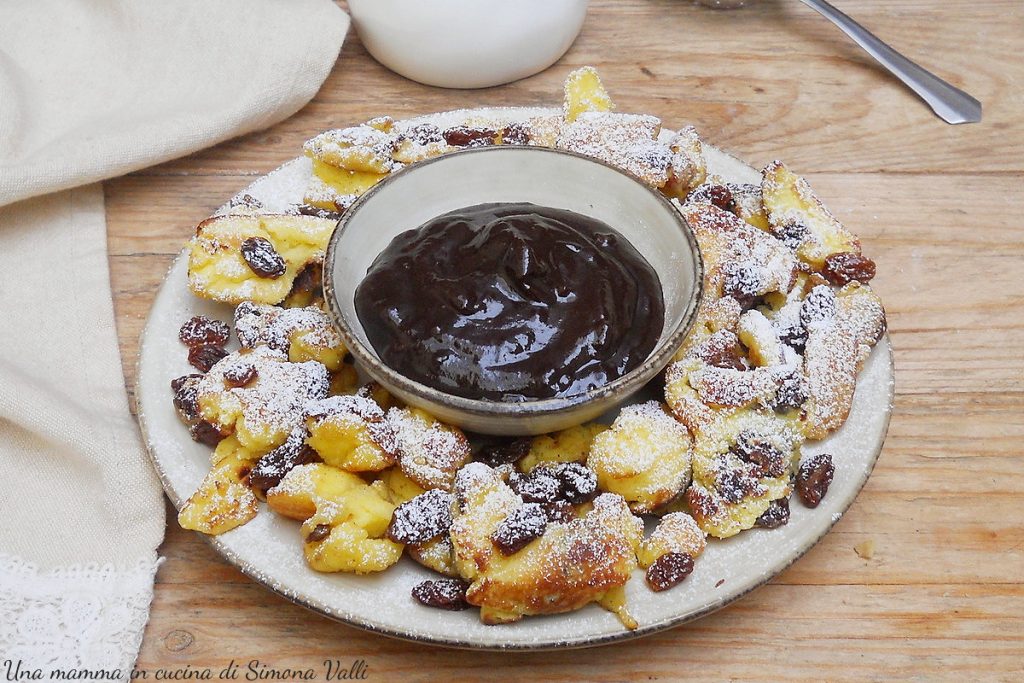
The Kaiserschmarren or “emperor’s sweet omelette” is a dessert of Austrian origin popular throughout the former Austro-Hungarian Empire and the South Tyrolean area. There are some legends about the origin of this dessert, although the most probable places it in the peasant kitchens of the seventeenth century, its preparation was a way to create a very substantial and energetic meal using ingredients that everyone had in the pantry.
Many traditional desserts were born in peasant homes with simple yet nutritious ingredients; in our area, typical sweets like the pinza, the biscuit and coffee brick cake, and the zuccherini montanari were born in this way.
I had already tasted the kaiserschmarren and I liked it a lot, so today I thought of preparing it at home. There are various ways to prepare it; I preferred the traditional recipe, which certainly gives a lot of fluffiness to the mixture and a better result.
The recipe is really simple; you just need to be a little careful with the cooking, which should be done in a large pan over low heat. Common aromas include: vanilla bean or vanillin, rum, and in the traditional Austrian version, lemon zest, an ingredient essential to me, as it mellows the taste of the egg.
Why does this dessert have such a peculiar name? Legend has it that the emperor’s sweet omelette was invented by mistake by a busy Austrian chef preparing the dinner for the royals. Busy with his recipes, he received an urgent order; the emperor himself asked for a crepe for dessert. In a panic, he prepared the batter, poured it into the pan, and forgot about it, letting it overbrown. Not having time to redo it, he decided to tear it into pieces, add raisins and sugar in the pan, and sprinkle it with plenty of powdered sugar to hide the overbrowning, completing it with abundant jam. The emperor liked it so much that it became his favorite dessert, naming it Kaiserschmarren or emperor’s omelette.
Also try:
- Difficulty: Easy
- Cost: Cheap
- Preparation time: 15 Minutes
- Portions: 4 People
- Cooking methods: Electric Oven
- Cuisine: Austrian
- Seasonality: Autumn, Winter, and Spring
- Energy 223.86 (Kcal)
- Carbohydrates 39.44 (g) of which sugars 29.02 (g)
- Proteins 4.38 (g)
- Fat 5.46 (g) of which saturated 3.11 (g)of which unsaturated 2.28 (g)
- Fibers 0.64 (g)
- Sodium 90.83 (mg)
Indicative values for a portion of 100 g processed in an automated way starting from the nutritional information available on the CREA* and FoodData Central** databases. It is not food and / or nutritional advice.
* CREATES Food and Nutrition Research Center: https://www.crea.gov.it/alimenti-e-nutrizione https://www.alimentinutrizione.it ** U.S. Department of Agriculture, Agricultural Research Service. FoodData Central, 2019. https://fdc.nal.usda.gov
Ingredients
- 3 eggs (medium)
- 100 ml whole milk
- 1/3 cup sugar
- 1/2 cup all-purpose flour
- 1/3 cup raisins
- 1 tbsp rum
- Half vanilla bean
- 1 pinch salt
- 1 tsp lemon zest (grated – optional)
- 2 tbsp butter
- 2 tbsp sugar
- to taste vanilla powdered sugar
- to taste plum jam (or currant or raspberry)
Tools
- 2 Bowls
- 1 Electric Whisk
- 1 Scale
- 1 Spatula
- 1 Pan with thick bottom, 11 inches in diameter
- 1 Flame Diffuser
Procedure
To prepare this dessert, you need room temperature eggs.
Rinse the raisins very well and put them in a bowl covered with lukewarm water for 30 minutes until they become soft. If you like, add a tablespoon of liquor.
Separate the yolks from the whites and place them in two different bowls.
Whip the egg whites until soft peaks form and set aside while you prepare the batter.
Add 1/3 cup of sugar and the vanilla to the yolks, and whip with an electric whisk until you get a light and frothy mixture. Add alternately the sifted flour and the milk; finally, add the lemon zest, salt, and rum.
Add one-third of the egg whites to the batter, folding them in with a spatula from the bottom upwards; add the remaining egg whites, incorporating them gently. You should get a fluffy and airy mixture.
Place a flame diffuser on the burner for better heat distribution, place a 11-inch pan on top, and light the flame; add the butter and let it melt, then pour in the mixture and cook over the lowest flame.
When the edge starts to become opaque and a few bubbles form in the center, distribute the drained and patted raisins on the surface. Check the cooking of the dessert often by gently lifting the edge; as soon as it becomes golden, cut the dessert into 4 and flip it, even if the surface is still creamy.
Cook the other side for a few more minutes until lightly golden; at this point, cut the Kaiserschmarren into pieces with the spatula, add 2 tablespoons of sugar, mix, and quickly brown the pieces of the omelette.
Remove the dessert from the heat, flip it onto a serving plate, dust it with plenty of powdered sugar, and serve the kaiserschmarren immediately, accompanied by plum, raspberry, or apple jams.
Tips
Storage
The Kaiserschmarren should be consumed immediately or within a couple of hours. If any remains, you can store it in the fridge for 1 or 2 days at most.
***********************
For recipe-making tips, contact me on FACEBOOK and, if you like, follow me on INSTAGRAM
Send me your photos; I will be happy to publish them on my social media
