
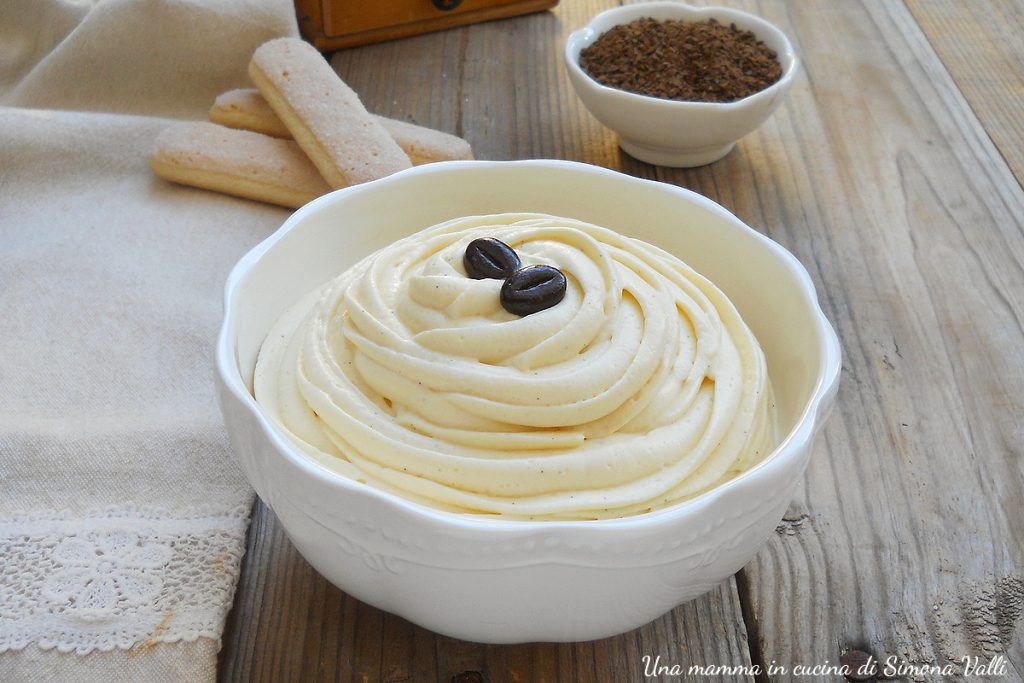
Mascarpone cream is one of the most commonly used bases in pastry, especially known for making tiramisu. Excellent as a dessert spoon cream, it is perfect to accompany fruit cakes, panettone, and pandori, and is ideal for creating all the variations of the world’s most famous and appreciated dessert: tiramisu. If you cannot use eggs, try the egg-free mascarpone cream, which is more delicate but equally good.
This iconic dessert is the source of many debates regarding the base, which can be made of sponge cake, ladyfingers, and in our areas from brazadela, or the cream. The mascarpone cream is made with yolks whipped with sugar and vanilla, to which mascarpone is added. Whipped cream is used to lighten it, but some prefer to replace it with egg whites.
I will talk extensively about tiramisu in the next article, today we focus only on mascarpone cream; I will tell you about the most known and used versions in pastry and the food safety to which you need to pay attention.
But… what is the correct recipe? There is no correct recipe, and there is no codified recipe, so everyone makes their own version at home and in pastry shops. In pastry, creams follow a balance to give the palate an even taste, while at home, personal taste is followed. The techniques used to make an excellent cream are very important.
In the 70s/80s, tiramisu was made with fresh eggs; my mom also prepared it that way. Today, thanks to studies and techniques, pasteurized eggs are preferred to avoid bacterial forms like salmonella.
Before giving you the recipe, I will leave you with the advice from pastry chefs with whom I have been taking courses for years, Luca Montersino and Silvia Boldetti, and the most famous web communicator, Dario Bressanini.
ADVICE
Is mascarpone cream made with raw eggs? NO or rather MAYBE, in pastry and catering, pasteurized eggs are used to avoid pathogens like salmonella; at home, you can do it as you see fit, but using raw eggs exposes you to unnecessary risks. I always use pasteurized eggs; if you want to buy them, you can find them in the refrigerator section of the supermarket. They are very convenient, and if you have some left, you can easily freeze them.
Can eggs be pasteurized at home? There are techniques to pasteurize eggs at home, but making pate à bombe or semifreddo base, which is surely the most known method, is NOT safe for pasteurizing eggs. When we pour the 250°F syrup over the yolks that are being whipped, we do not achieve uniform heating of the mixture; the syrup will hardly reach all the egg mass, especially the part on the sides of the bowl, so we will NOT ensure pasteurization, furthermore, the amount of mixture we prepare at home is very small, and it is practically impossible to reach the safety temperature.
TECHNIQUES
There are safe techniques but they are more demanding than buying a brick with pasteurized yolks:
1) syrup base: mix the yolks with a syrup of water and sugar, bring everything to 185°F, then transfer to a mixer and whip until cooled. Bringing the yolks to such a high temperature even for a few seconds results in pasteurization. A softer and more delicate structure is obtained.
2) milk base or custard: prepare a custard with milk, eggs, and sugar, bring the mixture to 185°F, and transfer to a mixer and whip until cooled. Again, as in the previous method, pasteurization occurs. A softer and creamier structure is obtained.
3) bain-marie: place the yolks and sugar in a steel (or heat-resistant glass) bowl, place it over a saucepan with slight boiling water, continuously stirring the mixture with a hand whisk, bringing it to 185°F for a few seconds, then transfer to a mixer and whip until cooled. Bringing the yolks to such a high temperature even for a few seconds results in pasteurization.
The recipe I propose today is from Luca Montersino, and it is definitely my favorite; my mascarpone cream remains fluffy, velvety, and firm for days. Here is the recipe:
Try also the other basic recipes:
- Difficulty: Easy
- Cost: Inexpensive
- Preparation time: 15 Minutes
- Portions: for 1.6 lbs of mascarpone cream
- Cooking methods: Stovetop
- Cuisine: Italian
Ingredients
To prepare the mascarpone cream, I use the semifreddo base even though I use pasteurized yolks because it allows me to obtain a more firm and compact cream that does not run. Moreover, it prevents one of the most frequent problems of whipped creams, the formation of liquid at the bottom of the container (syneresis) during refrigeration. If I use it for tiramisu, I don’t add gelatin, but if I need to make decorations or store it in the fridge for a few days, I add a small amount of gelatin.
- 7.9 oz semifreddo base
- 8.8 oz mascarpone
- 8.8 oz fresh whipping cream
- 3.1 oz pasteurized egg yolks
- 6 oz granulated sugar
- 1.8 oz water
- Half pod vanilla
Tools
- 1 Mixer
- 1 Small pot
- 1 Scale
- 1 Thermometer
- 1 Whisk
Procedure
Place the water and sugar in the small pot and bring them to 250°F without stirring. Avoid using metal or steel utensils as the temperature change would make the sugar grainy.
Meanwhile, pour the yolks at room temperature into the mixer with the vanilla pod seeds and start whipping them.
As soon as the sugar reaches the temperature, pour it in a stream over the yolks that are whipping and continue until cooled.
The pate à bombe is ready.
When the semifreddo base is cold, add the mascarpone, mixing carefully with a whisk, and finally add the semi-whipped cream, mixing gently from bottom to top.
Mascarpone cream is ready. Use it to prepare tiramisu or serve it on a slice of panettone or pandoro at room temperature.
If you need to use it for decorations or if you need to store it in the fridge for a few days, add 0.26 oz of 200 Bloom gelatin hydrated in 1.34 oz of water.
Advice
Storage
Mascarpone cream with pasteurized eggs can be stored in the fridge, well-covered, for 4/5 days.
When preparing liquid sugar, remember not to stir it in the pan with a metal utensil, as you risk lowering the temperature and making it crystallize.
In pastry, mixtures should always be combined by gradually mixing the more fluid ingredient into the thicker one, doing the opposite will not bind them well and could ruin the structure.
************
For advice on making the recipes, contact me on FACEBOOK and, if you like, follow me on INSTAGRAM.
Send me your photos, I will be happy to publish them on my social media
FAQ (Questions and Answers)
How do you make mascarpone cream with fresh eggs?
In a bowl, whip the yolks with the sugar and the vanilla pod seeds until they become light and fluffy.
In another bowl, whip the cream (it must be very cold to whip well) and keep it in the fridge until use.
Add the mascarpone to the eggs, continuing to whip the mixture for a few seconds, then incorporate the cream, stirring with a spatula from bottom to top.
If you do not want to use cream, replace it with semi-whipped egg whites.How many yolks are used for 250 g of mascarpone
I use 3 oz of pasteurized yolks, which is equivalent to 4/5 fresh yolks, depending on the size of the eggs. If you wish, you can reduce it to 2.1 oz for a more delicate taste.
Let’s debunk a myth but always with a smile
“In our family, we’ve always made it with raw eggs, and nothing ever happened” I hear this phrase repeated often, and it’s a faulty reasoning because, in 50 years, we have acquired a lot of knowledge through which we have learned that raw eggs can be very dangerous.
Do you want to use raw eggs at all costs?
Feel free to do so, accepting the risk; consider that just last month, 80 batches of eggs contaminated with salmonella were recalled.
What liquor is added to mascarpone cream?
Usually, Marsala is added, but if you do not like it, you can replace it with another liquor of your choice.
How many yolks are used for 500 g of mascarpone
I use 6 oz of pasteurized yolks, which is equivalent to 8/9 fresh yolks, depending on the size of the eggs. If you wish, you can reduce it to 4.2 oz for a more delicate taste.
