
The Syrian Arab Republic is a state in the Near East, in Western Asia, hosting various ethnic and religious groups: Arabs are the largest ethnic group and Sunnis the largest religious group.
The modern Syrian state was established in the mid-20th century, having been part of the Ottoman Empire for centuries and a brief period under French mandate.
The post-independence period was tumultuous, with many military coups and attempted coups.
Syria and the ruling party have been criticized for human rights violations, frequent executions of citizens and political prisoners, and massive censorship.
In 2011, popular uprisings erupted in the context of the Arab Spring, eventually escalating into a civil war, still ongoing, between government and rebel forces.
Syrian cuisine boasts one of the world’s oldest traditions, with legacies from Ottoman rule to French colonialism.
Flavorful and refined, it primarily revolves around lamb and mutton, nuts, legumes, rice, bread, and spices.
In Syrian cooking, simple and fresh ingredients are used, adhering to rules established by the Quran.
In the Middle East, a meal typically concludes with a tray of fruit, usually presented with crushed ice, but also with a dessert.
Aleppo, for instance, is particularly famous for its desserts that feature original shapes and emit a delicate aroma of roses or orange blossoms.
An example is Atayef (or Qatayef, or Katayef), similar to pancakes, fried, folded and filled with hazelnuts, walnuts, almonds, pistachios, raisins, powdered sugar, vanilla extract, and cinnamon cooked on one side only, filled and folded, then immersed in a fragrant syrup, called Attar in Arabic.
There is also a cone version, baked, filled with Ashta (or Achta), a dense and velvety Middle Eastern milk cream, often flavored with rose or orange blossom water.
They are usually consumed during Ramadan, after the iftar, the meal that breaks the fast after sunset, or during suhur, the meal before dawn fasting begins.
Find other recipes dedicated to Carnival in the blog’s collection “Carnival Sweets“.
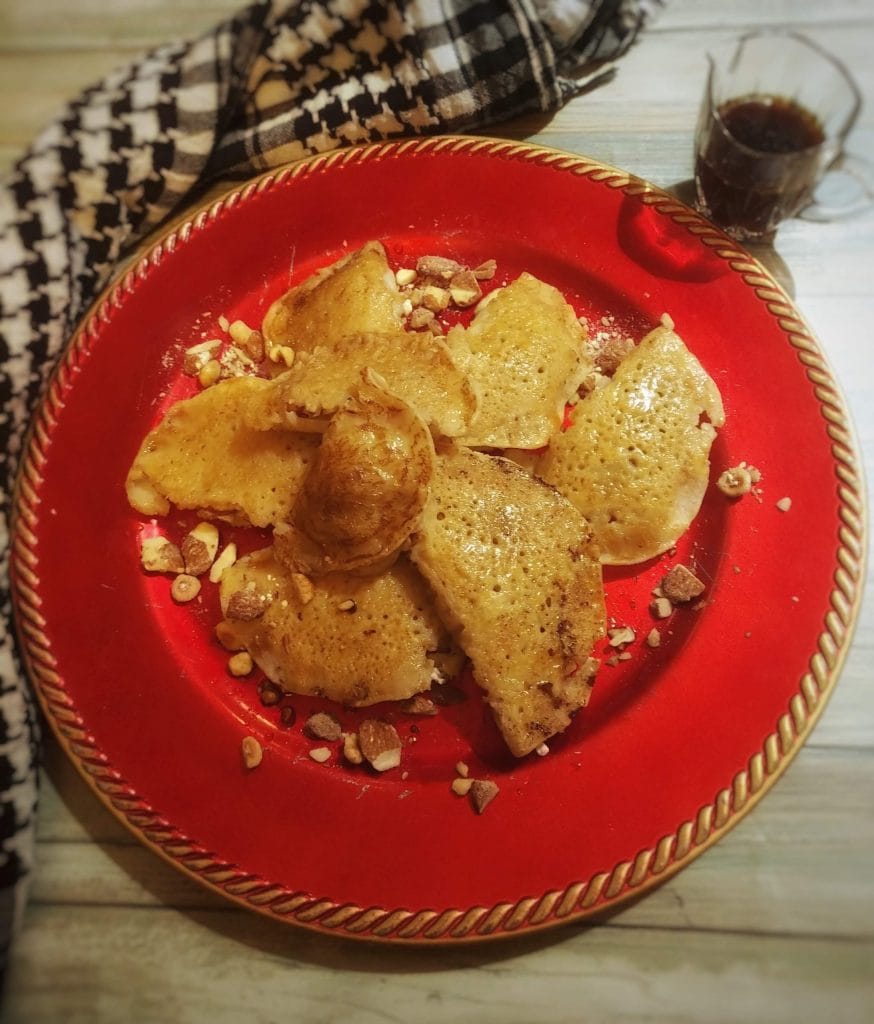
- Difficulty: Easy
- Cost: Medium
- Rest time: 45 Minutes
- Preparation time: 15 Minutes
- Portions: 10 pieces
- Cooking methods: Frying, Oven
- Cuisine: Middle Eastern
- Seasonality: Eid al-Fitr, All seasons
Ingredients for the dough:
- 2 cups flour
- 1 cup water
- 1 1/2 tbsp dry yeast
- 1 tsp sugar
- 1 1/4 cup warm water
- to taste salt
- 7.1 oz nuts (hazelnuts, walnuts, almonds, pistachios, raisins)
- 1/3 cup powdered sugar
- to taste ground cinnamon
- to taste vanilla extract
- 1 1/4 cup sugar
- 1 cup water
- 4 tsp lemon juice
- 1 oz orange blossom water (or rose water)
- as needed vegetable oil or butter
Preparation
The Dough:
Dissolve the yeast and sugar in water.
In a separate bowl, combine the flour, water, and salt. Add the yeast and sugar water mixture. Cover and let rise in a warm area for 30-45 minutes.
The Filling:
Crush the nuts and mix them with cinnamon, vanilla extract, and powdered sugar.
Preheat a griddle or skillet over medium-high heat. Using a ladle, make a pancake with the batter.
Once the batter starts to bubble on top, remove the pancake from the griddle and set aside – cook on one side only.
Once all batter is finished, let it cool for just a couple of minutes, take each atayef, and with your fingers, press the edge until it sticks, leaving an opening on top for filling, fill and close.
During cooking, there are two methods: frying and baking:
For frying (traditional version), heat a generous amount of vegetable oil in a deep pan and immerse the pieces, turning them for a few minutes, until they become darker and crispy.
For oven baking, spread a tray with butter or ghee and place each atayef on it, also brushed with some butter, separated from each other. Bake at 390°F for 10 minutes.
The Syrup:
Bring the water and sugar to a boil in a saucepan until the mixture becomes clear, and finally add the lemon juice and, with the heat off, the rose or orange blossom water.
Dip the atayef in the syrup.
Remember: either the atayef is hot and the syrup cold, or the syrup hot and the atayef cold.
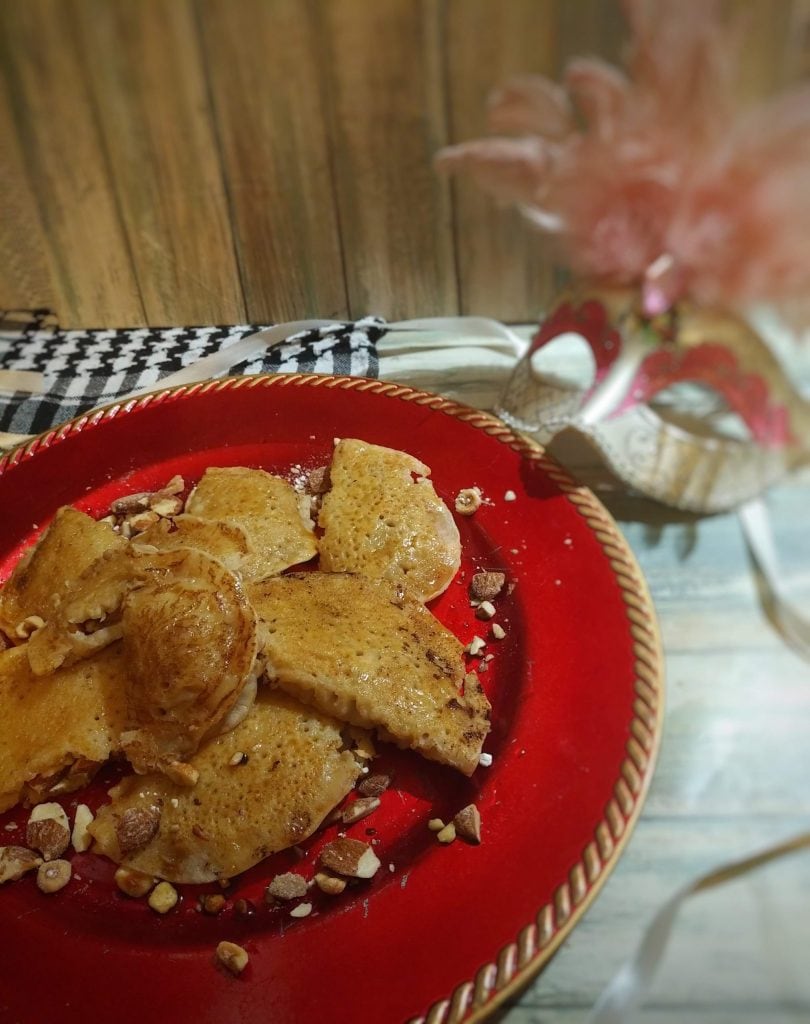
They can also be a great dessert for Carnival due to their resemblance to our traditional fried Ravioli…
Variants:
Called Yassi Kadayif in Turkey, the name refers to a very similar version of this dessert, often prepared in the Malatya region.
Another way to serve atayef is filling it with qishta (قشطة) – known as ashta in the Levant (Lebanon, Syria, Jordan) – and pistachios, folding it only halfway and serving it with fragrant syrup without frying or baking, or with whipped cream as a modern substitute for traditional Ashta.
This variant of the dessert is called assafiri qatayef (قطايف عصافيري). They are usually smaller in size and have a soft exterior, not fried, but served fresh with a sprinkle of crushed pistachios and a drizzle of sugar syrup (atar).
See a photo of one tasted at the Lebanese restaurant “Cedro del Libano” in Savona:
If orange blossom extract to create the syrup for dipping the atayef is easy to find even at the supermarket, rose water for sweets is more easily found online.
