
The Couscous Trapanese Style can be considered a one-pot meal, in its traditional version with fish, typical of the Trapani area.
A rich, symbolic, and complete dish, celebrated in San Vito Lo Capo during the Cous Cous Fest.
The couscous is steamed and then flavored with a very rich fish broth (often based on scorpionfish, redfish, grouper…), called “ghiotta” which is poured over the hand-rolled and steamed semolina in the local couscoussier, called “mafaradda”.
The fish used for the broth is usually sometimes served separately, whole or in pieces, but not mixed into the couscous itself.
The dish is sometimes accompanied by a spicy sauce with garlic, almonds, and tomato.
The fish is not directly added into the couscous, but the broth is used to flavor it, and the fish remains apart or served alongside.
The Couscous Trapanese Style is an extraordinary example of cultural fusion.
It originates in western Sicily, particularly in the Trapani area, where for centuries the geographical proximity and commercial relations with North Africa (especially Tunisia) have favored the exchange not only of goods but also of culinary traditions.
Couscous, a staple dish in Maghreb cuisines, has been adapted by Sicilians using local ingredients.
Instead of the meat or legumes typical of the Arabic versions, here it is prepared with fish broth.
The dish thus reflects the maritime identity of Sicily and the Arab cultural heritage that has profoundly marked the island, especially between the 9th and 11th centuries during the Islamic emirate of Sicily.
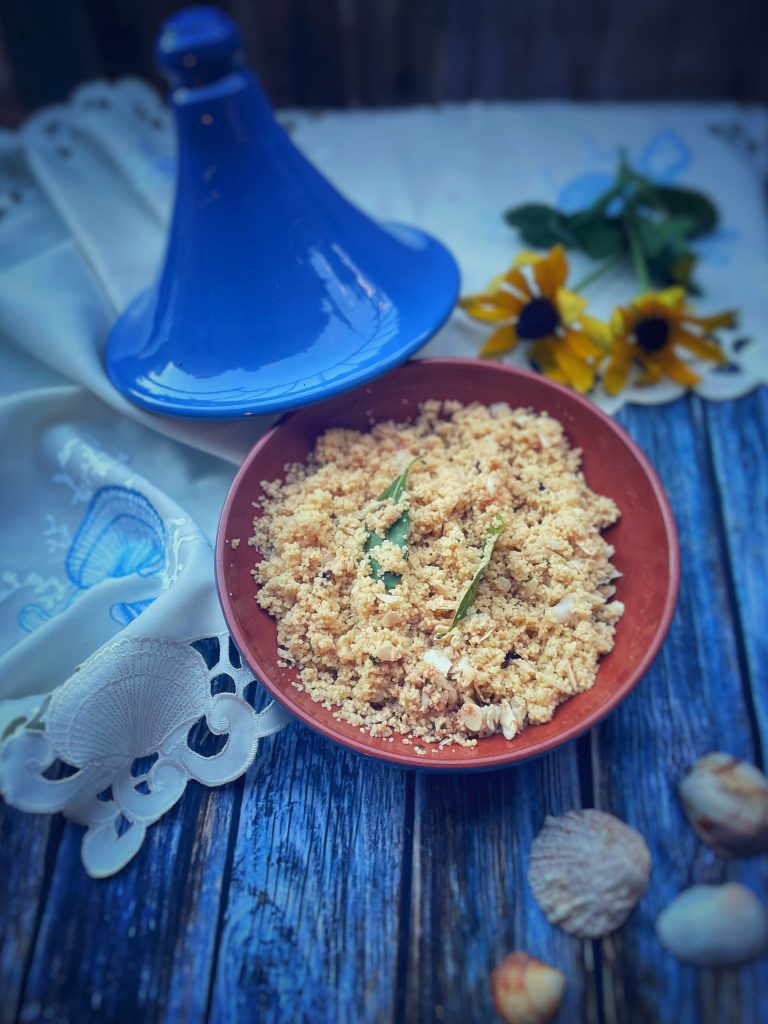
- Difficulty: Medium
- Cost: Medium
- Preparation time: 40 Minutes
- Portions: 4People
- Cooking methods: Steaming, Stovetop
- Cuisine: Italian
- Seasonality: All seasons
Ingredients
- 10.5 oz raw couscous
- to taste parsley
- to taste cinnamon
- to taste cloves
- to taste extra virgin olive oil
- to taste salt
- 2.2 lbs Fish bones, heads, and scraps for soup ((scorpionfish, redfish, bream, John Dory, etc.))
- 1 tablespoon strattu (or 2 peeled tomatoes)
- 4 cloves Nubia red garlic
- 1 onion
- 2 leaves bay leaf
- to taste salt and pepper
- to taste extra virgin olive oil
- 1.76 oz flaked almonds
Tools
- 1 Couscoussier mafaradda
Steps
Seasoning and preparing the semolina:
Slightly moisten the semolina with salted water, add minced garlic, parsley, oil, any spices, mix and rub with your hands to obtain small clumps (cocci).
Let rest and fluff with a little oil.
Cooking in the couscoussier:
Pour the clumps into the top part of the couscoussier.
Steam for about 1 and a half hours. Seal well between the two pots with a dough of flour and water.
Halfway through cooking, fluff and drizzle with a little broth (abbivirata), then continue cooking.
Preparation of the ghiotta:
In a pan, sauté onion, garlic, and chopped almonds.
Add strattu, the fish parts, water to cover, bay leaf, salt.
Cook for 40-50 min.
Strain everything to obtain a dense and aromatic broth.
Place the couscous in a bowl, drizzle with the hot ghiotta.
You can also serve a raw sauce with crushed garlic, almonds, oil, and tomato concentrate separately.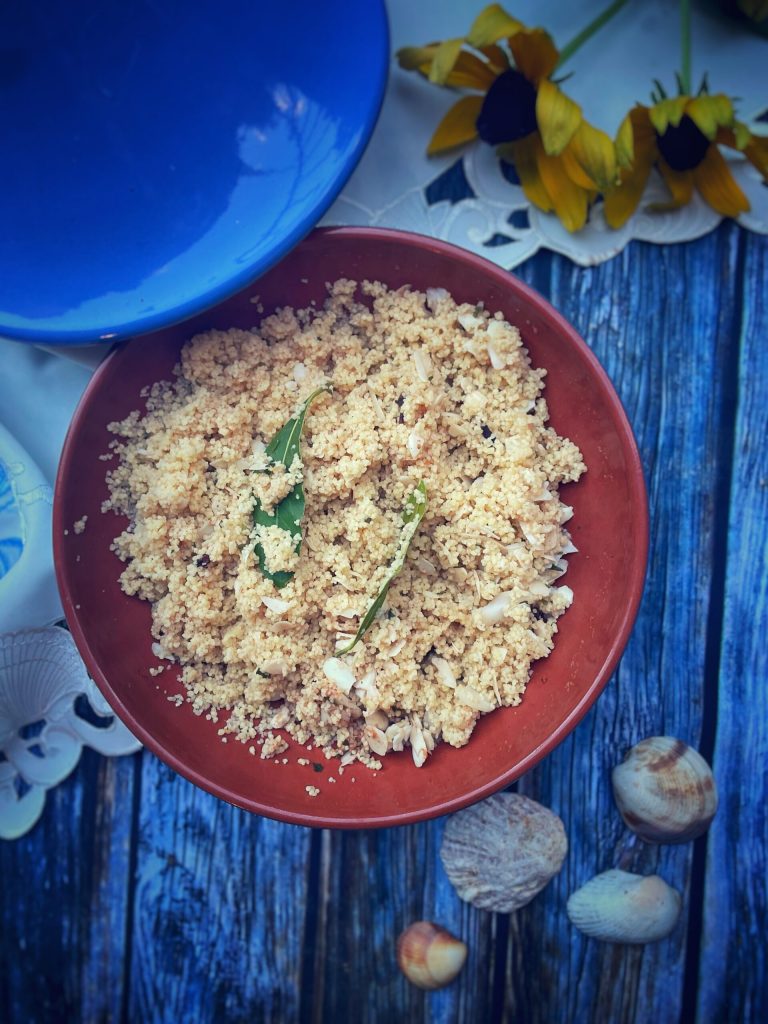
FAQ (Questions and Answers)
Is it possible to use pre-cooked couscous?
Yes, it is possible to use pre-cooked couscous for a simplified version of the Couscous Trapanese Style, but with some precautions:
do not cook it in the fish broth, but rehydrate it with slightly salted hot water, then fluff it with a fork and later season it with the strained broth.
You will not achieve the same aroma and consistency as the traditional steaming in the mafaradda, but you will still get a good dish, much quicker to prepare.What is strattu?
“Strattu” is the Sicilian term for tomato concentrate, a traditional product of the island.
It is obtained by sun-drying tomato sauce until a dense consistency and intense flavor are achieved.
It is an essential ingredient in many Sicilian recipes, especially for long cooking of meats and sauces.
