
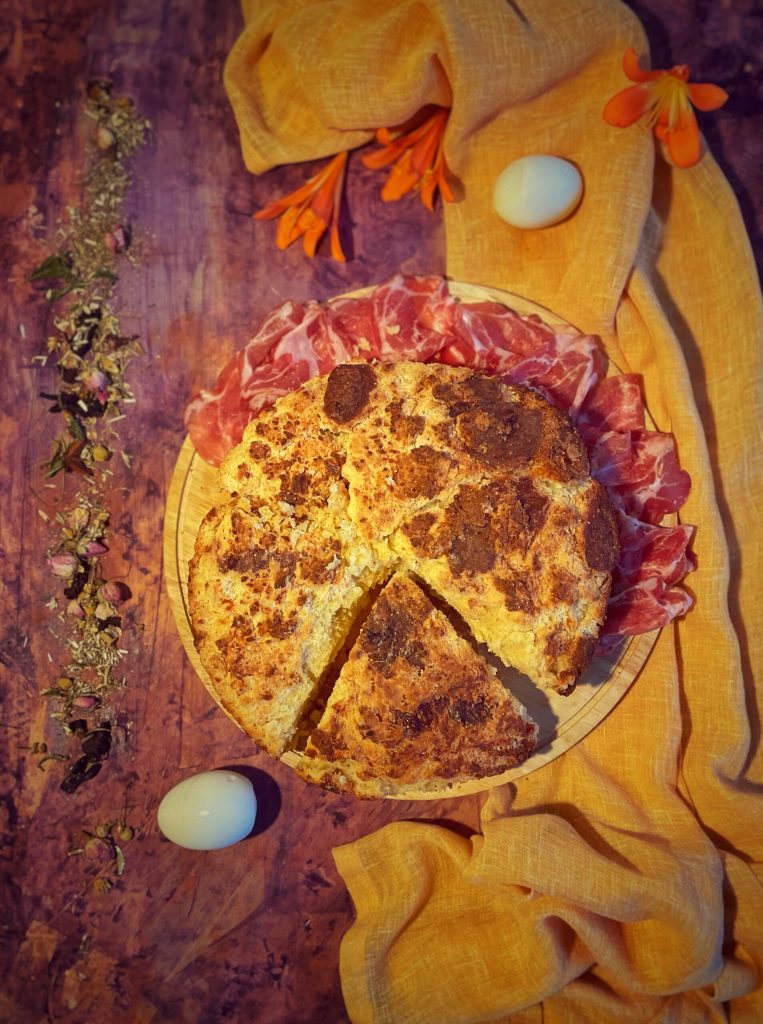
The Marchigiana Crescia (also known as Crescia brusca or Easter Bread/Pizza) is a leavened bread typical of the Easter tradition in the Marche region.
It is distinguished by a savory dough rich in eggs and cheeses, traditionally eaten during the Sunday Easter breakfast or on the Monday picnic (Pasquetta).
Historically, the recipe is linked to monastic life in the Middle Ages; the best-known testimony places its codification in the monastery of Santa Maria Maddalena in Serra de’ Conti.
The preparation served to use up the eggs accumulated during the Lenten abstinence. The term “Crescia” visually refers to the substantial rise of the dough during baking, which makes it expand well beyond the edges of the cylindrical mold.
The key ingredients are flour, whole eggs and a blend of grated cheeses (mainly Pecorino Romano and Parmigiano Reggiano). A specific technical feature of the Marchigiana version is the inclusion of cubed cheese (usually Emmental or fresh pecorino) which, melting, creates irregular pockets in the crumb.
The use of lard as the fat component and a generous amount of black pepper defines the aroma profile and texture of the finished product.
The recipe presented here is a gluten-free version made with a sourdough starter. Using a natural gluten-free starter allows a slower maturation of the dough, improving digestibility and structural stability.
Despite strong similarities, the Crescia differs in some local nuances from the:
- Difficulty: Easy
- Cost: Economical
- Rest time: 20 Hours
- Preparation time: 10 Minutes
- Cooking time: 50 Minutes
- Portions: 6 Servings
- Cooking methods: Oven, Electric oven
- Cuisine: Italian
- Seasonality: Easter, Spring
Ingredients
- 5 fl oz (about 2/3 cup) fresh gluten-free sourdough starter (refreshed)
- 3.4 fl oz (about 1/3 cup + 1 tbsp) milk
- 4 1/4 cups gluten-free flour mix
- 4 eggs
- 3 oz (about 6 tbsp) lard (or melted butter)
- 1 1/3 cups grated cheeses (such as Pecorino from the Sibillini Mountains)
- 3.5 oz (about 1 cup diced) cubed cheese (e.g., Emmental)
- to taste salt and pepper
Tools
- 1 Pan Ø 6 x 4 h 6.25 in
Steps
Activation: Dissolve the gluten-free sourdough starter in lukewarm milk.
Dough: Combine the flours and the eggs. Start mixing while gradually adding the dissolved starter. Work until the dough is homogeneous.
Fats and Cheeses: Incorporate the lard (or melted butter) and the grated cheeses. Once the dough is smooth, add the cubed cheese by hand so the cubes remain intact. Adjust salt and pepper.
Proofing: Place the dough in the greased mold (it should reach halfway up). Cover with plastic wrap and let it proof in the oven with the light on (about 82°F) until it reaches the rim. With a sourdough starter, count on about 8-10 hours.
Baking: Bake at 338–356°F for about 45–50 minutes.Let cool completely before removing from the pan to avoid crumbling, a common issue with gluten-free products.
Similarities and Differences Between Marchigiana Crescia and Umbrian Easter Cake
A shared origin
Both recipes derive from the same medieval tradition. The most cited historical document for both leavened breads is the recipe book of the nuns of the Monastery of Santa Maria Maddalena in Serra de’ Conti, in the Marche region.
In that monastery the formula was codified that today underlies both the Umbrian Cake and the Marchigiana Crescia.
The nuns needed to:
Use up the eggs: accumulated during the 40 days of Lent (when they were forbidden to eat them).
Celebrate the Resurrection: by creating a “rich” bread that contrasted with the plain, poor bread eaten during the fast.
In the Middle Ages the borders between Umbria and Marche were very fluid and monastic orders (especially Benedictines and Franciscans) frequently moved between the abbeys of the two regions, bringing with them baking techniques and recipes.
The difference between the “Umbrian Cake” and the “Marchigiana Crescia” is therefore not of origin but of geographical evolution.
The recipe migrated from monasteries to peasant kitchens.
Each area then adopted the local name and the cheeses of its territory (Pecorino from the Sibillini Mountains in the Marche, Umbrian Pecorino in Umbria), as well as the presence of whole pieces of cheese in the dough.
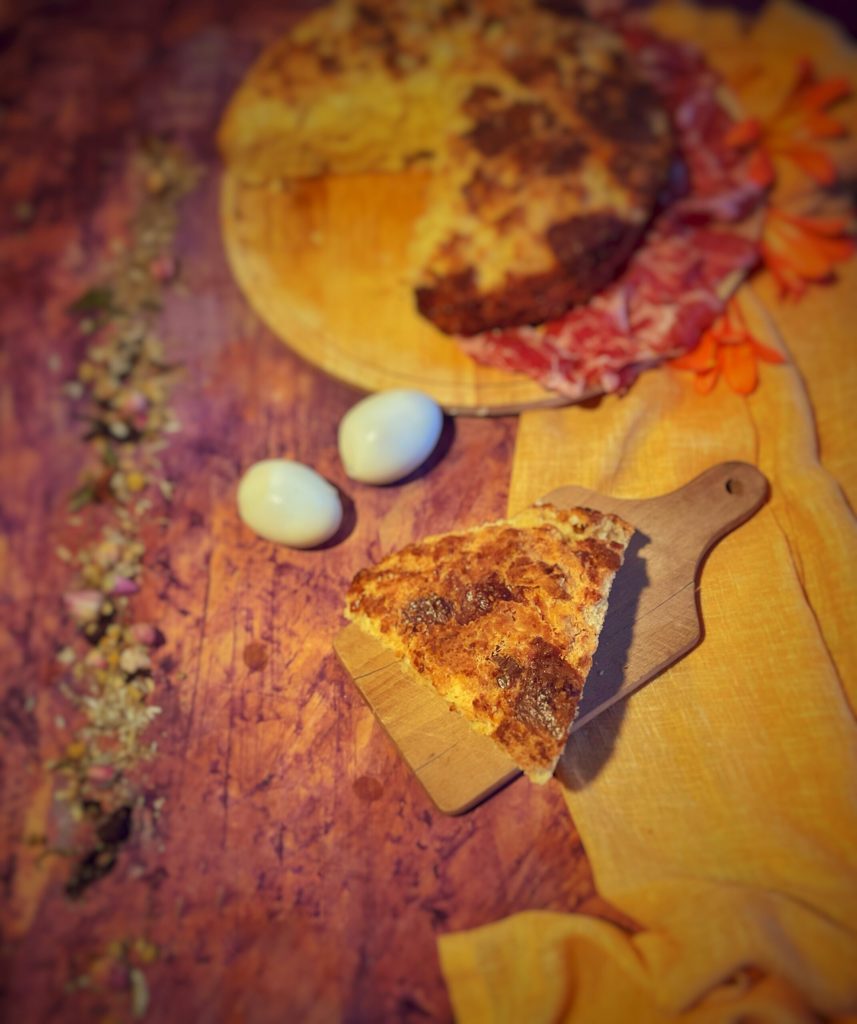
Moreover, while in Umbria the typical cured meat is capocollo, in the Marche the Crescia is almost exclusively paired with ciauscolo, the region’s typical spreadable salami.
In short, it is the same historic product that has taken different names depending on which side of the Apennines it is prepared.
