
The Danubio (originally Danubio brioche) is a savory leavened dough (though sweet versions also exist) made up of leavened dough balls filled with cured meats and cheeses (usually provola and salami), typical of Neapolitan cuisine.
It originates from a Bohemian dessert, but widespread in Austria: the Buchteln, dough balls filled with plum or apricot jam.
In 1920, the young pastry chef Giovanni Scaturchio, owner of the eponymous Neapolitan pastry shop, inspired by his wife’s culinary traditions, originally from Salzburg whom he met at the front, enriched his pastry tray with some typical Austrian tradition products.
It later became savory.
It is called “Danubio” as a tribute to the European river crossing Austria, the homeland of the sweet version.
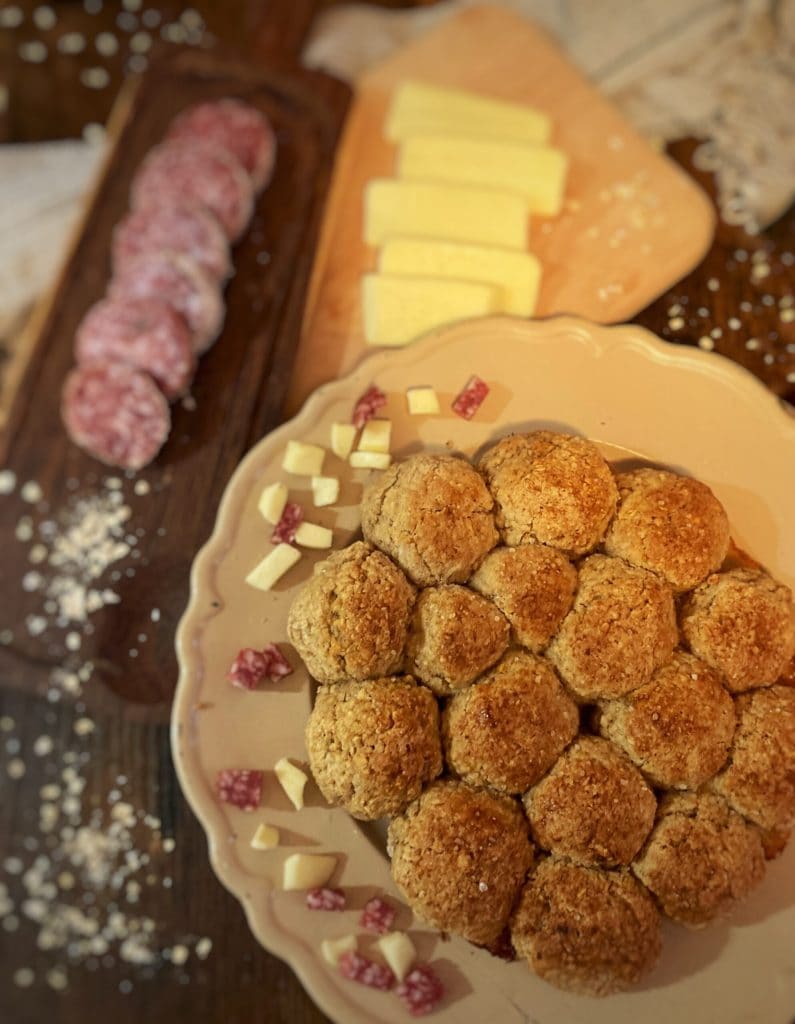
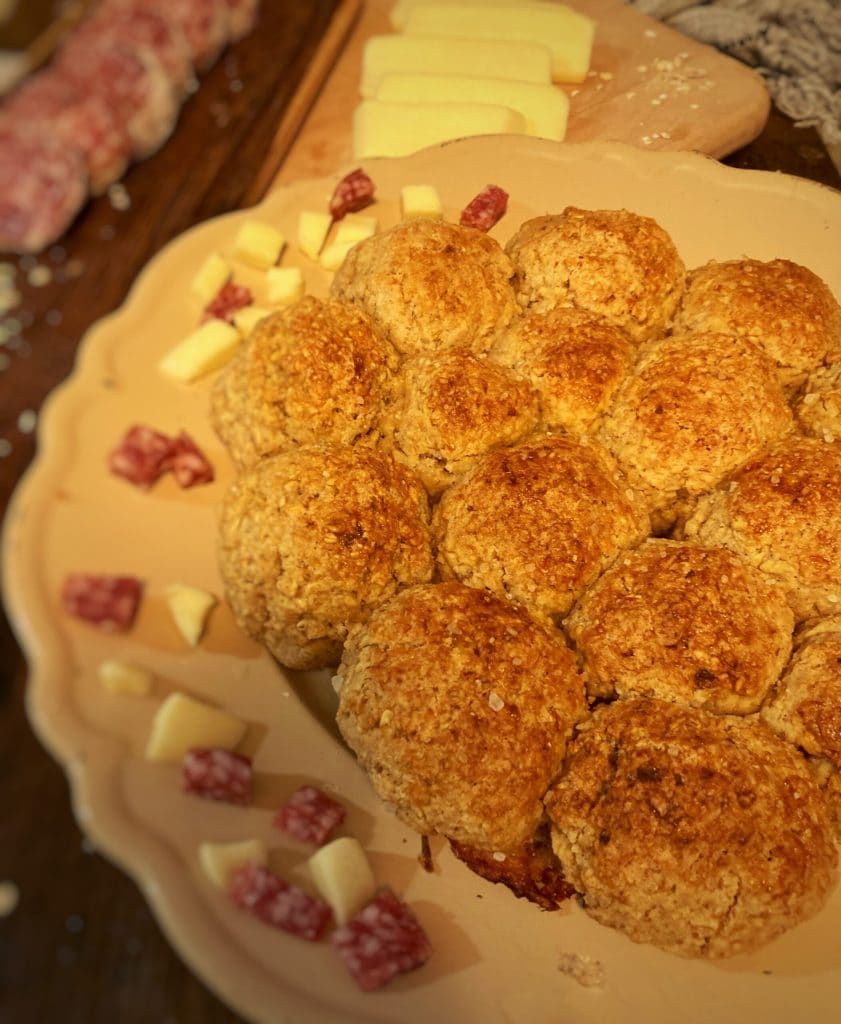
I have developed an alternative version, gluten-free and lactose-free with:
– pulverized oat flakes flour;
– rice and coconut milk
– maple syrup
– lactose-free butter.
Stuffed with salami and lactose-free provola.
On the blog, you can find other gluten-free Neapolitan recipes and in the video, the “Pizza Danubio” version:
- Difficulty: Medium
- Cost: Economical
- Rest time: 2 Hours 30 Minutes
- Preparation time: 10 Minutes
- Portions: 6 people
- Cooking methods: Oven
- Cuisine: Italian
- Seasonality: All seasons
Ingredients
- 5.8 oz oat flakes (gluten-free)
- 2 g dry brewer's yeast (or 4–5 g of fresh brewer's yeast)
- 1 teaspoon sugar
- 2 eggs
- 1/2 tablespoon maple syrup
- 10.6 oz lactose-free butter
- to taste lactose-free provola
- to taste salami
- to taste salt
Steps
Dissolve the yeast in some lukewarm water with a pinch of sugar, let it activate for 10 minutes.
Chop the oat flakes to reduce them to a kind of flour.
Combine the flour derived from the pulverized oat flakes with the yeast and salt.
Separately combine the milk with the slightly beaten egg and maple syrup.
Gradually combine the dry ingredients with the wet ones, continuing to mix.
Once a smooth ball is obtained, add the melted butter gradually.
Cover with a cloth and let it rise in a turned-off oven for 2 hours.
After rising, divide the dough into 40 g portions.
Roll each portion into a disc and fill as desired with salami and provola.
Close and form a ball.
Place each ball on a baking tray lined with parchment paper, with the seam facing down and forming a circle by joining the balls.
Let rise for another 30 minutes.
Brush with a mixture of milk and the beaten egg yolk.
Bake in the oven at 338°F for 30 minutes.
Serve warm.
You can also find the recipe in English on the blog with measurements expressed in cups and ounces as units of measure: HERE.
FAQ (Frequently Asked Questions)
What is the best yeast for gluten-free dough?
If you want to let your dough rise for 2 hours + 30 minutes, dry brewer’s yeast is an optimal choice because:
• It is stable and easy to measure
• Allows good rise within medium times
• Works well even with gluten-free flours (especially if you use xanthan gum or psyllium to help the structure)
If you want to use another type of yeast for 165 g of gluten-free flour, the amount of yeast depends on the type:
Fresh brewer’s yeast
• 3.5–5 g (approximately one-eighth of a 25 g cube)
• If you want long rising time, you can decrease to 2–3 g
Instant yeast for savory (type for savory pies or quick pizzas)
• 5–6 g (about half a packet), but does not require rising time
Dry sourdough (gluten-free)
• 30–40 g, but it depends on the specific productWhat is the difference between Savory Danubio and Pizza Danubio?
The main difference between Pizza Danubio and Savory Danubio lies more in the filling and the “concept” than in the dough, which is basically very similar (brioche dough, soft and leavened).
Classic Savory Danubio
• Made with dough balls individually filled with cured meats and cheeses (like cooked ham and scamorza).
• The balls are placed in a pan to touch, rise together and are easily pulled apart when baked.
• Each ball is a little surprise.
Pizza Danubio
• A more recent variant, inspired by pizza flavor.
• The balls can contain fillings reminiscent of pizza (tomato, mozzarella, oregano, eggplants, etc.).
• Sometimes the filling is more “moist”, like in pizza.
• It can also be presented with a topping of sauce or tomato before baking for a more “pizza” effect.
In summary: the Savory Danubio is the traditional version, more neutral and rustic, while the Pizza Danubio is a creative variant with fillings that recall the taste and ingredients of pizza.
