
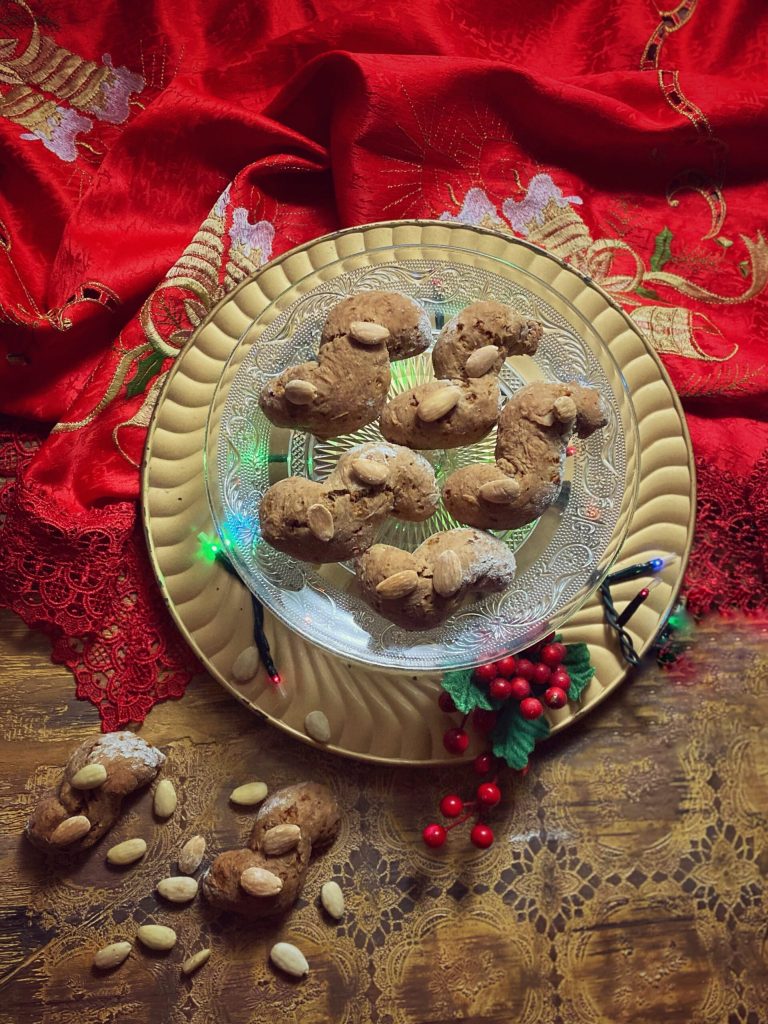
Susamielli are Neapolitan cookies shaped like an S, typical of the Christmas period.
Made with flour, sugar, almonds, and honey, with the addition of pisto (a spice mix of cinnamon, cloves, nutmeg, and star anise); I made them gluten-free with rice flour.
Many believe that the name Susamiello comes from its shape; actually, the Greek-origin sweet owes its name to the fact that sesame seeds were once added to the dough to better flavor it; indeed, they used to be called “sesamielli.”
In the 1700s, they were made from a dough with giulebbe, which is a sugar syrup with fruit and flower essences, honey (popularly replaced by cooked wine must made with a long cooking), flour, roasted almonds, candied orange peels, cinnamon, cloves, and pepper.
According to tradition, the best ones were made by the nuns of Donna Regina. They were shaped both like a circle and in the form of an S.
The oldest recipe of Susamielli is contained in the 1788 recipe book by Vincenzo Corrado “Advisor of good taste, beauty, gentleness, and delight to satisfy men of knowledge and taste,” under the name of “noble susamielli.”
Cook, philosopher, and writer, Corrado was already the author of the famous book “The Gallant Cook,” a famous banqueting manager of the era, known for being the first gastronome to write about “Mediterranean cuisine.”
In ancient times, three different recipes of Susamielli were prepared.
Those offered to the bagpipers were called “Bagpiper’s Susamielli” and were made with flour and recycled ingredients, like citrus peels.
The “Good Journey Susamielli” were intended for the clergy, prelates, priests, nuns, and friars, and had a filling of sour cherry jam.
The recipe intended for the nobles is the most widespread one still today.
An urban legend also tells of a nun named Celestina, belonging to one of the many Neapolitan convents used as sweetness factories, who, while preparing these cookies still in round shape, exclaimed: “damn you, you tempt me… you’re a devil! And so I’ll turn you into a snake!!!”
They are perfect for the holidays, along with other Neapolitan Christmas classics like roccocò, mustaccioli, and struffoli.
The recipe was the star of the TikTok live “Waiting for Christmas.”

- Difficulty: Medium
- Cost: Cheap
- Preparation time: 10 Minutes
- Portions: 10 Pieces
- Cooking methods: Oven
- Cuisine: Italian
- Seasonality: Christmas
Ingredients
- 3/4 cup rice flour
- 2 1/2 cups almond flour
- 1/3 cup rice starch (or corn starch)
- 1/2 cup sugar
- 3/4 cup honey
- 1 tsp pisto
- 1/2 tsp baking ammonia
- as needed almonds
Steps
If you don’t use almond flour, first roast the almonds and then grind them into flour.
Mix the rice flour with the starch and almond flour.
Melt the honey.
Add it to the flour mixture, add the sugar, pisto, and baking ammonia.
Work the dough into a ball shape.
Cut small portions of dough and make long 4-inch cords about 3/4 inch wide.
Shape into S’s, decorating by inserting whole almonds inside the two bends.
Bake in a static oven at 356°F for 15 minutes.
For a vegan version, you can replace honey with maple syrup or, according to an ancient recipe, use cooked wine.
FAQ (Frequently Asked Questions)
What is giulebbe, and how is it prepared?
Giulebbe is a syrup obtained by boiling 180 grams of water and 180 grams of sugar together until a viscous consistency is achieved.
