
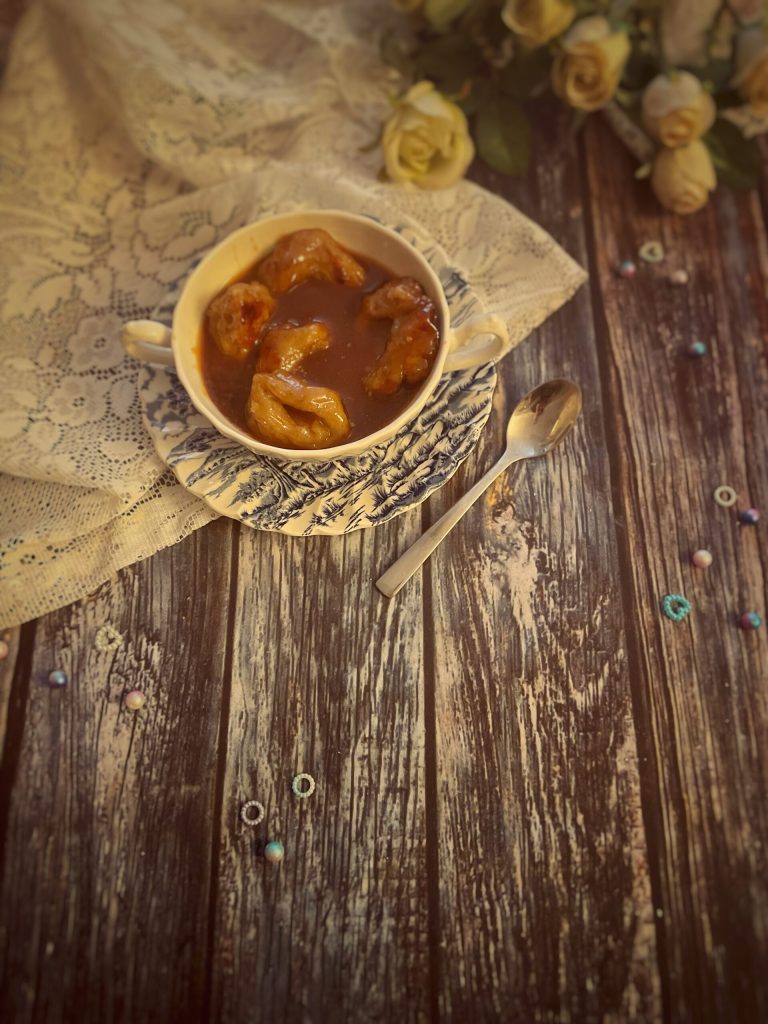
The Tertzelouthkia (τερτζελούθκια) are a traditional Cypriot sweet preparation🇨🇾, nowadays quite rare, but once associated with humble cuisine and especially during the Orthodox fasting period
▶They are closely related to koulourouthkia (a generic term for dry cookies), differing in shape, cooking, and final texture.
▶They originated as a recycled sweet: a version not to waste dry or leftover dough.
▶Shaped into rings or flattened donuts, often with a light incision to facilitate cooking, unlike koulourouthkia which are baked, the tertzelouthkia are boiled in carob syrup and served with it.
▶Traditionally prepared in Cypriot rural homes, during community moments or religious holidays avoiding animal products.
▶▶With a simple dough, made of flour, olive oil, water. They contain no eggs, butter, or milk, making them perfect for Lent.
⭐I used buckwheat flour combined with carob seed flour which acts as a neutral thickener for a Gluten-free version.
▶The use of carob syrup “χαρουπόμελο” (charoupomelo) is typical of the Cypriot tradition, rich in this fruit that replaced honey or sugar in ancient times.
▶In the past, they were mainly made when wine was not available or harvests were scarce: in those cases instead of epsima, a grape must syrup or cooked grape, carob syrup, abundant on the island, was used.
- Difficulty: Medium
- Cost: Economical
- Preparation time: 5 Minutes
- Portions: 40 Pieces
- Cooking methods: Boiling
- Cuisine: Greek
- Seasonality: All seasons
Ingredients
- 5.3 oz gluten-free buckwheat flour
- 3.5 oz potato starch
- 0.1 oz carob seed flour
- 0.4 cup water (warm)
- 1 pinch salt
- to taste cinnamon
- 3.4 cups water
- 0.5 cup carob syrup
Steps
1. Dough:
In a large bowl, mix the flour, starch, carob seed flour, cinnamon, salt, and sesame seeds.
Gradually add the warm water and knead until you get a smooth and soft dough, not sticky. If necessary, add more flour or water to adjust the consistency.
2. Shaping:
Take small pieces of dough and shape small rings around your index finger.
3. Syrup preparation:
In a pot, bring the water to a boil, add the carob syrup or honey, and simmer for 3/5 minutes until you get a thick but fluid syrup.
4. Cooking:
Gently immerse the fresh Tertzelouthkia in the hot syrup.
Cook over low heat for about 10 minutes, until they become soft, swollen, and well-soaked in syrup.
5. Cooling:
Carefully drain and let dry a bit on a rack or plate. They are consumed in a bowl with a bit of syrup and sesame seeds.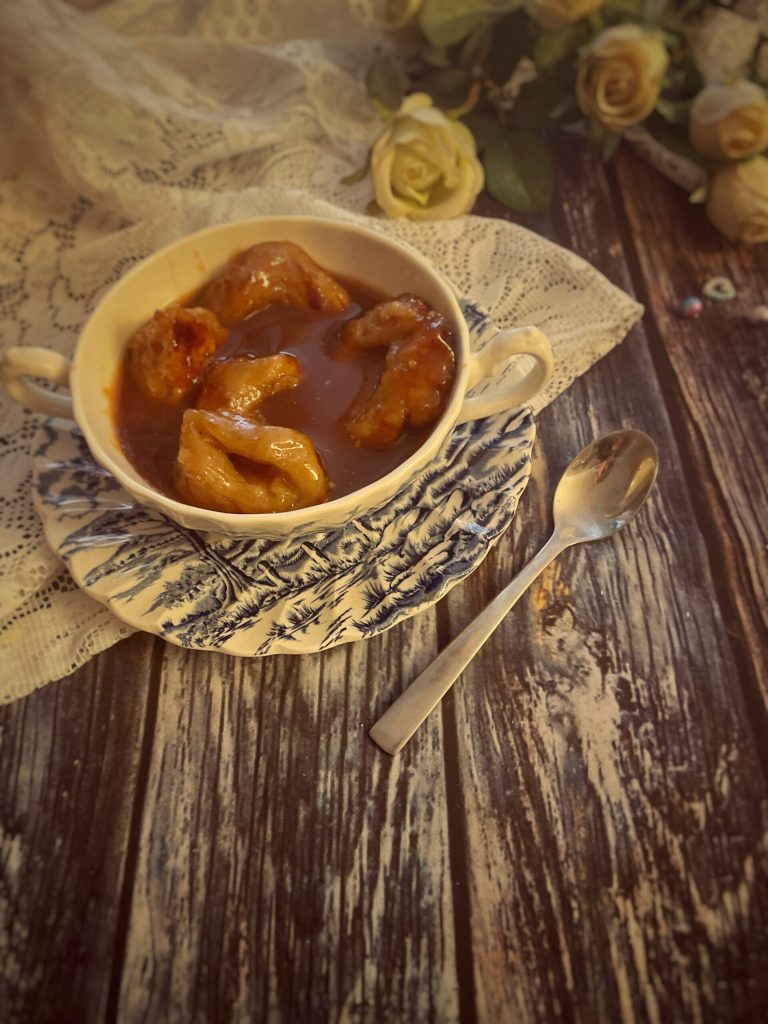
Difference in Cooking Steps:
• Traditional “fresh” version (Just-formed Tertzelouthkia)
They are cooked directly in the hot syrup (teratsomelo extended with water), without the need for boiling in water. This applies when they are freshly kneaded, soft, and moldable.
• Version with dry or pre-prepared dough
If the sweets have dried or hardened, then: they are briefly boiled in water to soften them.
Then they are transferred to the hot syrup to absorb the flavor and complete the cooking.
FAQ (Frequently Asked Questions)
What is the difference between carob seed flour and carob pulp flour?
The difference between carob seed flour and carob pulp flour is quite distinct, both in use and characteristics:
Carob pulp flour (or simply “carob flour”)
• Derivation: from the pulp of the carob fruit, after being dried and ground.
• Color: dark brown.
• Flavor: naturally sweet, similar to cocoa.
• Usage: used as a cocoa substitute, in sweets, cookies, drinks, creams, etc.
• Properties: rich in fiber, natural sugars, caffeine-free.
Carob seed flour (or carob gum / E410)
• Derivation: from the inner seeds of the carob pod, very hard and mucilaginous.
• Color: white-beige.
• Flavor: neutral.
• Usage: natural thickener and gelling agent, used in ice creams, sauces, desserts, often in the food industry.
• Properties: contains galactomannans, which form gels and provide viscosity.
• Carob pulp flour is an aromatic and nutritious ingredient (for taste).
• Carob seed flour is a technical additive (for texture).
