
We inaugurate the column “Leavened Easter” with a classic that takes us straight to the shores of the Aegean: the Greek Laganá (Λαγάνα).
This flat, crispy bread, covered by a shower of sesame seeds, is not only a recipe but a millennial symbol of transition and purification.
The roots of Laganá go back to classical antiquity and are already mentioned in Aristophanes’ comedies.
Traditionally, it is the bread of Clean Monday (Kathari Deutera), the day that marks the beginning of the Orthodox Lent. This festive and reflective Monday opens the 40-day journey toward Easter, representing spiritually the “cleansing” of heart and home.
Although its shape resembles a focaccia, Laganá stands out for its unique texture: a crispy crust that encloses a tight, aromatic crumb.
Originally prepared as unleavened bread to recall the Israelites’ exodus from Egypt, the tradition has evolved over time.
Today, the use of sourdough starter (prozymi) is considered the quintessential traditional method.
This “ancient leaven” not only ensures superior digestibility, but gives the bread that slightly sour bouquet of aromas that pairs perfectly with the toasted sesame.
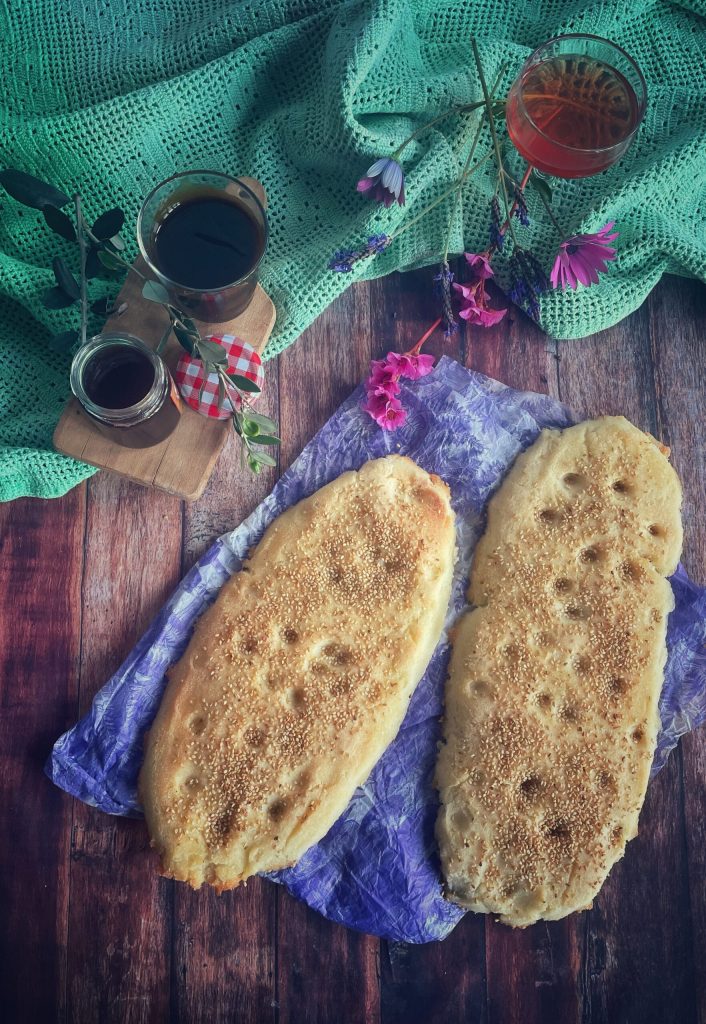
- Difficulty: Easy
- Cost: Very inexpensive
- Rest time: 5 Hours
- Preparation time: 15 Minutes
- Cooking time: 40 Minutes
- Portions: 2 Pieces
- Cooking methods: Oven
- Cuisine: Greek
- Seasonality: Easter, Spring
Ingredients
- 4 cups Type 0 flour (approx. all-purpose/white flour) (approx. 500 g)
- 5.3 oz fresh sourdough starter (refreshed (150 g))
- 1 1/3 cups warm water (approx. 320 ml)
- 2 tbsp olive oil (approx. 30 ml)
- 2 tsp salt (approx. 10 g)
- to taste sesame seeds
Steps
The Dough: In a large bowl dissolve the sourdough starter in the warm water with the honey. Add the flour gradually and begin to mix. When the flour is absorbed, add the oil and the salt.
Working the Dough: Knead vigorously for about 10–15 minutes until you obtain a smooth, elastic ball.
First Fermentation: Place the dough ball in an oiled bowl, cover with a cloth and leave to rise in a warm place for about 3–4 hours, until doubled.
Shaping: Take the dough, gently deflate it and stretch it onto a floured or oiled baking sheet. The shape should be a very large, flat oval (about 13 3/4″ x 6″ and roughly 3/8″ high).
Second Fermentation: Cover and let rest another 45–60 minutes.
The “Dimples” with your fingers: This is the iconic step. Press your fingertips across the entire surface to create deep craters.
Finishing: Brush with water and a pinch of sugar (this helps the sesame adhere and adds color) and sprinkle with a dense shower of sesame seeds.
Baking: Bake at 392°F for 35–40 minutes. It should be well browned with a crispy crust and a soft interior.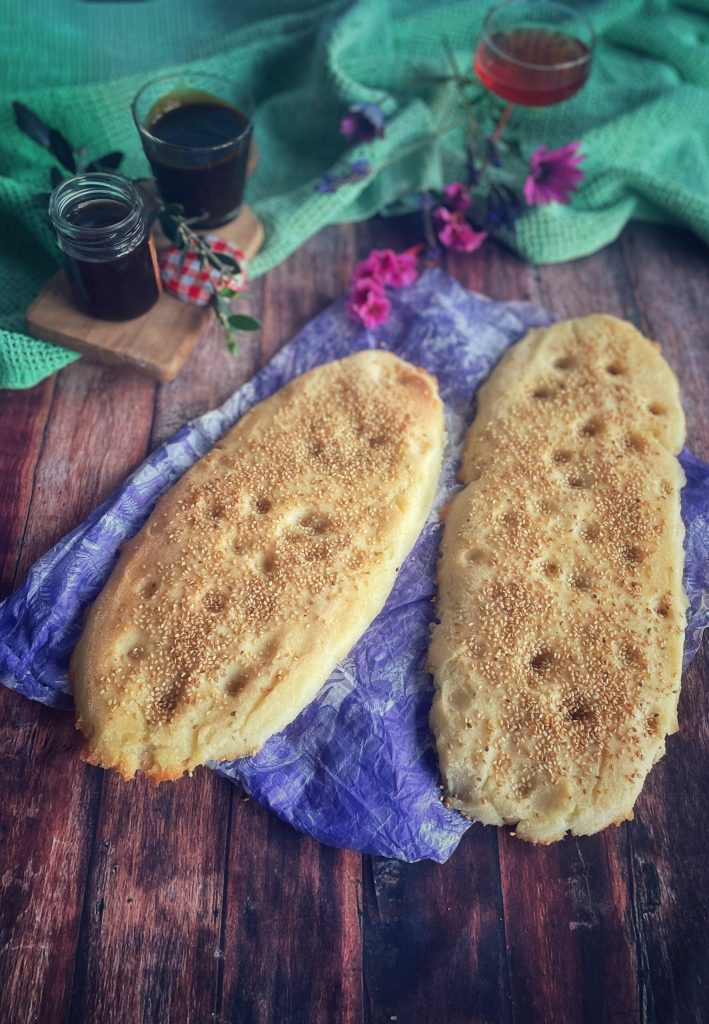
Laganá and Sourdough Starter
The oldest and most authentic tradition of Greek Laganá absolutely requires the sourdough starter (called prozymi in Greek).
In the past, in Greek villages, on Lent Monday there was no industrial baker’s yeast: women used a piece of dough kept from the previous baking.
This gives Laganá that slightly sour taste and incredible keeping quality (it stays good for days, becoming progressively crunchier).
Symbolism: The sourdough starter is a “living” element that is passed down, representing the continuity of life and faith, a central theme of Orthodox Easter.
Digestibility: The long fermentation of the sourdough starter makes this bread very light, ideal for the start of the fast Lenten booklet.
Texture: Only with sourdough starter do you get that tight yet soft crumb, enclosed in a crust that crackles thanks to the sesame.
FAQ (Questions & Answers)
Can I make laganá with baker’s yeast?
If you decide to switch to baker’s yeast for an “express” version of Laganá, the main differences concern the resting times and the final texture.
While sourdough gives a tight, aromatic crumb that lasts for days, baker’s yeast yields a more open crumb, immediate lightness and that typical “freshly baked bread” aroma.
Here is what changes technically:
1. Timing: From 6 hours to 3 hours
With baker’s yeast (dry or fresh), the leavening power is much more aggressive. You won’t need prior refreshments: the dough will be ready for the oven in about 2–3 hours total.
2. The Quick Recipe (Quantities)
4 cups Type 0 flour (approx. 500 g)
1 1/4–1 1/3 cups warm water (approx. 300–320 ml)
1 packet (7 g) active dry yeast (or about 1/2–3/4 oz / 15–20 g fresh yeast)
1 tablespoon honey (for lift and color)
2 tsp salt (approx. 10 g)
2 tbsp extra virgin olive oil
White sesame in abundance
3. What changes in the method:
Dough: Dissolve the yeast directly in the warm water with the honey. Wait 5 minutes until you see a light foam (activation).
Fermentation in the bowl: 60–90 minutes in a warm place will be enough to see the dough double.
Shaping: Once stretched on the baking sheet, laganá made with baker’s yeast tends to puff up much more. Technical tip: press firmly with your fingertips to create the dimples; if the dough is too “lively,” prick it also with the tines of a fork to avoid it becoming a focaccia that’s too tall.
Second fermentation: Reduce it to only 20–30 minutes before baking.
