
Why would anyone want to go to Iraq?
A place that for as long as I can remember has always been ravaged by endless wars and even now, despite the withdrawal of part of the American contingent, and not only, is certainly not hospitable for tourism.
Because the Middle East has always attracted me.
The calm of the desert, contrasted with the madness of war, ancient history, perched cities, and perhaps also due to the objective impossibility of visiting many of its states, and of course for its spicy and fragrant cuisine.
The Middle East consists of: Saudi Arabia, Bahrain, Cyprus, United Arab Emirates, Egypt, Jordan, Iraq, Iran, Israel, Kuwait, Lebanon, Oman, Palestine (even though it has no established borders), Qatar, Syria, Turkey and Yemen.
Many of these states are in perpetual war, but despite this, many of them are part of my choices for the column “Around the World in 80 Dishes”.
Specifically, Iraqi cuisine makes extensive use of spices such as saffron and mint, and the main ingredients are lamb, mutton, goat, beef in addition to white meats like chicken.
Iraqi food is heavily influenced by neighboring countries, Turkey, and Iran, and is one of the few Middle Eastern nations lacking a unique cuisine.
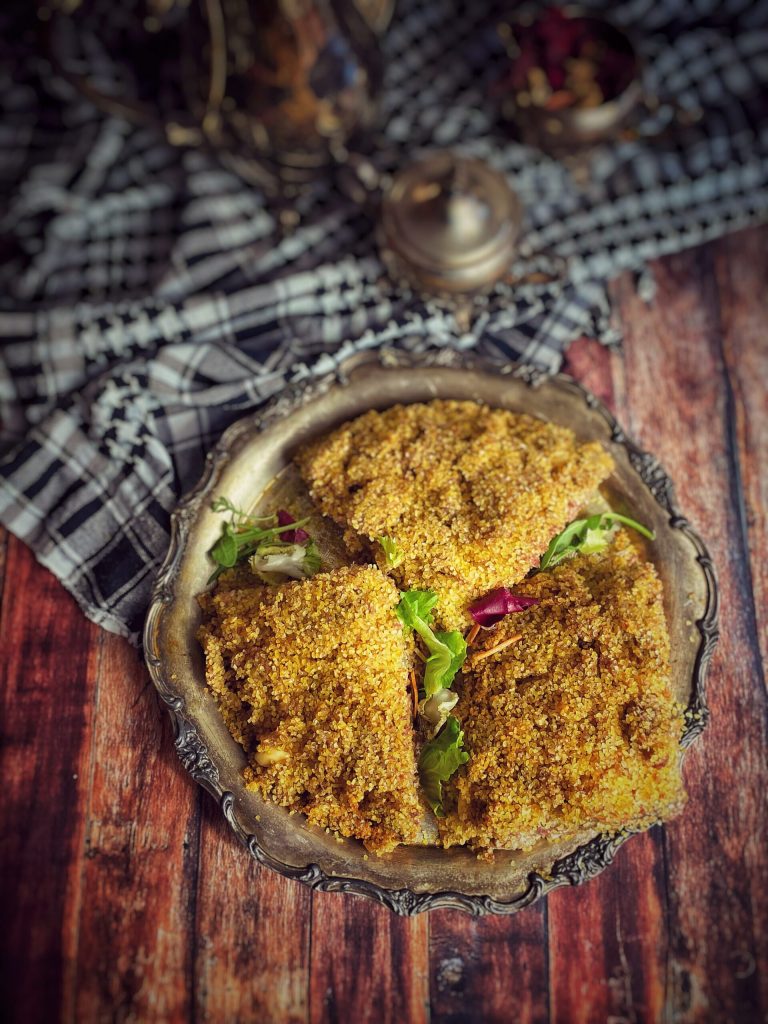
For the blog, I chose a very original recipe, it is Kubba Mosul.
Kubba (koo-bah) or kibbeh (kih-bah) is a dish based on bulgur (sprouted whole wheat, whose grains are steamed, dried, and then crushed), chopped onions, and lean ground beef, lamb, goat, or camel meat with Middle Eastern spices (cinnamon, nutmeg, cloves, allspice).
The Kubba Mosul is a savory pie filled with meat, but other types of kibbeh or kubbah can be shaped into meatballs, cooked in broth, fried, or served raw.
The word derives from classical Arabic kubbah (kibbeh in North Levantine Arabic ) and indeed means “ball”.
It consists of two layers of bulgur dough stuffed with spiced beef, flattened into a circle, with a diameter of about 1 inch.
- Difficulty: Medium
- Cost: Economical
- Rest time: 1 Hour 5 Minutes
- Preparation time: 40 Minutes
- Portions: 1 large disc or 6 medium discs
- Cooking methods: Frying, Electric oven, Boiling
- Cuisine: Middle Eastern
- Seasonality: All seasons
Ingredients
- 18 oz lean ground beef
- 2.2 lbs extra fine bulgur
- 9 oz bulgur
- to taste salt
- 18 oz ground lamb
- 2 onions
- to taste pine nuts and/or almonds
- to taste spices (black pepper, nutmeg, cinnamon)
- to taste salt
- to taste olive oil
Preparation
To prepare the outer part of the kubba Mosul:
mix together the extra fine and regular bulgur by hand, adding a bit of water. Then, pass it through a sieve to remove excess water.
Add the ground beef to the bulgur mixture. Season generously with salt.
Mix everything with your hands, then process it in a mixer, also adding a tablespoon of water.
Let it rest for 20-25 minutes.
To prepare the filling for the kubba Mosul:
toast the pine nuts and/or almonds in a pan with a drizzle of oil.
Finely chop the onions in a mixer. Add the lamb, salt, and spices.
Form the discs, you can decide to make one large or many smaller ones:
after wetting your hands, sprinkle a few drops of water on a flat, clean surface.
Place a sheet of parchment paper (approximately 12 x 12 inches) and sprinkle a few drops of water here as well.
Take a ball of the outer dough and place it in the center of the sheet. Place another sheet of paper on top of the ball. Using a rolling pin, start rolling the ball of dough from the center outwards. Roll until you get a thin disc.
Gently remove the top parchment paper. Place an inverted plate over the dough disc to get the shape of a circle. Remove the excess dough.
Once you have a smooth circular disc, add a tablespoon of filling in the center, spread it with the back of the spoon, making sure to leave enough free space on the outer edge. Add also some toasted pine nuts (or almonds).
Form a new dough disc as already described and place it on top of the first already filled disc. At this point, press on the edges of the discs to make them adhere.
Let the Kubba rest for at least 40 minutes before cooking.
There are several ways to cook the Kubba Mosul:
boil the discs in boiling water in a shallow and wide pot. When the Kubba rises to the surface, remove it from the water and let it drain on a dry cloth,
or
fry the discs in a pan with little oil or on a very hot griddle,
or
brush both sides with oil and wrap the disc in aluminum foil and bake in the oven at 356°F for 20 minutes.
or
boil and then fry each disc.
Once completely cooked, cut the Kubba Mosul, if large, into four parts and serve.
Coffee in Iraq
The rich and dark coffee prepared in Iraq is unique. The beans are ground, then heated and cooled nine times before serving the coffee. It is believed that this removes all impurities from the imported coffee.
Affiliate Link #adv
Book “Living in Mosul with the Islamic State. Efficiency and brutality of the caliphate”, €18.05
