
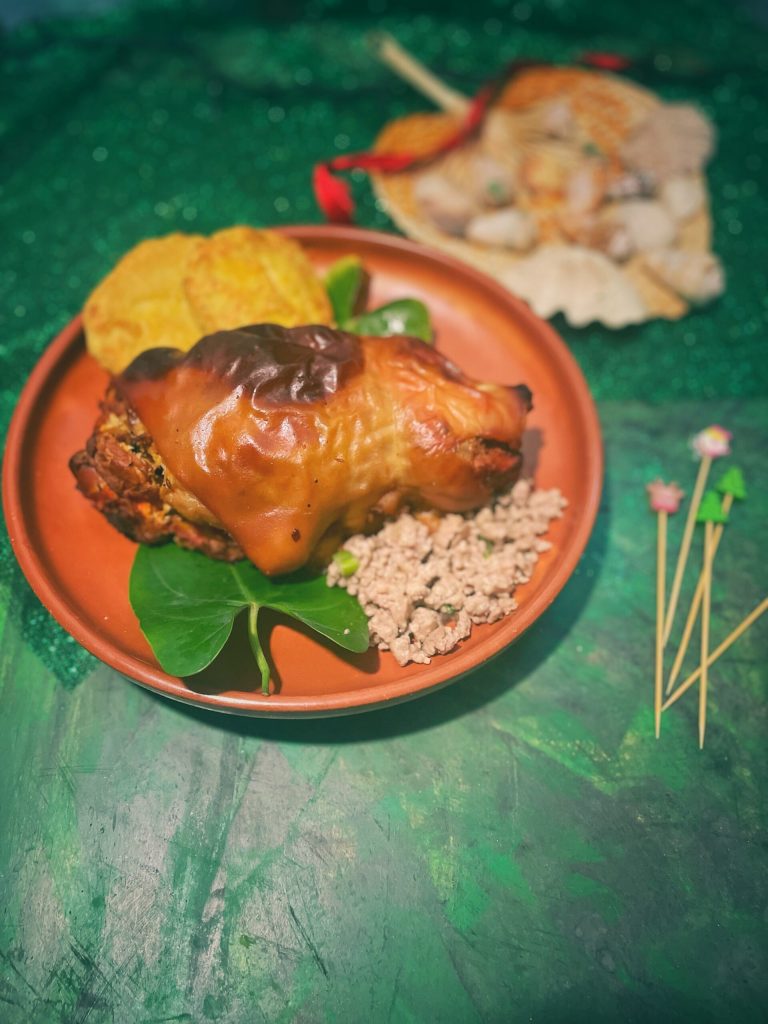
The Lechona Tolimense is a Colombian dish, originating from the Tolima region (particularly El Espinal), and of colonial origin, derived from the Castilian roast brought by the Spaniards.
Over time, the recipe has been adapted to local tastes and resources, incorporating ingredients such as yellow peas (arveja), widely used in Colombian cuisine.
Authentic Lechona Tolimense is a rich and festive dish with a simple stuffing of pork and yellow split peas inserted into the pig’s skin before the slow cooking.
Traditionally it is cooked in a brick oven or large oven at low temperature for 12-14 hours until the meat is extremely tender and the skin is very crispy.
In the traditional Tolimense version, in addition, a true marinade is not always provided, but rather a dry marinade with a mix of salt, pepper, garlic, cumin, and annatto.
The ‘rustic’ variants, or non-Tolimense, may add ingredients like rice or different spices, but the heart of the tradition remains long slow cooking, crispy skin, and flavorful pork and arveja stuffing.
The word lechona derives from the Spanish term lechón — a roasted suckling pig— but the Colombian version has a character all its own: a whole pig, hollowed out and stuffed with a rich filling of pork meat, spices, and arveja.
Lechona is so rooted in the local culture that in 2004 the municipality of El Espinal declared June 29 as ‘Día Nacional de la Lechona Tolimense.’
In Tolima, lechona is often served with white arepa and insulso (a sort of corn puree with a sweet or neutral flavor according to tradition), which accompanies the meat and balances the richness of the dish.
What follows is the home version adapted to a piece of pork under 4.4 lbs for 4 or 6 people.
Do not confuse with:
- Difficulty: Difficult
- Cost: Medium
- Rest time: 4 Hours
- Preparation time: 20 Minutes
- Cooking methods: Oven, Stove
- Cuisine: South American
- Seasonality: All seasons
Ingredients
- 3 lbs pork leg or shoulder (with skin)
- 0.35 oz coarse salt
- to taste pepper
- to taste cumin
- to taste annatto
- 10.6 oz yellow peas
- 3.5 oz onion
- 2 cloves garlic
- 10.6 oz ground pork
- to taste pork fat
- to taste salt
Tools
- 1 Kitchen twine
Steps
Dry Marinade
Mix salt, pepper, cumin, and annatto in a bowl.
Thoroughly rub the outside of the shoulder or other piece of meat (excluding the skin) with this mixture to flavor it. Let it marinate for 4 hours.Stuffing Preparation
Cook the split peas (soaked) in salted water until tender but not mushy.
In a pan, sauté onion and garlic with some pork fat.Add the ground pork (and possibly also the meat from the piece that will be stuffed), cumin, salt, and pepper, and cook until the meat is well browned.
Then add the cooked peas and mix with the meat sauté.
Assembly and Sealing
Open the meat on a surface (skin side down), create a pocket between the skin and the meat, and stuff with the filling in the internal space.
Roll the meat onto itself.Close with tight kitchen twine.
In Colombian tradition, whole pigs are sewn with skin, but in a home version, tying with twine is sufficient and more practical.
Cooking (home oven)
1. Slow phase: static oven at 350 °F for 3 hours, covered with foil.2. Browning: remove the foil and increase the temperature to 400 °F for 30 minutes to make the skin crispy.
(If you’re cooking a very large pig or the skin is thick, extend the final part by 30-60 minutes.)Serving
Let the lechona rest for 15-20 minutes before serving, creating a rectangle on the skin from which to extract the stuffing.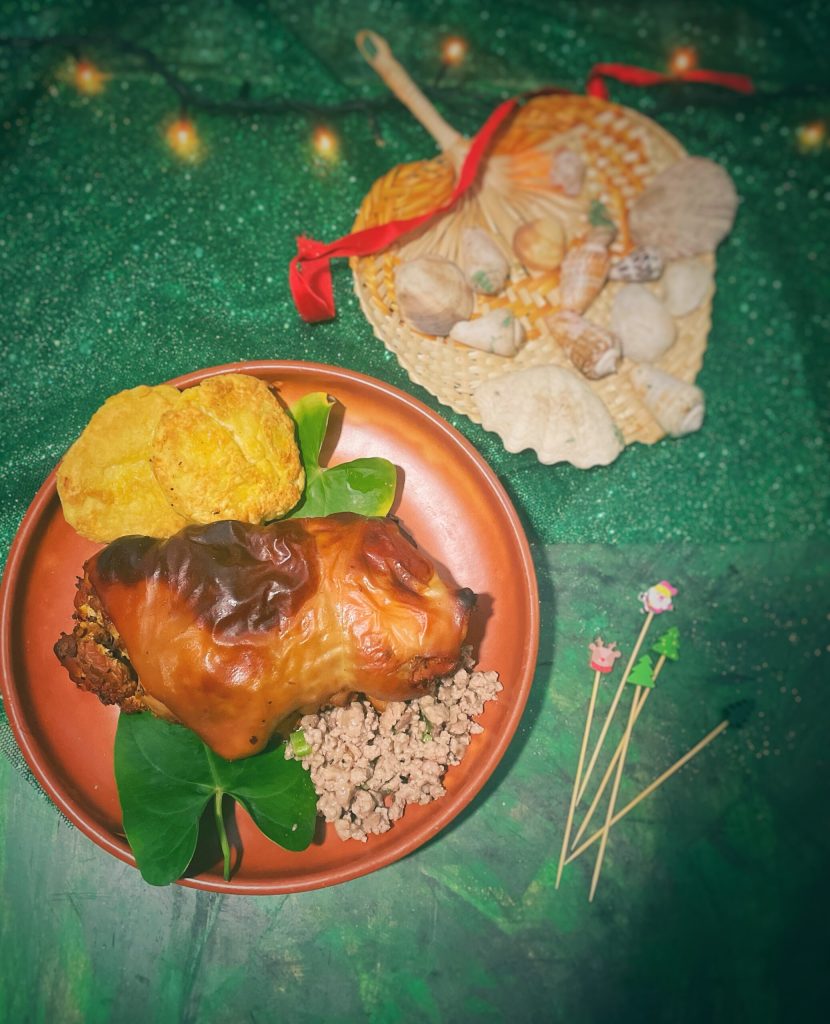
Lechona Tolimense in Italy
In Italy, to prepare Lechona Tolimense similar to the Colombian tradition, you can use these easily available pork cuts:
Pork shoulder (preferably with rind): has a good amount of meat and fat, ideal for a flavorful stuffing and a skin that can become crispy.
Pork shoulder (preferably with rind): has a good amount of meat and fat, ideal for a flavorful stuffing and a skin that can become crispy.
Pork leg with rind: less fatty than the shoulder but still suitable for long cooking and crispy skin.
Pork leg with rind: less fatty than the shoulder but still suitable for long cooking and crispy skin.
Pork belly with rind: if you want a flatter piece, rich in fat and with skin, perfect for a crispy crust.
Pork belly with rind: if you want a flatter piece, rich in fat and with skin, perfect for a crispy crust.
Alternatively, you can ask the butcher to prepare a unique piece of rind with meat (similar to the Colombian ‘cushion’), that is, a cut with the rind attached and a layer of meat underneath, possibly boneless for easy stuffing.
The key is to use a piece with the entire and thick rind because it is essential for the final crispiness.
The key is to use a piece with the entire and thick rind because it is essential for the final crispiness.
FAQ (Frequently Asked Questions)
How does Lechona Tolimense compare to non-Tolimense rustic variants?
Traditional Tolima: only pork and yellow pea stuffing, with very long cooking and carefully sewn skin.
District or urban variants: they may include cooked rice with the peas in the stuffing or various proportions of more versatile meat; these versions are found especially outside the Tolima region or in home-adapted kitchens.
