
Taiwan has a rather peculiar history as it was born in 1949 with the escape of General Chiang Kai-shek to the island of Formosa following the proclamation of the People’s Republic of China, resulting in political-military frictions in the following years.
A land of ancient Malay settlement and relatively late sinicization, then a base for European expansionism in the Far East, later a Japanese conquest, from 1949 Taiwan became the headquarters of the Kuomintang, the nationalist party, and the Chinese who did not accept the regime of People’s China.
Since then, both Taipei and Beijing have always claimed to be the only legitimate government of China.
The question is, but is Taiwan China?
Currently, Taiwan, the Penghu, Kinmen, the Matsu, and some other minor islands actually form the jurisdiction of the state under the official name of the Republic of China, but widely known in the West as “Taiwan”.
Even today, the Chinese government considers Taiwan its territory and refuses to establish relations with countries that have formal relations with Taiwan.
Only 23 countries officially recognize the state of Taiwan, while all others maintain informal relations with Taipei.
The game has been played over the years mainly from a political and military point of view, with Beijing, continuing to consider Taiwan a rebellious province, has always opposed its independence, declaring itself willing to invade the island in case Taipei chose to change the status quo.
For this reason, from the mainland region facing the island, China has deployed more than 1000 short-range ballistic missiles, as well as hundreds of thousands of soldiers ready to intervene in case of war.
Just like Hong Kong, I love rebels, especially those rebelling against China, so I consider Taiwan a separate state and included it in the “Around the World in 80 Dishes“.
The Taiwanese cuisine is often associated with the influences of the southern and central provinces of mainland China, particularly the province of Fujian, but influences from all over China can be easily found.
There is also a Japanese influence due to the period of Japanese rule on the island.
But Taiwan is mainly known for its street food and snacks, including: lu rou fan, a comfort food made with braised pork mainly in soy sauce and served spoonfuls over a bowl of steaming hot rice accompanied by hard-boiled eggs.
The pork is slowly cooked to make it tender and juicy, but the ingredient that makes the difference is the fried shallot in pork fat.
There is an ongoing debate whether this dish originated in Taiwan or Shandong, China.
Apparently, 滷肉 饭 and 鲁 肉 饭 are written differently, but both sound the same.
To help establish its own origin, the Taipei government launched a large campaign in 2011, distributing 1000 bowls of lu rou fan and claiming the ownership of the dish.
There are two versions depending on the type of pork used: minced or cubed.
In southern Taiwan, “Bah-sò (肉燥)” (minced pork) is used, but for this recipe, we are going north using the cubed version.
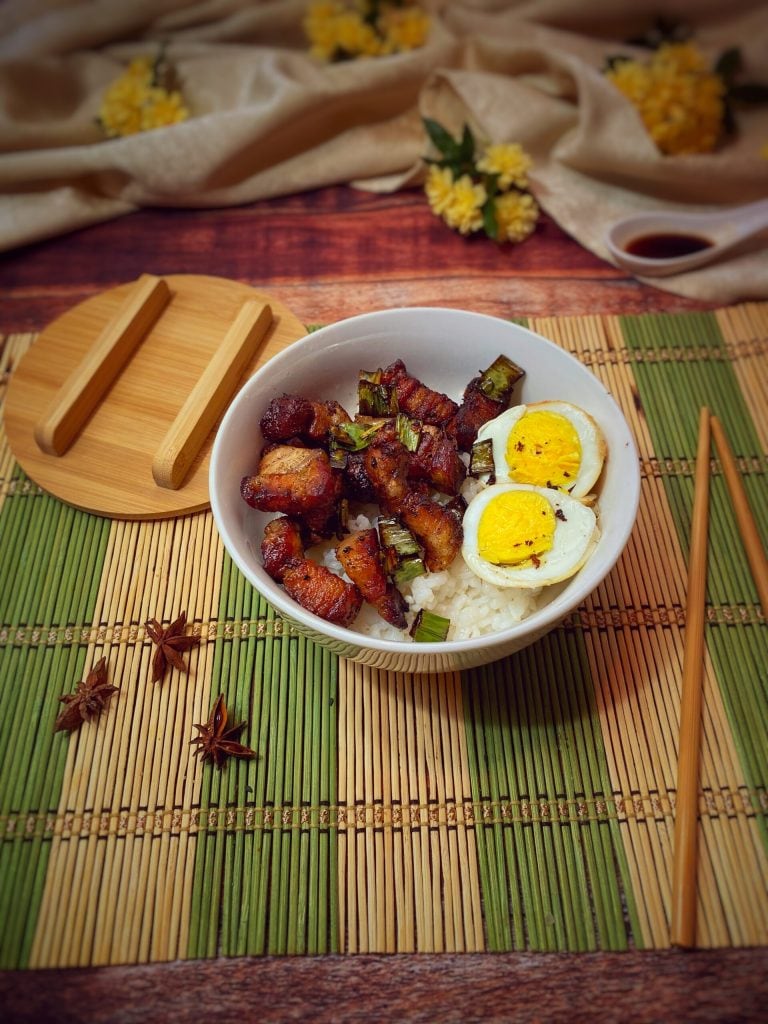
- Difficulty: Easy
- Cost: Economical
- Preparation time: 10 Minutes
- Portions: 2 people
- Cooking methods: Stovetop
- Cuisine: Chinese
Ingredients
- 1.3 lbs pork belly
- 4 shallots
- 2 cloves garlic
- 3 tablespoons soy sauce
- 1 tablespoon rice vinegar
- 1/4 cup water
- 4 hard-boiled eggs
- to taste spices (1 star anise, cinnamon, ginger, Five-spice powder)
- 1.1 cups steamed rice
Preparation
Cut the pork into cubes. Chop the shallot and mince the garlic.
Sauté the pork in its fat until golden. Remove the meat (leave the fat in the pan) and sauté the shallot and garlic over medium-high heat until lightly browned. Set the shallot aside.
Add the soy sauce, rice vinegar, dark soy sauce, water, and spices (star anise, 5-spice, cinnamon, and ginger) and the meat. Let it simmer for about 30-60 minutes or until tender.
Add the eggs in the last 10-15 minutes.
Turn the eggs occasionally so that both sides are evenly stewed.
Serve over steamed rice, garnish with the reserved shallot and eggs.
Affiliate Link #adv
Among the most famous Taiwanese directors in the world: Ang Lee
Among the most famous Taiwanese directors in the world: Ang Lee
