
If you try typing “Maakouda” into search engines, you’ll see a spread of golden fritters, the most beloved street food in Morocco. But if you step into a Jewish Tripolitan home, the Maakouda (or Maquda) isn’t a fried appetizer, but the queen of the Saturday table: a baked casserole made with meat and potatoes.
This dish symbolizes the journey of the Sephardim. Expelled from Spain in 1492, the Jews brought with them the technique of “Tapada” (from the Spanish tapar, to cover): the art of “covering” a tasty filling between two protective layers. Upon reaching Tripoli, this technique met the potato and desert spices, transforming into what many today simply call Tapada de Papas, but which Libyans know as the one and only Oven-Baked Maakouda.
Unlike the Anglo-Saxon Shepherd’s Pie or the South American Pastel, the Tripolitan version doesn’t include dairy (to comply with Kashrut laws) and is distinguished by two sacred elements:
Turmeric: which paints the mash a golden yellow.
Baharat: a mix of cinnamon and cloves that spices the minced meat, refreshed at the end with a splash of lemon, the true hallmark of Tripoli.
Thus is born a compact brick.
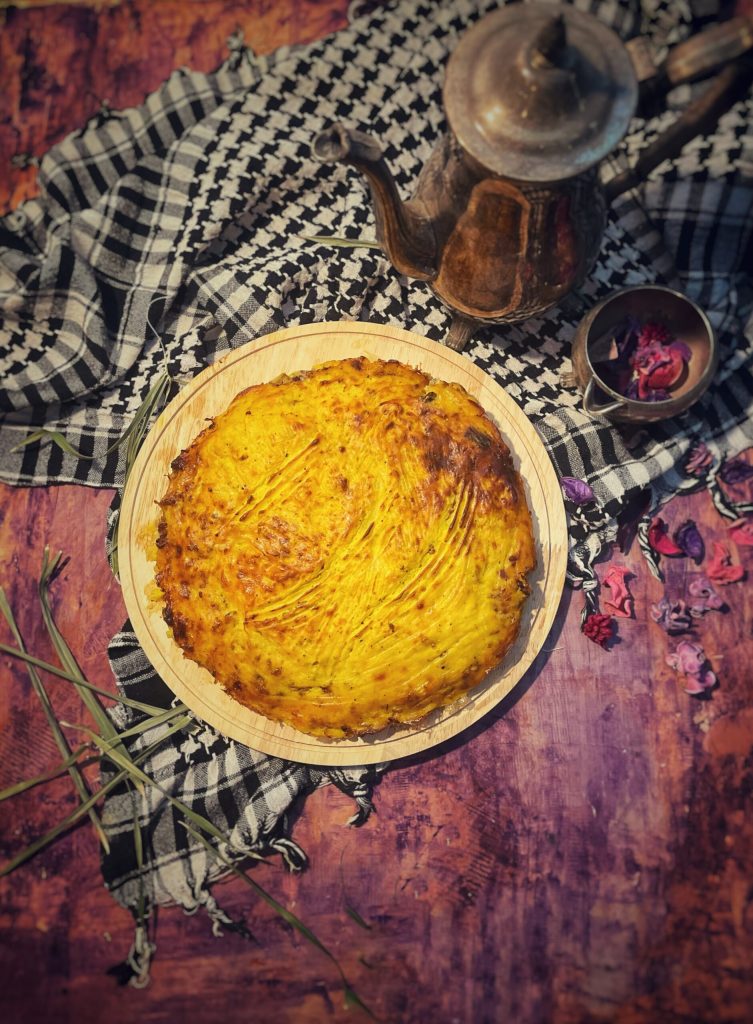
In Tripoli, this pie was often taken to bake in the city’s communal ovens on Friday afternoon, to be collected ready for Shabbat. The dark crust you see on top is the sign that the Maakouda is “alive”.
Not to be confused with:
- Difficulty: Easy
- Cost: Very cheap
- Preparation time: 15 Minutes
- Portions: 6 People
- Cooking methods: Stovetop, Oven, Electric oven
- Cuisine: Middle Eastern
- Seasonality: All seasons
Ingredients
- 2.2 lbs potatoes
- 2 eggs
- to taste ground turmeric
- to taste salt and pepper
- 1.1 lbs ground lamb or beef
- 2 onions
- to taste baharat
- to taste parsley
- to taste ground cinnamon
- 1 teaspoon lemon juice
- 1 egg yolk
Steps
1. Potato Preparation
Boil the whole potatoes with their skin. Once cooked, peel them and mash them with a potato masher while still hot. Let cool, then add the eggs, turmeric, salt, and pepper. Mix well until the mixture is smooth and a vibrant yellow.
2. Meat Filling
In a large skillet, sauté the chopped onion with a bit of oil. When transparent, add the ground meat. Break it apart well and let it cook until it changes color. At this point, add the Baharat, salt, and pepper. Off the heat, stir in chopped parsley, a pinch of cinnamon, and the lemon juice. Let it cool slightly.
3. Assembly (The “Cover”)
Base: Grease the baking dish (or line with parchment paper). Spread slightly more than half the potato mixture on the bottom and slightly up the sides.
Center: Evenly distribute the spiced meat filling over the potato base.
Cover: Top with the remaining potato mixture.
4. Decoration and Baking
With the tines of a fork, draw crisscross lines or waves on the surface (this will create crunchy zones). Brush with the beaten egg yolk.
Bake in a preheated oven at 350°F for about 45 minutes, until the surface is well browned with slightly dark edges.Before baking, don’t forget to score the surface with a fork: those small grooves will become dark and crispy, the hallmark of a perfectly made Maakouda.
Once ready, let it rest: it is served warm or at room temperature, cut into perfect bricks or diamonds, just as the Shabbat tradition dictates.
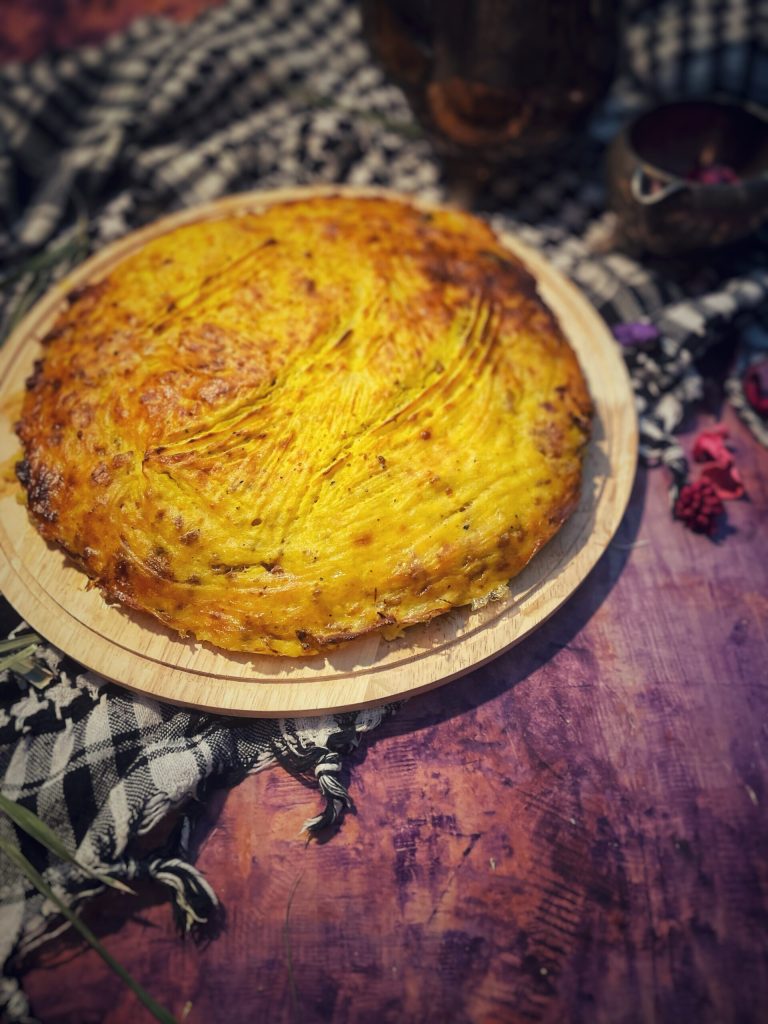
Attention: no raisins or olives, today we prepare the classic Tripolitan version!
For this classic Tripolitan version, we have removed any distractions: no raisins or olives, which belong to other traditions. The true character of this Maakouda lies in the balance between the sweetness of the stewed onion, the strength of the Baharat, and the acidic note of the lemon, which ‘lightens’ the palate and makes every bite unforgettable.
If you can’t find Baharath ready-made, mix equal parts of cinnamon, ground cloves, and black pepper
FAQ (Questions and Answers)
Can a parallel be drawn between Maakouda and Shepherd’s Pie?
The Tapada/Maakouda and the Shepherd’s Pie (or Hachis Parmentier in France) is technically perfect, but reveals fascinating cultural and religious differences.
1. The Structure (The Common DNA)
Both dishes follow the concept of the layered casserole: a base of flavorful meat protected by a “blanket” of potatoes. The historical goal was the same worldwide: to create a single dish, nutritious and capable of dignifying less prized cuts of meat or leftovers.
2. Crucial Differences
The Fats
Uses oil or animal fat (to respect Kashrut, meat and dairy are not mixed).
Uses plenty of butter and milk in the mash.
The Liquid
The meat is dry or bound with eggs and lemon.
The meat is immersed in a gravy (sauce) of broth and flour.
The Spices
Baharat, turmeric, cinnamon (warm and oriental).
Worcestershire sauce, thyme, rosemary (herbaceous).
The Crust
Brushed with egg for a shiny, firm effect.
Often sprinkled with cheese (Cheddar) for a stringy gratin.
3. The “Cover” vs The “Top”
In the Tapada: The potatoes encase the meat above and below (or are very firm due to the eggs). The result is almost a “cake” that you can cut into precise slices and even eat with your hands.
In the Shepherd’s Pie: The puree is only on top. Being very creamy (thanks to dairy), the dish is served with a spoon; it’s more of a covered stew than a solid pie.
4. An Etimological Curiosity
There’s a link in the names too:
Hachis Parmentier (France): Named after Antoine Parmentier, who promoted the potato in Europe to combat famines.
Tapada: As we’ve seen, emphasizes the act of “hiding” or “covering”.How can the different savory pies of the Maghreb be recognized?
The Tapada de Papas (The Sephardic Soul): Spread between Morocco and Libya, it is the pie of comfort. Here, there is no pastry: the casing is a soft and compact potato mash bound with eggs. It is recognized for its soft texture and dark, ridged browning done in the oven. It is the authentic taste of Jewish homes during Shabbat.
The Pastilla or B’stilla (Moroccan Elegance): It is the queen of banquets, born from the meeting between Andalusia and Morocco. Unlike the Tapada, it is encased in thin sheets of phyllo dough (ouarka). Its unmistakable trait? The extreme sweet-salty contrast: a filling of chicken and almonds covered with a shower of powdered sugar and cinnamon.
The Tajine Malsouka (The Tunisian Giant): In Tunisia, the term Tajine doesn’t indicate a stew, but this rich pie. The casing is the malsouka dough (a crispy sheet), but the heart is very different: a very dense mixture of whole eggs, meat, and cheese. The result is a sort of high and majestic frittata protected by a crunchy shell.
The Popular Maakouda (Moroccan Street Food): If in the rest of the Maghreb you ask for a Maakouda, you will most likely receive single potato fritters. Unlike the Tripolitan baked version, this one doesn’t have a meat “heart” or a casing: it’s a unique dough of potatoes and flavors, usually fried and eaten on the go as a snack.
