
Madeleines are quintessential literary desserts, immortalized and instantly synonymous with memories, thanks to Proust and his “A la recherche du temps perdu“, where the protagonist is overwhelmed by childhood memories after tasting a madeleine dipped in tea.
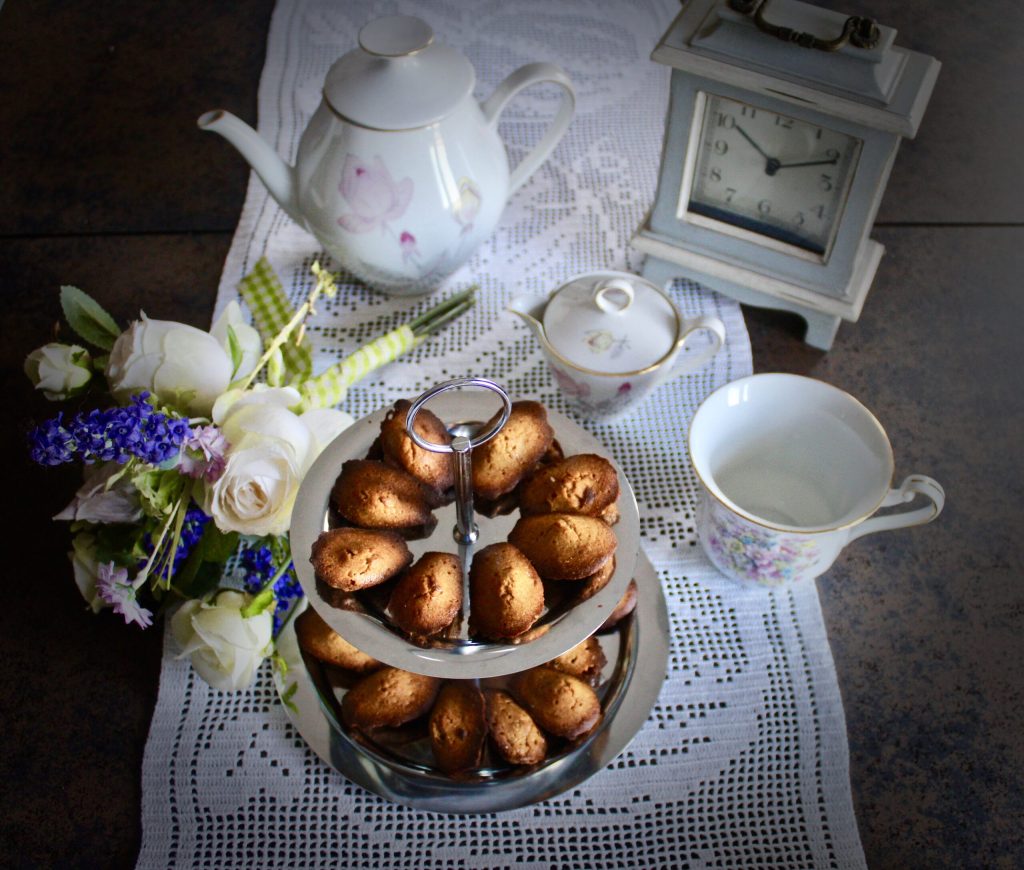
Soft, shell-shaped typical of Lorraine, in the northeast of France, with a characteristic hump that marks their success.
I remember that upon first reading the text, still in high school, they immediately struck me, and when I think of a French dessert, Proust and his madeleines immediately come to mind.
The history of madeleines is wrapped in French tradition and has several legendary versions. Their origin dates back to the 18th century.
The most well-known version of the legend tells that Madeleine Paulmier, a young maid in the service of Stanislas Leszczynski, Duke of Lorraine and father-in-law of King Louis XV, invented these pastries in 1755.
The duke’s cook had abandoned the kitchen, and Madeleine prepared a grandmother’s recipe with eggs, butter, sugar, and flour, baked in shell molds.
Stanislas was so impressed that he named them after the girl: Madeleines.
• From the court of Lorraine, the madeleines arrived in Versailles and then became famous throughout France.
By the 19th century, they were already part of French pastry tradition, often served with tea or coffee.
In the video, a gluten-free and savory version.
- Difficulty: Easy
- Cost: Very affordable
- Rest time: 3 Hours
- Preparation time: 5 Minutes
- Portions: 20/24 pieces
- Cooking methods: Electric oven
- Cuisine: French
- Seasonality: All seasons
Here is the excerpt from “In Search of Lost Time. Swann’s Way” where Les madeleines are mentioned
One winter evening, just as I had gotten home, my mother, noticing I was cold, suggested I have some tea, which was unusual for me.
At first I refused, then, for some unknown reason, changed my mind. She sent for one of those short, plump cakes called madeleine, which look like the fluted shell of a scallop.
And shortly afterward, feeling sad from the dreary day and the prospect of a painful tomorrow, I mechanically brought to my lips a spoonful of the tea in which I had soaked a piece of madeleine.
But as soon as the sip mixed with the crumbs touched my palate, I started, attentive to the extraordinary phenomenon taking place in me.
A delicious pleasure had invaded me, isolated, without a notion of its cause. And immediately, it made the vicissitudes indifferent, the reversals harmless, the brevity of life illusory… I no longer felt mediocre, contingent, mortal.
Where could that violent joy have come from? I felt it was connected with the taste of the tea and the madeleine. But it surpassed it infinitely, it must not have been of the same nature.
Where did it come from? What did it mean? Where to seize it? I take a second sip, finding nothing more in it than the first, a third that brings me even less than the second.
As time to stop, the drink’s virtue seems to diminish. Clearly, the truth I seek is not in it, but in me.
It awakened it, but doesn’t know it, and can only repeat indefinitely, with ever-increasing force, that same testimony I cannot interpret and would like at least to be able to demand and find intact, at my disposal (and right now), for a decisive explanation. I put down the cup and turn to my spirit.
It is up to him to find the truth… I mentally retrace to the moment I took the first spoonful of tea. I find the same state, without any new clarity. I ask my spirit for one more effort… but I notice the fatigue of my spirit which cannot succeed; then I force it to take the distraction it was denied, to think of something else, to regain strength before a supreme attempt.
Then, for the second time, cleared in front of him, I bring back the still-fresh taste of that first sip and feel in me the tremor of something moving, wanting to rise, that has unmoored from great depth; I don’t know what it is, but it rises, slowly; I sense the resistance and hear the noise of traversed spaces…
Suddenly the memory is before me. The taste was that of the piece of madeleine that in Combray, on Sunday mornings, when I went to say good morning to her in her room, Aunt Leonie offered me after dipping it in her infusion of tea or lime blossom.
- 4.4 oz butter
- 4.4 oz sugar
- 5.3 oz flour
- 1 tsp baking powder for gluten-free pastries
- 2 eggs
- to taste almond flavoring
- 1 lemon
- to taste salt
Tools
- 1 Mold for Madeleine
Preparation
Melt the butter in a saucepan and allow it to cool slightly.
Beat the eggs with the sugar until you have a light and frothy mixture.
While mixing, add the sifted flour with the baking powder, slowly add the butter, the almond flavoring, and the grated lemon zest.
Cover with plastic wrap and let it rest in the fridge for at least 3 hours, better if 12 hours.
Preheat the oven to 428°F, remove the batter from the refrigerator and distribute it into the shells, filling them about 2/3, bake for 4 minutes, then lower to 356°F and continue for another 5-6 minutes.
Remove from the oven, immediately take out of the mold, and let them cool.
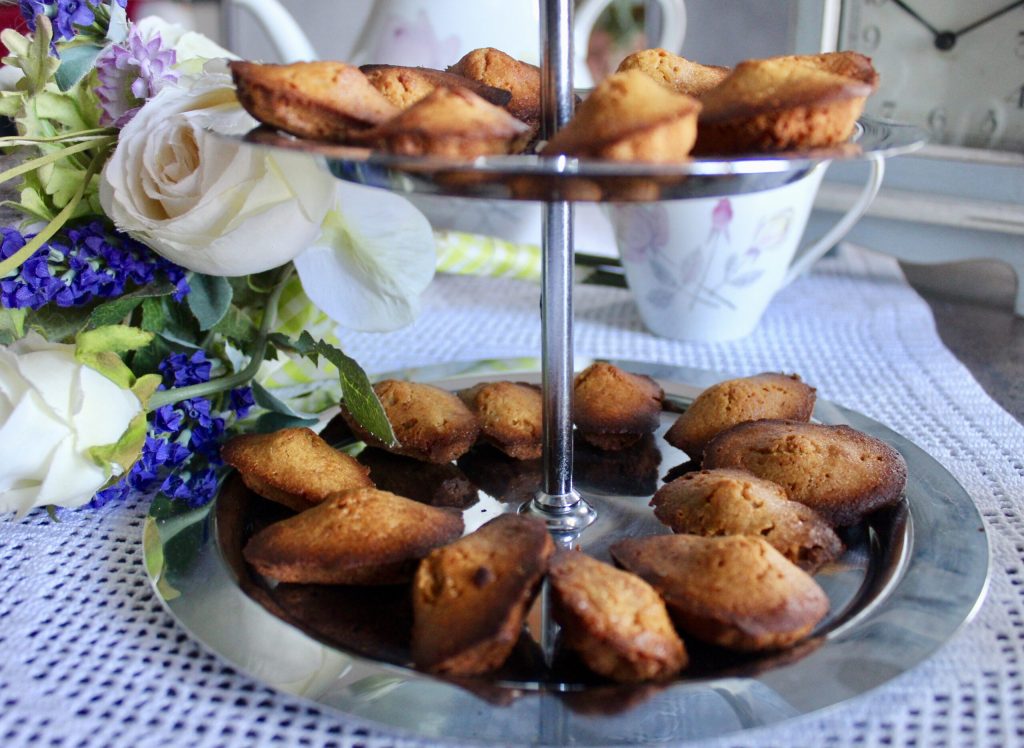
Madeleines post on Instagram @viaggiandomangiando80:
During the months of preparing new recipes for the column “Around the World in 20 Desserts”, I posted the preparations on the Blog’s Instagram page, to get “feedback” from my followers, whom I thank.
Here you can find the post with les madeleines.
Here you can find the post with les madeleines.
Here you can find the post with les madeleines.
If you haven’t yet, read Proust’s masterpiece, here’s the volume from which the excerpt is taken:
