
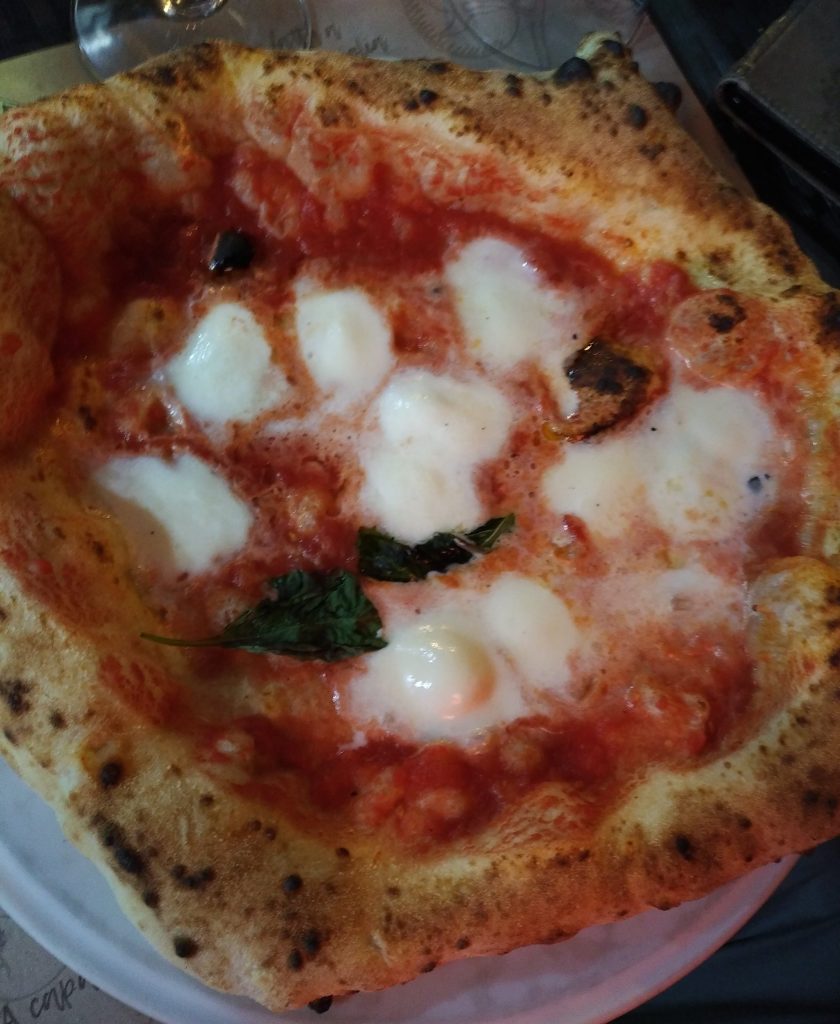
As you can see in the video HERE made during our vacation in Naples in October 2020, I too managed to eat the wonderful Neapolitan pizza, because at Piazzaioli Veraci Toledo I found it with gluten-free dough.
I really love Neapolitan pizza, because it’s soft yet crispy at the same time, well-topped, with its high edges, because the ingredients for the topping are of excellent quality, and because Neapolitans have that extra touch that makes the difference.
Because Neapolitan pizza is not just any pizza.
To be such, it must have precise characteristics:
– the flour must be 0 or 00 and there should be no oil in the dough;
– the diameter should not exceed 14 inches;
– the rising time should be min 8 hours – max 24 hours;
– it should have a raised edge (the famous crust), puffy and free of burns about 0.5-0.8 inches, and in the center, the thickness should not exceed 0.1 inches;
– it should not be burnt underneath;
– it should fold like a wallet;
– it should be cooked in a wood-fired oven at about 842 °F for about 60-90 seconds.
Officially recognized in 2010 as a traditional specialty guaranteed by the European Union and in 2017 by UNESCO as an intangible cultural heritage of humanity!
It was born around 1720 when the first discs of dough topped with tomato appeared, but only in 1889 was the most famous of the Neapolitan pizzas: the Margherita pizza born.
In the strictest tradition of Neapolitan cuisine, only two variants are allowed regarding the topping:
Pizza marinara: with San Marzano tomatoes, garlic, oregano, and oil.
Pizza Margherita: with San Marzano tomatoes, fiordilatte mozzarella, or diced buffalo mozzarella from Campania, basil, and oil.
Here follows the Margherita pizza recipe according to the International Regulations of the Verace Pizza Napoletana Association, which is the set of codified rules passed orally from generations of Neapolitan pizzaioli, who handed down its secrets from father to son.
Legend has it that in 1889, Queen Margherita of Savoy appreciated it so much that the pizzaiolo who made it for her, Raffaele Esposito, decided to rename it after her.
If you don’t have a wood-fired oven, you can use a fan oven at maximum temperature and bake it for about 10-15 minutes.
Or you can bake it using a baking stone, grill function, lower part of the oven, maximum temperature, for 10 minutes, but be careful as the cooking might not be uniform.
- Difficulty: Medium
- Cost: Cheap
- Rest time: 8 Minutes
- Preparation time: 5 Minutes
- Portions: 6 people
- Cooking methods: Oven
- Cuisine: Italian
Ingredients
- 4 lbs flour 0 or 00
- 4.2 cups water
- oz salt
- 0.1 oz fresh baker's yeast (or 0.035 oz dry yeast)
- 28 oz buffalo mozzarella slices (or fiordilatte cut into strips)
- 21 San Marzano tomatoes cut into wedges (or peeled tomatoes cut into pieces)
- basil
- to taste extra virgin olive oil
Preparation
For kneading, you can use either hands or a double-speed mixer with diving arms or a fork mixer.
Pour one liter of water (68-72°F) into the mixer, dissolve a quantity of sea salt between 1.4 and 2.1 oz, add 10% of the flour relative to the total amount required, then dissolve the yeast and add it to the mixture, turn on the mixer and gradually add the rest of the flour until the desired consistency is reached.
Cover the container with a clean kitchen towel and store it in a warm place.
The rising should be a minimum of 8 hours, a maximum of 24 hours in total, so the first rise must be at least 2-3 hours (it should double in size).
After the time deemed necessary for the dough to settle and rest, proceed to the shaping of the dough ball.
The dough is shaped (cut) into balls with a technique that resembles making mozzarella (mozzatura). The dough balls should weigh between 7-10 oz.
A second rise occurs in food trays for about 5-6 hours.
Spread the pizza on a previously floured work surface, moving from the center outward.
Top the pizza with the ingredients, drizzling a circular motion of extra virgin olive oil.
The baking in a wood-fired oven should have reached a temperature of about 806-896°F. With these temperatures, it’s enough to insert the pizza for 60-90 seconds, where the pizza will cook uniformly around the circumference.
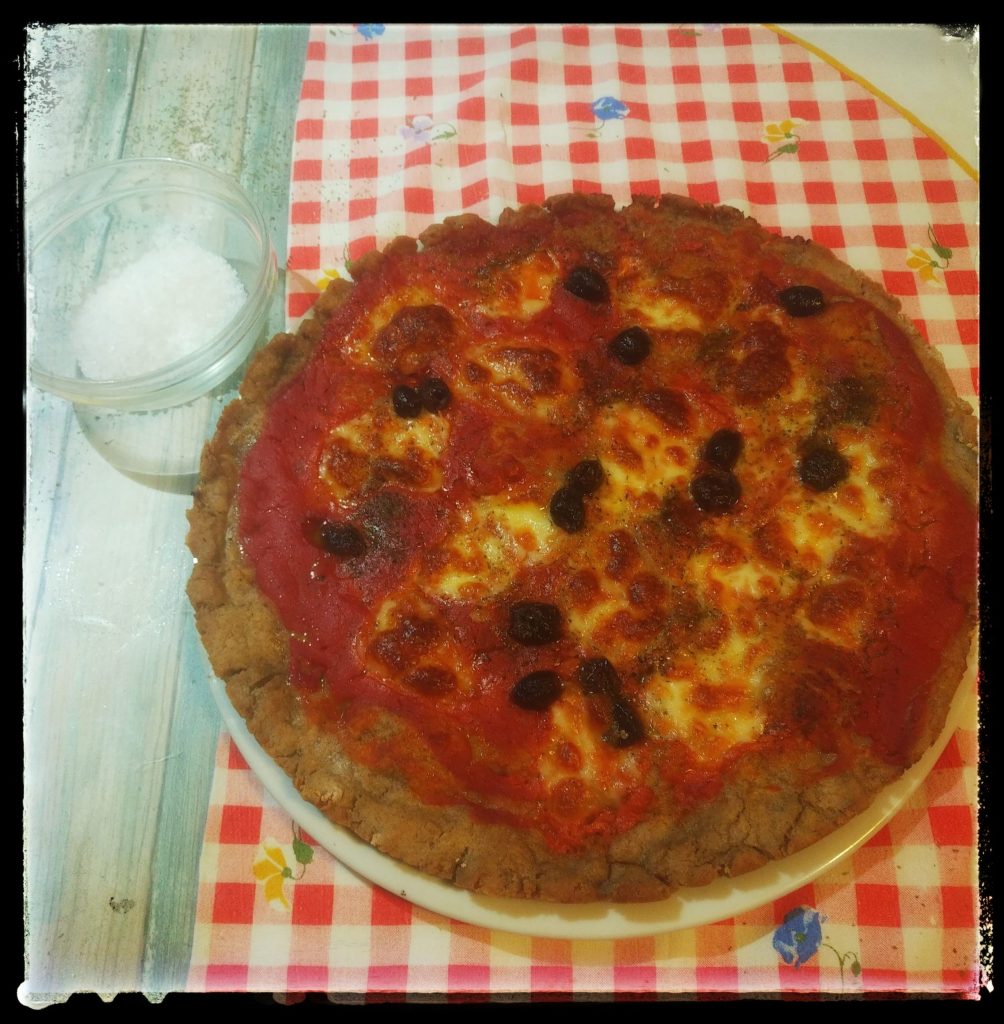
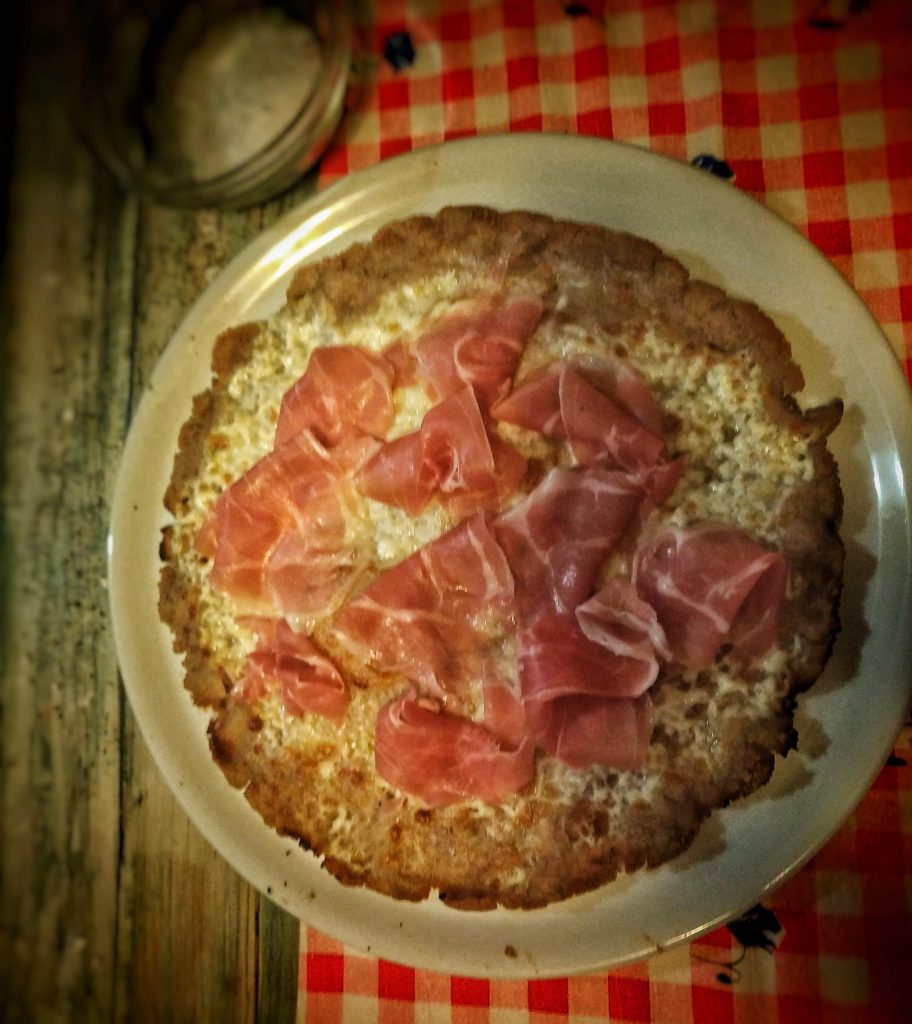
I also tried making a GLUTEN-FREE version, with buckwheat flour and sorghum flour, topped like a Margherita pizza and with lactose-free stracchino and prosciutto crudo.
Here are the ingredients. The process is the same, but don’t expect a high and soft pizza, because it will be low and crunchy and not particularly easy to handle.
2.2 lbs buckwheat flour
15.5 oz sorghum flour
11.3 oz starch (corn, potato, or rice)
1/2 teaspoon of xanthan or guar gum
1.4-2.1 oz salt
0.2 oz fresh baker’s yeast
To prepare pizza like in a pizzeria.. Pizza baking stone
To prepare pizza like in a pizzeria.. Pizza baking stone
A special dedication from me…
Difference between Neapolitan and Roman pizza:
Roman Pizza is especially common in Central Italy. Thin and crispy, aptly described as “scrocchiarella” with an onomatopoeic adjective in the Roman dialect.
In the Roman dough, the percentage of water varies between 58% and 65%, it uses extra virgin olive oil in the dough, and it is customary to use a rolling pin for a more uniform and flat spread and more homogeneous cooking.
The Roman pizza dough is usually allowed to rise for a few hours in the refrigerator and then left to rest at room temperature, continuing to increase in volume.
The dough should be cut and shaped into balls weighing between 5.3 oz and 6.3 oz.
Finally, Roman pizza has a decidedly crunchy border and is cooked at 752°F.
Finally, Roman pizza has a decidedly crunchy border and is cooked at 752°F.
This is my version with Magic Cooker lid cooking
This is my version with Magic Cooker lid cooking
Did you know that thanks to the ability of the Kamado to reach high temperatures, it is possible to cook pizza with a crispy crust and authentic flavor, similar to that of a wood-fired oven?
Prepare the Kamado for a direct high-temperature cooking, heating it to about 572-662°F.
Spread the tomato puree on the dough, then add the sliced mozzarella and a drizzle of olive oil.
Place the pizza on the baking stone or directly on the grill. Cook for about 5-7 minutes or until the crust is golden and crispy.
Before serving, add fresh basil leaves.
Before serving, add fresh basil leaves.
During another trip to Naples, this time in April 2025, I ate another excellent gluten-free Neapolitan pizza … watch the video …
