
The sfogliatella frolla, filled with semolina, ricotta, and candied fruit, originates from a secular evolution of a monastic secret from the 17th century
The history of the sfogliatella frolla is closely tied to its “sister” riccia and has its roots in a mix of monastic ingenuity and commercial intuition.
It all begins at the Santa Rosa Monastery, between Amalfi and Positano. Legend has it that the cook nun, having leftover semolina cooked in milk, decided not to waste it.
She added ricotta, dried fruits, and lemon liqueur, creating a creamy filling that she inserted between two sheets of dough shaped like a monk’s hood. Thus, the Santarosa was born, the ancestor of the sfogliatella, enriched on top with custard and black cherry.
For over a century, the recipe remained secret within the convent walls. In 1818, the Neapolitan innkeeper Pasquale Pintauro came into possession of the original recipe. Pintauro had two great insights:
he transformed his tavern on via Toledo into a pastry workshop.
He simplified the dessert: he eliminated the top cream and black cherry, thinned the pastry, and created the classic shell shape.
While the “riccia” became famous for its showy crispiness, the sfogliatella frolla was born as a more practical and substantial variant.
Instead of the complex and laborious “pulled” puff pastry, shortcrust pastry was used, easier to produce on a large scale and capable of containing a larger amount of filling without breaking.
Today, walking through Naples, you can still find the historic Pintauro Pastry Shop on via Toledo, where the tradition of both variants continues since the 19th century.
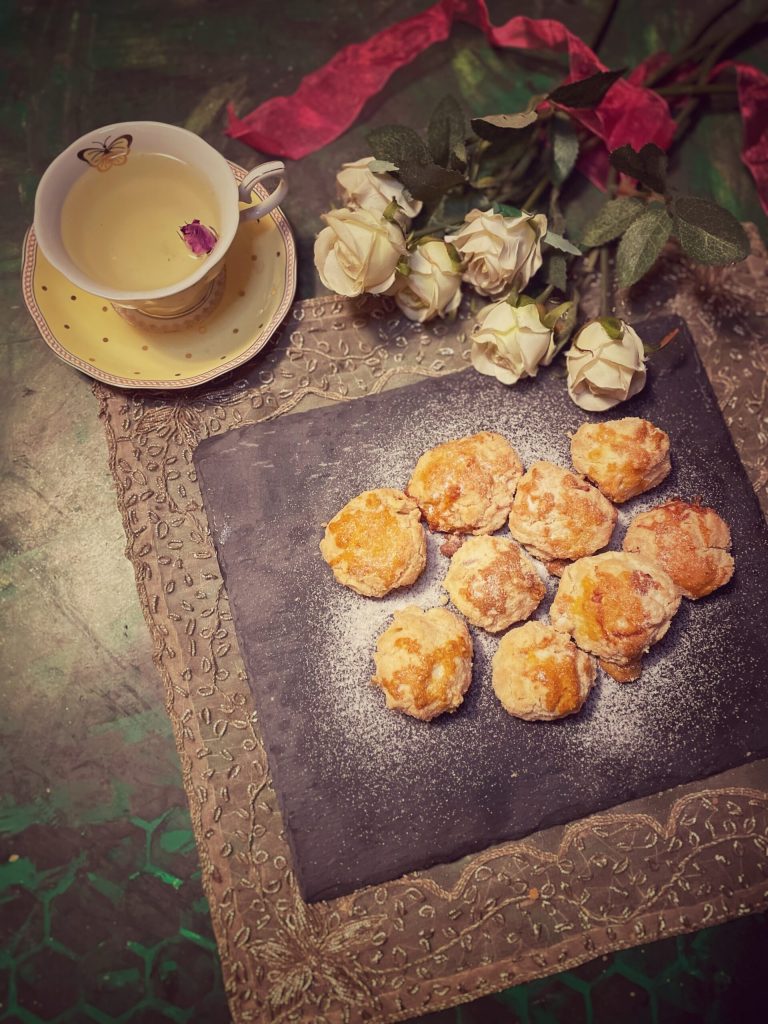
My version is a gluten-free sfogliatella frolla with a mix of gluten-free flours and the use of rice semolina.
- Difficulty: Medium
- Cost: Cheap
- Rest time: 9 Hours
- Preparation time: 15 Minutes
- Portions: 10 Pieces
- Cooking methods: Stovetop, Oven
- Cuisine: Italian
- Seasonality: All seasons
Ingredients for the gluten-free sfogliatella frolla:
- 300 g gluten-free flour mix
- 125 g lard (or high-quality butter)
- 100 g powdered sugar
- 1 egg
- 1 egg yolk
- 1.5 g baking ammonia
- 1 pinch salt
- 75 g rice semolina
- 300 ml water
- 120 g sheep ricotta
- 120 g sugar
- 60 g gluten-free candied fruit (Orange, Citron, and Cocozzata finely chopped)
- to taste flavors (Cinnamon, natural vanilla extract, orange blossom water, and a tablespoon of Strega Liqueur)
Steps
Cooking and Resting: Cook the rice semolina in salted water for 5-6 minutes. Transfer it to a bowl, cover with cling film in contact, and leave in the fridge overnight (at least 8 hours). This step is vital: the rice semolina must “gelatinize” completely to avoid a grainy texture.
The next day, sift the ricotta with the sugar. Work the cold semolina (which will be firm) with a fork or hand blender to make it creamy before adding it to the ricotta. Add the candied fruit and flavors only at the end.
The Shortcrust: Quickly work the flour and butter to obtain a sandy mixture. Add sugar and eggs, knead until smooth. Let rest in the fridge for at least 1 hour (crucial for gluten-free handling).
The Filling: Combine the sifted ricotta with the semolina, add sugar, candied fruit, and flavors. Mix well until a homogeneous cream is obtained.Assembly: Roll out the shortcrust (about 4-5mm), cut out circles, place a generous spoonful of filling in the center, and close like a semi-spherical bundle, sealing the edges well.
Use circles about 3-4 inches in diameter. The finished sfogliatella will have the typical “dome” appearance and will weigh about 4.5-5.3 ounces.
Baking: Brush with egg yolk and bake at 356°F convection for about 20-25 minutes until golden.
Curiosities
Although the riccia is considered the aesthetic icon of Naples worldwide, locally the frolla enjoys enormous popularity: about 30% of sfogliatelle sold in Naples are frolla, appreciated for the greater perceived amount of filling.
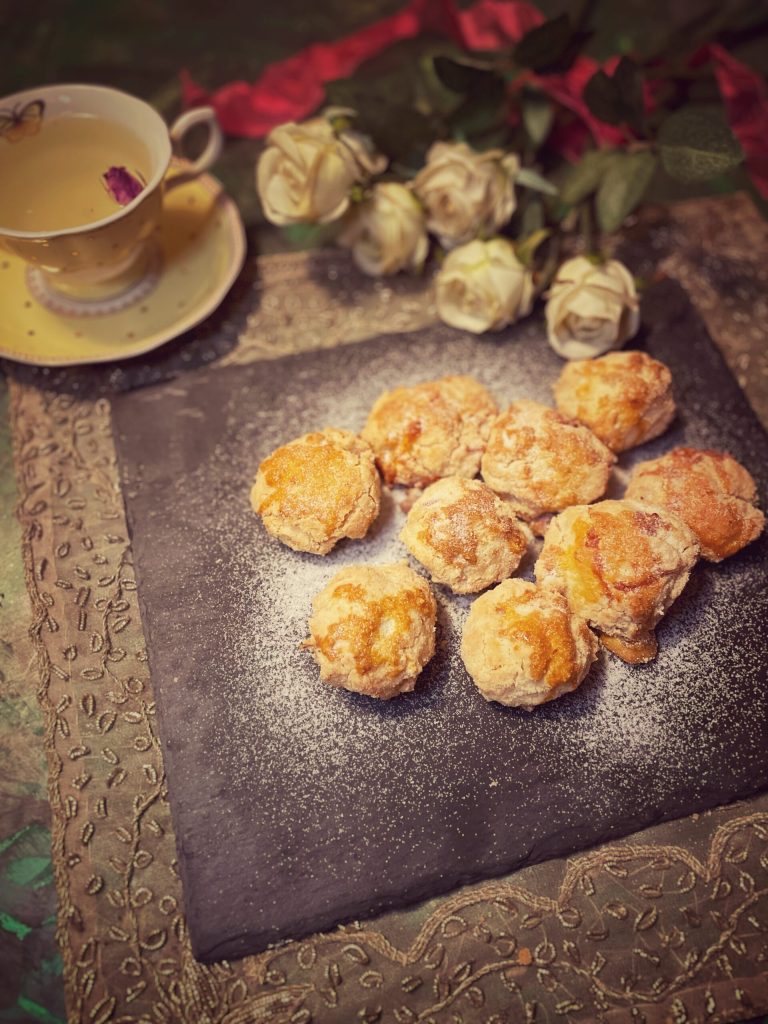
It is often served warm with a final dusting of powdered sugar.
It is often served warm with a final dusting of powdered sugar.
In the deeper and “academic” tradition of Neapolitan pastry, candied fruits are not limited to just orange.
The original historical recipe indeed includes a mix of orange and citron cubes, to which cocozzata (candied pumpkin) was often added.
The original historical recipe indeed includes a mix of orange and citron cubes, to which cocozzata (candied pumpkin) was often added.
Orange dominates for its citrusy aroma, but citron is essential to provide a slightly more bitter and crunchy note, while cocozzata was used in historical shops for its ability to maintain the internal moisture of the filling, making it less dry after cooking.
Today, for practicality, many pastry shops use only orange, but high-end sfogliatella (like Pintauro’s or those of great pastry families) still maintains the mix.
FAQ (Frequently Asked Questions)
Does the traditional frolla filling require the semolina to be cooked in milk or water?
Traditionally, the classic Neapolitan recipe calls for cooking the semolina in
water only with a pinch of salt.
This choice is not accidental: using water makes the mixture more neutral and lighter, allowing the flavors of sheep ricotta, cinnamon, and candied orange to emerge without the cover of the lactic flavor of cooked milk.
However, there are two schools of thought:
Traditional (Water): Ensures longer preservation and a flavor more faithful to the origins of historic pastry shops.
Homemade/Modern (Milk): Many prefer to use milk (or half water and half milk) for an even creamier, sweeter, and rounder filling on the palate.
For the gluten-free version, water is often the best choice because rice semolina tends to absorb liquids differently from wheat and water helps maintain a less “sticky” consistency.
