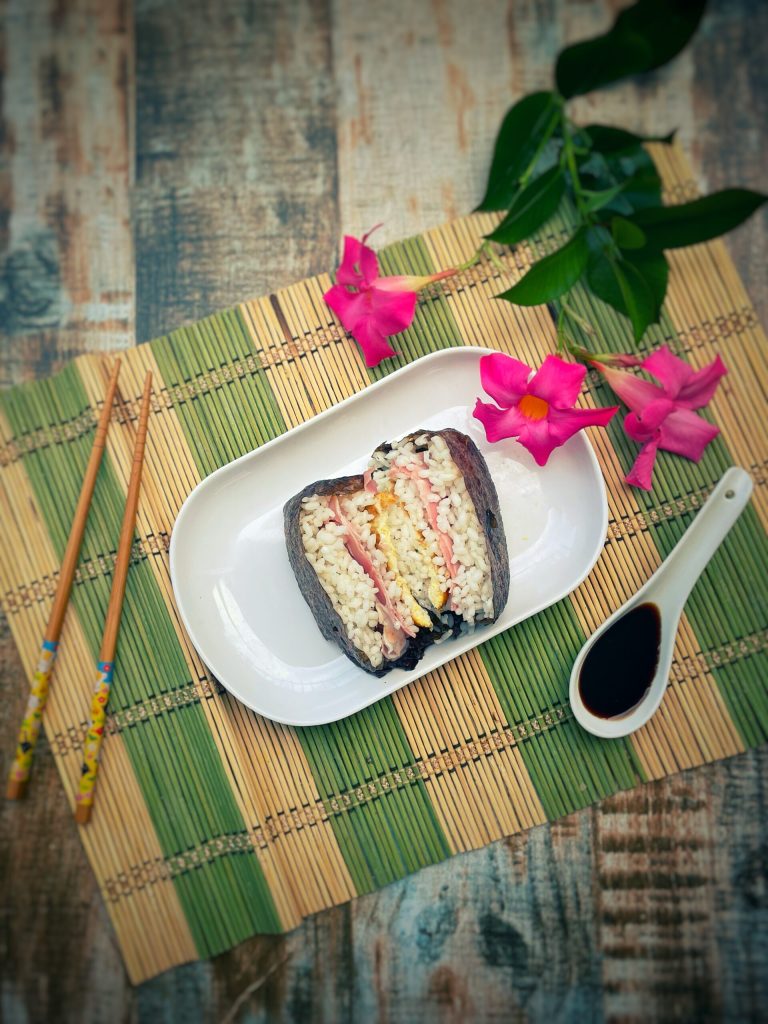
The Japanese are known for being very creative in the kitchen. They have a remarkable ability to adapt Western recipes to their cuisine.
But not vice versa.
They cherish their traditions.
So, after the katsu-sando, a sort of Japanese club sandwich, here comes the sushi-sandwich, or the Onigirazu おにぎらず, a culinary evolution of the famous Onigiri (the classic stuffed rice ball).
It is essentially a sandwich in which rice is used instead of bread.
The filling can be of any type.
To hold the structure together, a sheet of nori seaweed is used.
Onigirazu first appeared in Japanese cuisine around the mid-1980s in a manga series titled “Cooking Papa“.
You can be creative with the fillings; I opted to combine another Japanese recipe from the blog, the tamagoyaki, with grilled chicken breast, lettuce, and Teriyaki sauce.

- Difficulty: Medium
- Cost: Cheap
- Rest time: 20 Minutes
- Preparation time: 15 Minutes
- Portions: 2 servings
- Cooking methods: Steaming
- Cuisine: Japanese
Ingredients
- 2 nori seaweed
- 7 oz sushi rice
- tamagoyaki
- 7 oz chicken breast
- to taste lettuce
- to taste teriyaki sauce
Preparation
Prepare the rice gohan: rinse the rice thoroughly up to 10 times until the washing water is clean and clear. Let the washed rice dry in a colander for 15 minutes.
Add water, cover, and bring to a boil; as soon as the water boils, turn the heat to low and, without lifting the lid, cook for 15 minutes.
Transfer the rice to a large bowl, lightly salt it, and mix until it becomes lukewarm.
Grill the chicken breast and slice it thinly into strips.
Prepare the tamagoyaki following the recipe here.
Cover the work surface with plastic wrap, then place a nori seaweed sheet with the rough side facing up.
Take about 1/2 cup of sushi rice and shape it into a square in the center of the seaweed. Wet your hands before handling the rice so it won’t stick to your fingers.
Proceed layer by layer, without overdoing the quantities.
Insert the filling of tamagoyaki, grilled chicken, lettuce, and Teriyaki sauce, then fold the nori seaweed towards the center and use the plastic wrap to tie it tightly.
After letting it rest for at least 20 minutes, cut it. The best way to do this is with forward and backward motions, applying very little pressure with a sharp, non-serrated knife (we can also wet the blade to prevent rice from sticking).
Cut only in half, either horizontally/vertically or diagonally, according to preference, preferably while still wrapped in plastic.