
Pancit is a generic term referring to various traditional noodle dishes in Filipino cuisine.
There are numerous types of pancit, often named based on the noodles used, cooking method, place of origin, diameter, or ingredients.
In the case of Pancit palabok, it refers to the yellow corn starch noodles (sometimes replaced with bihon, rice noodles).
It is topped with a shrimp-based sauce with annatto seeds, shrimp, crushed or ground Filipino chicharon, tinapa flakes (smoked fish), hard-boiled eggs, and scallions.
Almost all pancit dishes are also served with calamansi, intended to be squeezed over the noodles as the juice adds a tangy acidity.
The most common toppings are:
smoked fish flakes (tinapa), fried garlic, Filipino chicharon*, shallots, black pepper, l’okoy (glutinous rice fritters), kinchay (Chinese parsley), peanuts, and sliced hard-boiled eggs.
Pancit can be enjoyed on its own or accompanied by rice, bread, or steamed rice cakes.

- Difficulty: Easy
- Cost: Economical
- Preparation time: 20 Minutes
- Portions: 2 people
- Cooking methods: Stovetop
- Cuisine: Filipino
- Seasonality: All seasons
Ingredients
- 10.5 oz noodles (corn starch)
- as needed shrimp
- 7 oz chicharon
- 1 clove garlic
- 1/2 onion
- 1.2 oz cornstarch
- 1 tsp annatto
- 4 hard-boiled eggs
- 2 calamansi (or lemons)
- as needed tinapa
- as needed vegetable oil
Steps
Boil the shrimp in 1.6 cups of water (about 375 ml). Do not discard the water, add the cleaned shrimp shells and simmer to make a broth after straining.
Prepare the chicharon or use ready-made ones:
Boiling: Cook pork rind in water with salt, pepper, and garlic until tender.
Drying: Drain the skin and let it air dry for several hours or in a low-temperature oven until hard and almost “woody”.
Double Frying: Fry first at medium temperature, let rest and then fry again in hot oil (374°F) to puff it up instantly.In a pan, add a drizzle of oil, onion, shrimp broth, annatto, and cornstarch. Add the meat (if chicharon is not available, you can use ground pork). A thick sauce should form.
Cook the corn starch noodles.
Serve on a flat plate with a noodle base, add the sauce with the meat on top, garnish with shrimp, chicharon powder, smoked fish flakes (I omitted it), and scallions.
Serve with hard-boiled eggs and calamansi (or lemon) to squeeze over the meat.
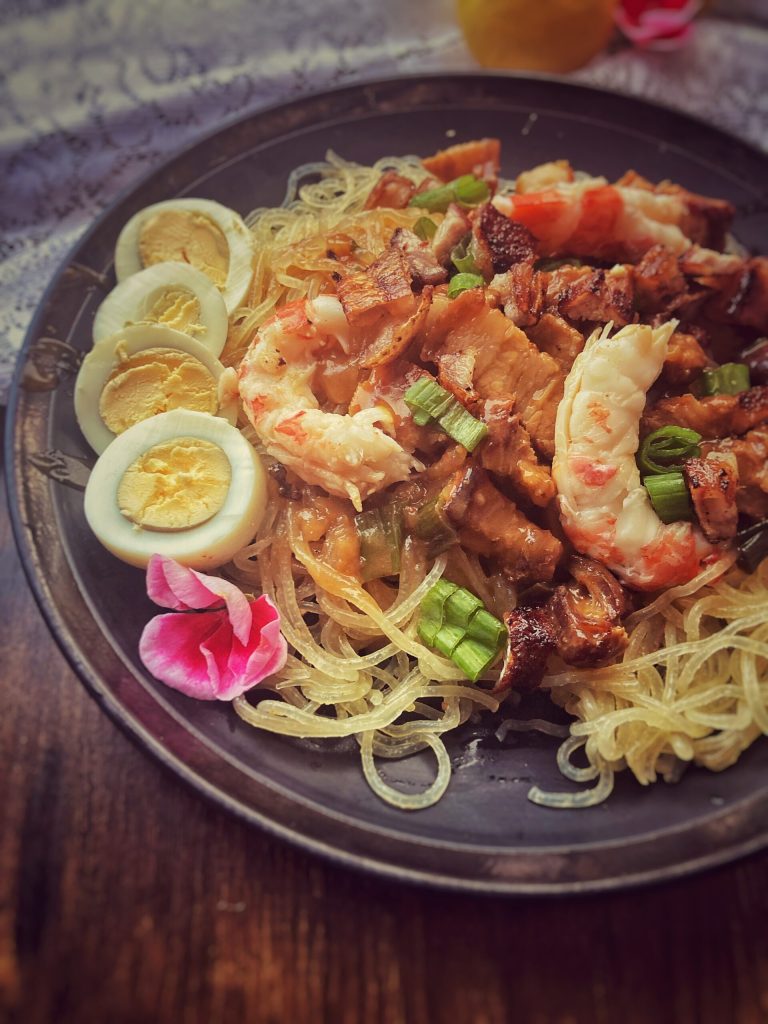
Filipino noodles:
I used yellow corn starch noodles purchased from the Asia Market website: HERE.
I used yellow corn starch noodles purchased from the Asia Market website: HERE.
I used yellow corn starch noodles purchased from the Asia Market website: HERE.
*Filipino chicharon:
Chicharron is a dish generally made of fried pork belly or fried pork rinds.
The Filipino (chicharon) made of fried pork rinds (pork rinds), often with a bit of meat attached, loved as “pulutan” (bar snack) or with rice, and typically dipped in spiced vinegar (sinamak) or seasoned with soy sauce, chopped garlic, and labuyo chili, or consumed with other condiments like bagoong (a salty and umami paste obtained by fermenting small fish similar to anchovies), lechon gravy sauce, or atchara papaya salad.
In addition to pork rinds, in the Philippines, chicken skin can also be turned into chicharong manok, while chicharong bulaklak – literally “flower chicharrón”, named for its characteristic shape – is made from pork mesentery.
A variant of chicharon involves cooking pork loin and belly (liempo) the same way, first boiled and then fried until crispy, becoming bagnet, originally from Ilocos, where it has been served since the 1960s.
Although similar, it is different from crispy pata (fried trotters and pork shank), it is more popular as a meal rather than finger food and has found its way into contemporary dishes and restaurants.
FAQ (Frequently Asked Questions)
What is the difference between Filipino chicharon and Hispanic chicharron?
Though they share the same Spanish colonial origin and an almost identical name, the
Filipino chicharon and the Hispanic chicharrón (Latin America and Spain) exhibit substantial differences in consumption and variety:
1. Seasonings and Accompaniment
Filipino: Almost always accompanied by spiced vinegar (sawsawan) with garlic and chili to “cut” the fat. Commonly used as a crunchy topping for soups and noodles (e.g., Pancit Palabok).
Hispanic (e.g., Mexico): Often consumed with guacamole, spicy sauces, or inside tacos. In Mexico, it is common to further cook it in sauces (e.g., chicharrón en salsa verde/roja) to soften it, turning it into a main dish.
2. Ingredients and Variants
Filipino: Besides pork rinds, the Philippines have unique variants like Chicharon Bulaklak (made with mesentery, flower-like appearance) or versions made with chicken skin or fish.
Hispanic: There is a greater variety of meats. In some countries, it can be made with lamb, beef, or chicken (e.g., chicharrón de pollo in the Dominican Republic). In Colombia and Peru, the term often refers to whole strips of fried belly with a lot of meat attached, served as part of complete dishes like the bandeja paisa.
3. Preparation
Filipino: The typical technique often involves double frying after a boiling and drying phase to achieve an extremely airy and light texture, similar to a puff.
Hispanic: Though the technique varies by region, in Spain and Mexico, a harder and crunchier texture is often achieved, sometimes frying the rind directly in its own lard until golden.
In summary, while the Filipino one is primarily a snack to dip in vinegar or a topping, the Hispanic one often serves as a versatile ingredient for complex dishes, stews, or fillings.
