
Russia represents one of the destinations I have been trying to reach for years, but somehow it always slips away …
Perhaps because of the long procedure to obtain a visa, or due to the cold weather, I end up opting for other destinations.
Yet Moscow and (especially) Saint Petersburg, their history and past, their grandeur, represent a perfect mix for a trip for me.
As for the cuisine, however, I have some reservations…
At the court of the tsars, the cuisine was very refined (tsarist cuisine) and sumptuous, similar to French cuisine, but the staple diet of most of the Russian population, which in the past was mainly represented by peasants, consists of cereals and vegetables, which are used for preparing salads, soups, polenta, bread, and related products.
The orthodox church has influenced Russian cuisine, as on more than half of the days of the year fasting is prescribed, so certain categories of food cannot be consumed.
This is also why traditional Russian cuisine predominantly features dishes with mushrooms, fish, grain, vegetables, berries rather than meat.
As a popular Russian saying goes – “щи да каша — пища наша” (soup and porridge are our food).
A peculiarity of this gastronomy is the limited use of fried cooking.
Food is almost always cooked in a wood-fired oven, preferring boiled, stewed, grilled, or baked dishes, but I have searched for the few specialties that can be fried (especially if served as “street food”) and among them, I found: the Pirozhki, pirozhki, pirozhki or pyrizhky, distant relatives of the pierogi tasted in Poland, often confused with them, but if pierogi are a kind of “ravioli,” Pirozhki are oval buns made of leavened dough stuffed with various fillings.
They usually contain meat (often beef) or offal, or a vegetable filling (mashed potatoes, mushrooms, onions, and eggs or cabbage) or fish.
Sweet Pirozhki, on the other hand, can be filled with cooked or fresh fruit (apples, cherries, apricots, etc.), jam, or ricotta.
This is the basic dough recipe.
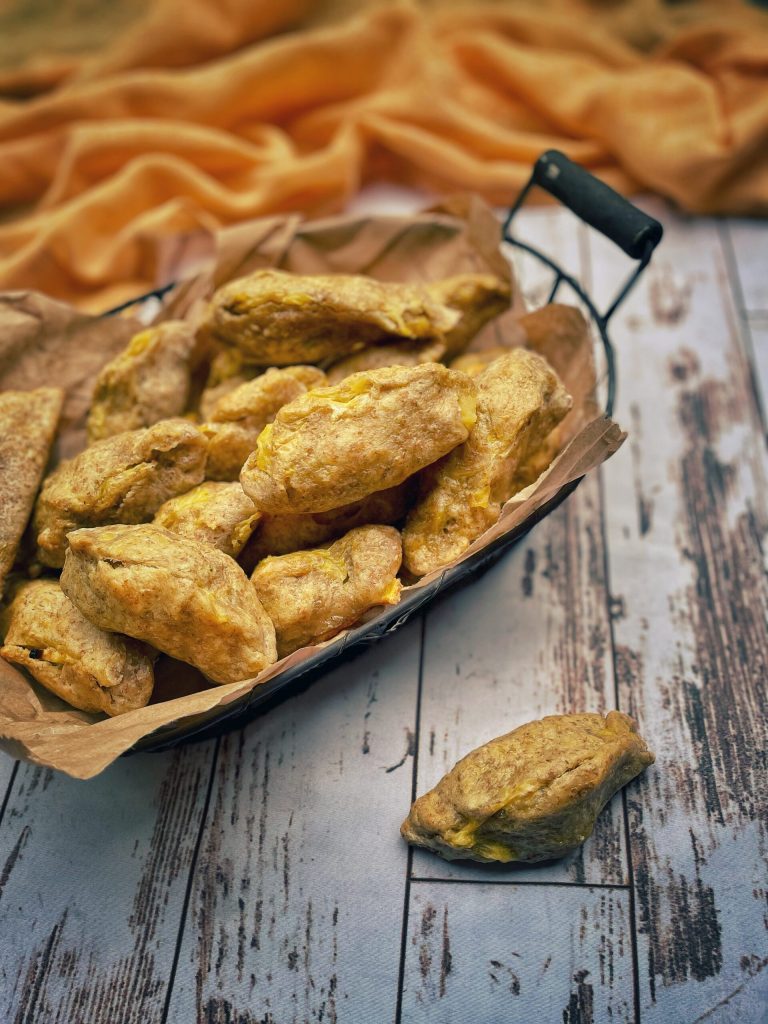
In the photo, they are filled with mashed potatoes, chopped hard-boiled egg, and spring onion.
- Difficulty: Medium
- Cost: Cheap
- Preparation time: 10 Minutes
- Cooking methods: Oven, Frying, Electric oven
- Cuisine: Russian
- Seasonality: All seasons
Ingredients
- 1.1 lbs flour
- 0.85 cup milk (warm)
- 0.88 oz fresh yeast (or 1.25 cups fresh sourdough or 0.25 oz dry yeast)
- 1 egg
- 1 teaspoon sugar
- 1.76 oz butter (melted)
- as needed vegetable oil (for the fried version)
- as needed salt
Preparation
In a bowl, mix the flour with the fresh yeast dissolved in part of the milk and the salt. Then add the egg, the melted butter, and finally, while still mixing, the remaining lukewarm milk in which you have dissolved the sugar. Mix everything well and continue working until the dough detaches from the sides of the bowl.
Let rise covered with a dish towel for about 30/60 minutes.
Ideas for the filling:
Classic: ground beef cooked with onion and spices.
Vegetarian: stewed cabbage with onion.
Other: mashed potatoes with onion, chopped hard-boiled eggs with green onion, rice with eggs and onion.Take an amount of dough the size of a tennis ball, about 1.76 oz. Roll it out until you get a circle as wide as the palm of your hand. Stuff with the filling and close, sealing the edges well and giving it an oval shape.
For the fried version: fry in abundant oil.
For the baked version: place the pirozhki on a baking sheet and brush them with a beaten egg. Let them rise for another ten minutes and bake at 356°F for about 20-25 minutes.
Once baked, let the pirozhki cool on a wooden board.
Tea in Russia…
In Russia, tea is a very important beverage that marks the rhythm of the day: black or green, prepared in the special kettle (the samovar) it is accompanied by jams, cakes, sweet or savory pirozhki, cookies, vodka, or cinnamon, sometimes offering “blinys“, a kind of crepe (flavored with sour cream or caviar).
In Russia, tea is a very important beverage that marks the rhythm of the day: black or green, prepared in the special kettle (the samovar) it is accompanied by jams, cakes, sweet or savory pirozhki, cookies, vodka, or cinnamon, sometimes offering “blinys“, a kind of crepe (flavored with sour cream or caviar).
Russian nesting doll wooden Matryoshka 5 pieces, 14.99 €
Is the traditional version of pirozhki baked or fried?
The traditional version of pirozhki can be either baked (печёные пирожки) or fried (жареные пирожки), but historically:
in peasant families and homes, they were more often baked, especially during festivals or when making bread (taking advantage of the hot oven).
The fried version was more common for quick daily consumption, or sold as street food or in school cafeterias, markets, and Soviet kiosks.
Today both versions are considered traditional, but the baked one is older and associated with grandmothers’ home cooking.
So, if you want to follow the most classic and homely version, choose the baked method.What is the traditional shape of pirozhki?
The traditional shape of Russian pirozhki is elongated and oval, similar to a crescent moon or a small closed boat.
Main features:
Length: about 3-5 inches.
Closure: the edges are pinched by hand to seal the filling, creating a visible “seam” on the side or center.
Appearance: smooth and golden, with a glossy surface (brushed with egg).
Regional variations:
Some are more round or slightly flattened.
In Ukraine and Belarus, shapes and sizes may vary slightly.
