
Second stop of the cruise aboard Costa Venezia, and to beautifully conclude the lunch at the “Ta Kokopia” restaurant in Corfu… a typical Middle Eastern dessert, super caloric based on tahini and, in this case, pistachios: the pistachio halva, similar in appearance to our Christmas nougats.
Today, it is possible to distinguish several main categories of this dessert:
– based on semolina flour (Turkish and Greek version)
– with sesame butter (tahini) and sugar (Israeli version)
– Indian, usually based on fruit or vegetables (famous for carrot gajar ka halwa) and spices.
The classic flavors of halva in Greece are those with dried fruits, but they can also be found flavored with chocolate, orange, vanilla, etc.
The following pistachio halva recipe, although tasted in Greece, is the Israeli version with tahini.
The tahini is a sesame seed paste and is the base of many recipes mostly from the Middle East, one of which ishummus (made with tahini, chickpeas, and garlic) and babaganoush (eggplant and tahini), and it is increasingly used by us as an ingredient for cookies and other desserts.
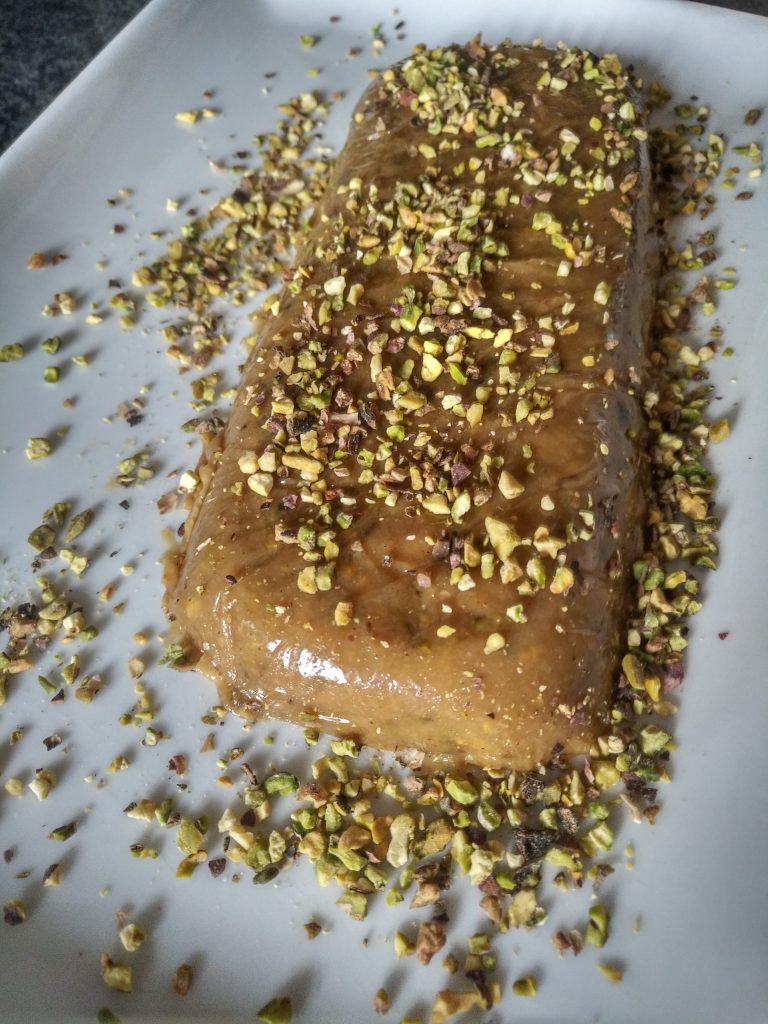
- Difficulty: Very easy
- Cost: Inexpensive
- Rest time: 2 Days
- Preparation time: 5 Minutes
- Portions: 4 servings
- Cooking methods: No cooking
- Cuisine: Middle Eastern
- Seasonality: All seasons
Ingredients
- 5/8 cup Tahini
- 1/2 cup Sugar
- 1 Lemon juice
- 2 3/4 tbsp Lukewarm water
- 1/3 cup Unsalted pistachios (or pistachio crumbles)
Preparation
Prepare the syrup by dissolving the sugar in the water in a small pan and adding the lemon juice.
Once it starts to boil, cook over medium heat until it reaches a syrup consistency.
Add the tahini and mix well until you get a homogeneous mixture.
Add the pistachios, whole, crumbled, or coarsely chopped as desired, then pour everything into a mold lined with cling film to seal the mixture.
Once cooled, store it in the fridge for at least 24 hours before serving it sliced with some pistachios as decoration.
Notes
The name “halva” or “hawa” derives from the Arabic term “helw“, which means sweet, and the term halva generally refers to the generic category of sweets in many Arabic-speaking countries. It is a dessert allowed by the kosher cuisine and halal cuisine.
In Argentina, a type of halva made with peanut butter is popular, produced by a company owned by a family of Greek origin, Georgalos, and is consumed as a snack: Nucrem.
VIDEO RECIPE
You can also buy tahini online, here you will find an organic quality for 9.99 €.
What are the different types of Halva?
The term comes from the Arabic halwa (sweet) and is mainly divided into two large families:
1. Flour or Semolina Based Halva
This is the typical version from Greece, Turkey, and India (Sooji Halwa).
Semolina (Simiydalis): It’s the classic Greek “1-2-3-4” (one part oil, two semolina, three sugar, four water). It has a grainy and soft consistency.
Flour: The flour is toasted in fat (oil or clarified butter) until it browns, creating a cookie-like and intense flavor.
2. Seed or Nut Paste Based Halva (Most common in stores)
This is often found in compact and crumbly blocks in ethnic stores.
Sesame (Tahini Halva): Typical of the Middle East and North Africa. It is made by mixing tahini (sesame paste) with sugar syrup at high temperatures. It is crumbly, almost “crystalline,” and melts in the mouth.
Sunflower: Very popular in Eastern Europe (Ukraine, Russia), where sunflower seeds replace sesame, giving a grayer color and a more pronounced flavor.
3. Unusual Variants
Carrot Halva (Gajar Halwa): A staple of Indian cuisine, where grated carrots are cooked for a long time in milk, sugar, and ghee until they become a dense cream.
Starch Halva (Farsan): In some Gulf regions, starch is used to obtain a gelatinous and transparent texture, often flavored with saffron and cardamom.
