
The Gibanica is a family of dishes spread throughout the Balkans, with variants that radically change in taste (sweet or savory), structure, and occasions for use.
The Prekmurska Gibanica (Over-Mura Gibanica) represents the most complex expression of layered pastry from Eastern Slovenia.
Since 2010, the name has been protected at the European level as a TSG (Traditional Specialty Guaranteed), which imposes strict standards regarding ingredients, stratification order, and dimensions.
The term derives from the dialectal giba (fold), referring to the laminated structure of the cake.
The oldest written documentation dates back to 1828, by the writer and priest Jozef Kosič, who codified its presence as an essential ceremonial food in the rural areas of Prekmurje to celebrate weddings and harvests.
Although it belongs to the family of Balkan gibanice (like the Serbian savory version or the Croatian Međimurska), the Slovenian variant is distinguished by the coding of no less than eight distinct layers.
The structure is based on a double type of dough and four different fillings.
According to the official protocol, the preparation must follow these parameters:
Base (Podplat): a layer of shortcrust pastry that serves as a structural support to sustain the moisture of the upper fillings.
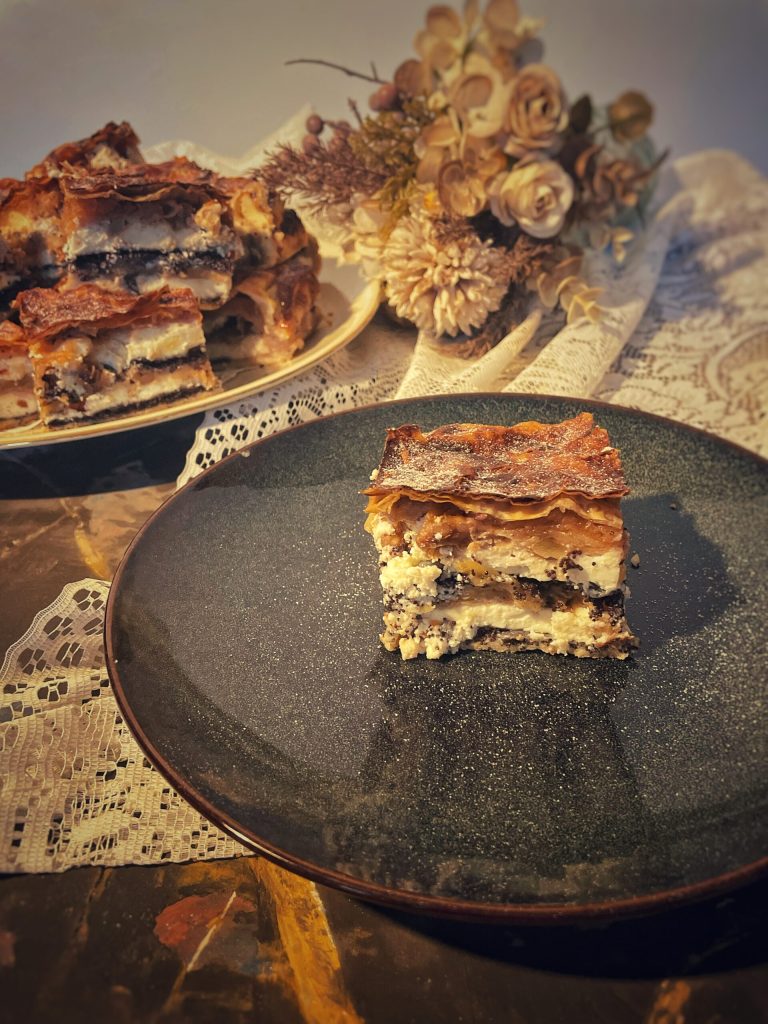
Stratification (8 levels): the central body is composed of sheets of phyllo dough (or hand-stretched strudel dough) that separate two identical series of four fillings, arranged in this order:
Poppy seeds ground and sweetened, symbolizing fertility and abundance.
Ricotta mixed with eggs and sugar
Walnuts with sugar and cinnamon
Grated and acidulated apples
Finishing (Preliv): the surface is sealed with a mixture of sour cream (kisla smetana) and eggs, which during baking stabilizes the structure and gives the characteristic golden color.
The cake requires prolonged baking at moderate temperatures (356°F-392°F) to allow controlled evaporation of the water contained in the apples and ricotta, preventing the collapse of the internal phyllo dough layers.
- Difficulty: Medium
- Cost: Medium
- Preparation time: 1 Hour 15 Minutes
- Portions: 20 people
- Cooking methods: Oven
- Cuisine: Eastern European
- Seasonality: All seasons
Ingredients
- 1 roll shortcrust pastry (rectangular 8×12 inches)
- 12 sheets phyllo dough
- 10.6 oz poppy seeds
- 11.3 oz sugar
- 0.42 cup milk
- 5.3 oz butter (melted)
- 2.2 lbs ricotta
- 5 eggs
- 10.6 oz walnuts (chopped)
- to taste cinnamon powder
- 1 lemon (juice)
- 3.3 lbs Renette apples
- 2.5 cups sour cream
- to taste powdered sugar
Tools
- 1 Baking Pan 8×12 inches
Steps
The Base: Roll out a layer of shortcrust pastry on the bottom of a high rectangular baking pan, then cover with a buttered sheet of phyllo dough.
The Layers: Start composing the layers following this strict order, separating each filling with a buttered phyllo dough sheet:1st: Half of the poppy seed filling mixed with 3.5 oz of sugar and warm milk.
2nd: Half of the ricotta filling mixed with 2 eggs and 3.5 oz of sugar.
3rd: Half of the walnut filling with 3.5 oz of sugar and cinnamon
4th: Half of the grated apple filling with 4.2 oz of sugar, cinnamon, and lemon juice.
Repetition: Repeat the sequence (poppy seed, ricotta, walnuts, apples) to complete the other 4 layers.Closure: Cover with 3 sheets of phyllo dough and pour over the mixture of sour cream and 3 eggs.
Baking: Bake at 356°F-374°F for about 60 minutes.
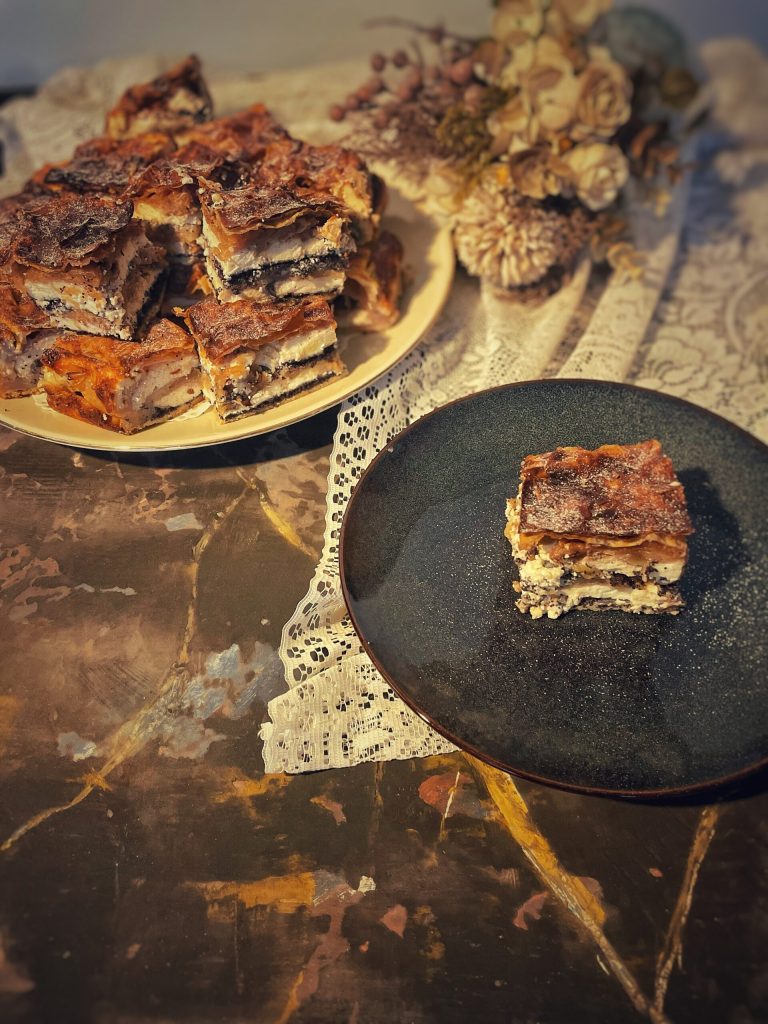
It is usually served cut into tall square slices, dusted with powdered sugar.
FAQ
What are the other types of gibanica?
1. Serbian Gibanica (The Queen of Savory)
It is the most common and widespread version, served as an appetizer or breakfast.
Characteristics: Layers of phyllo dough alternated with a filling of eggs, cheese (like Feta or “Sremski sir”), and yogurt.
Curiosity: There is the Chetnik Gibanica, a historical post-WWII version, much richer and greasier (prepared with more fat and eggs).
2. Slovenian Sweet Variants
Slovenia has turned Gibanica into an art of layering:
Prekmurska Gibanica.
Prleška Gibanica: Typical of the Prlekija region, similar to a sweet “pizza” or focaccia, less complex than the previous one.
Pohorska Gibanica: Made with a leavened dough and enriched with berries or pears depending on the season.
3. Međimurska Gibanica (Croatia)
Very similar to the Slovenian version but more rustic.
Differences: It has only 4 layers of filling (cheese, poppy seeds, apples, and walnuts) that are thicker and creamier. Often uses puff pastry instead of shortcrust for the base, resulting in a moister and softer cake.
4. Regional Variants and Different Names
Bulgaria: It is called Banitsa and is almost always savory with cheese.
Italy (Friuli-Venezia Giulia): It is known as Ghibanizza in the border areas, maintaining the tradition of layers of dried fruit and cheese.
Macedonia and Bosnia: There are local versions simply called “pita” or “gibanica”, often with chopped hazelnuts or various local cheeses
