
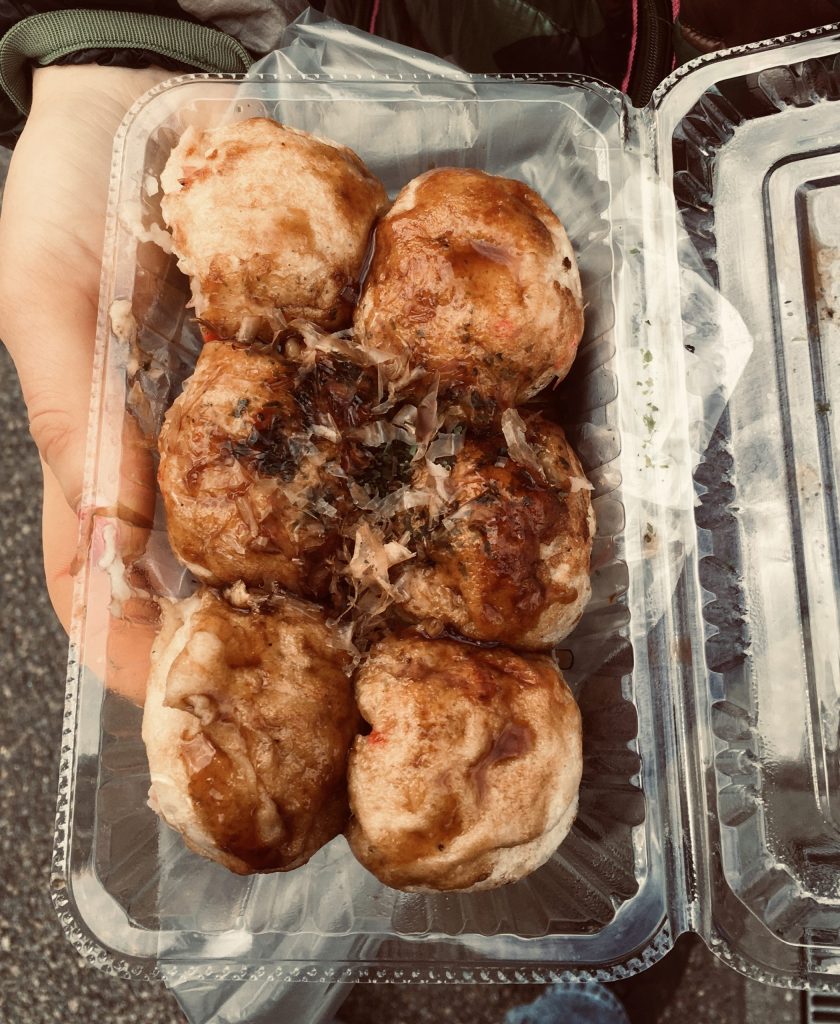
The areas around the many temples of the city of Tokyo are the richest in food stands. We, next to the Senso-Ji temple, tried the takoyaki, (“tako” = octopus), one of the most popular street foods among the Japanese (these are the stands with the longest line!), originating from Osaka.
They are octopus balls.
They are cooked after preparing a batter made with wheat flour, inside which a piece of octopus is placed. Other ingredients to add before cooking are tempura scraps (tenkasu), red ginger, and chives.
When they are ready, they are garnished with Otafuku sauce for takoyaki, chopped aonori seaweed, mayonnaise, and katsuobushi.
They are cooked using a special takoyaki pan made of cast iron (sold everywhere) with hemispherical shapes, which is lightly greased with oil using a cloth. The mixture is poured into the molds when the pan is very hot.
The history of takoyaki begins in Osaka in the 1930s.
The invention is attributed to Tomekichi Endo, a street vendor in Osaka, in 1935.
Endo was inspired by akashiyaki, a specialty of the city of Akashi, made with eggs and octopus, but softer and meant to be dipped in broth.
His idea was to create a more compact and flavorful version using a batter.
- Difficulty: Medium
- Cost: Medium
- Preparation time: 30 Minutes
- Portions: 20 balls
- Cooking methods: Other
- Cuisine: Japanese
- Seasonality: All seasons
Ingredients
- 3.5 oz Octopus
- 1.25 cups Flour
- 1.25 cups Dashi broth
- 1 bunch Chives (or green onion)
- 1 Egg
- 1 tsp Sugar
- to taste beni shoga (ginger marinated in umezu)
- to taste nori seaweed, mayonnaise, katsuobushi, Otafuku sauce (For decoration)
- to taste Salt
- to taste Oil
- to taste tempura scraps (optional)
Preparation
Boil the octopus. Cut the boiled octopus into pieces no larger than half an inch, and remember that the octopus should not be overcooked but just blanched.
Finely slice the chives and chop the beni shoga into small pieces a couple of millimeters thick.
Beat the flour together with the dashi broth, egg, salt, and sugar until smooth and without lumps, and put it in a jug that will be used to pour the batter onto the plate.
Heat the takoyaki plate and oil it very well to prevent the batter from sticking during cooking. When the plate is hot, pour the prepared mixture to fill all the spaces. Don’t worry if some of the batter spills over because it will be needed to form the balls.
Start by placing the octopus pieces so that each ball has at least one or two. After the octopus, add the chives and beni shoga.
When the batter at the bottom of the molds starts to cook, use a skewer to turn the balls and, while doing so, try to use the excess batter to cover the ingredients evenly with the batter.
After forming all the balls, continue turning them for a while until they turn golden. At this point, you can remove them from the plate and place them on a serving dish.
Sprinkle the Otafuku sauce for takoyaki over the balls, followed by mayonnaise, chopped nori seaweed, and dried bonito.
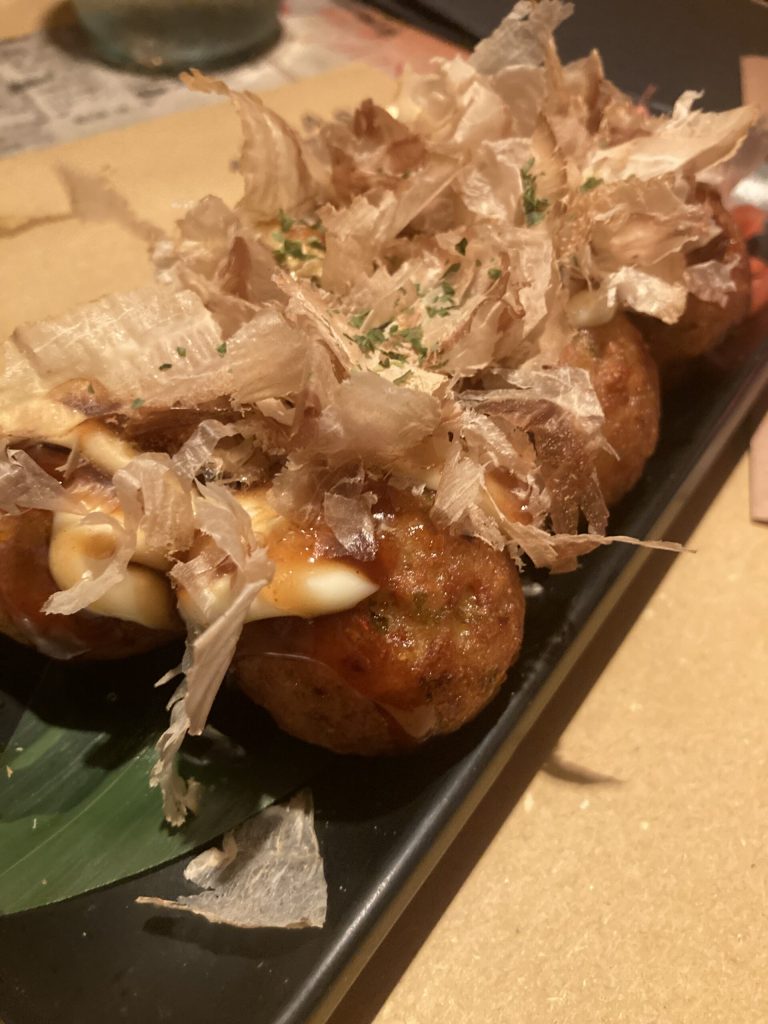
These are the delicious ones tasted at the Japanese restaurant “Tamashi Ramen” in Genoa during the Instagram live of ViaggiandoMangiando on air on August 21, 2023.
Video HERE.
These are the ones tasted during our trip to Okinawa in March 2025:
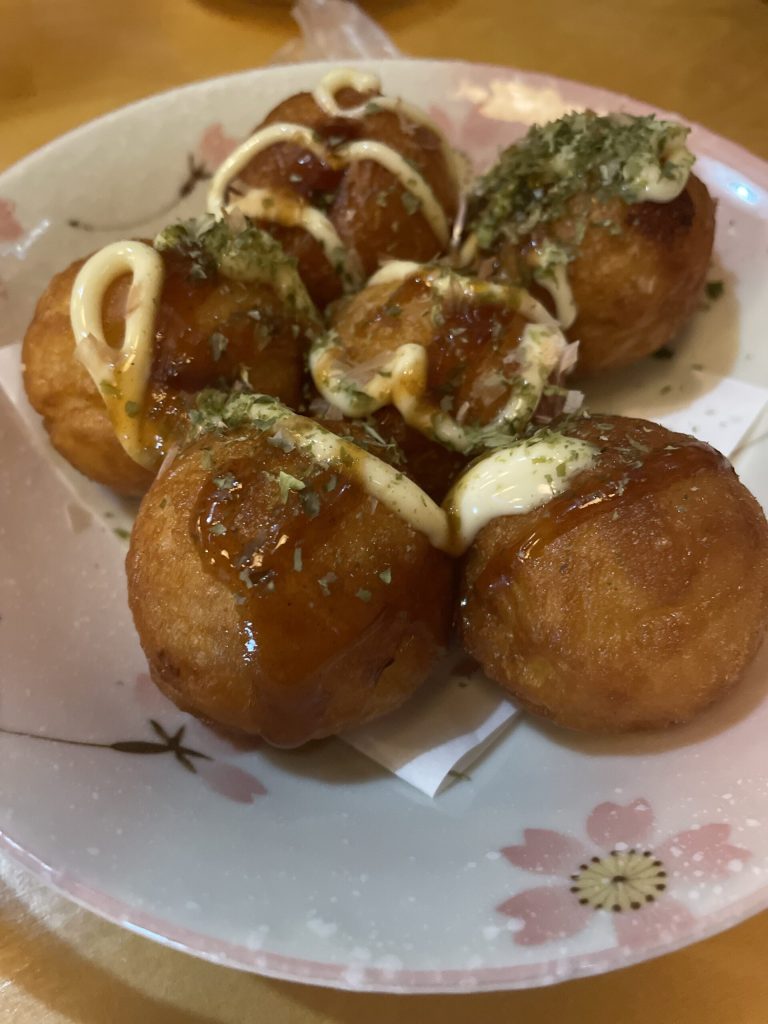
You can use the Takoyaki Cooking Plate or, as in the video, the Takoyaki plate or shape the takoyaki with your hands.
Check out my review on the StarBlue electric takoyaki machine.
What is Otafuku sauce?
Otafuku sauces are a mix of soy sauce, fruits (like apple and peach), vinegar, spices, and flavors extracted from vegetables and seafood.
The name of a company producing sauces and other Japanese food products, based on a revisitation of Worcestershire sauce.
The most well-known versions are the Otafuku sauce for Okonomiyaki and the Otafuku sauce for Yakisoba, but the company produces other sauce variants, including:
Takoyaki Sauce: specific for octopus balls.
Tonkatsu Sauce: ideal for pork cutlets.
Yuzu Sauce: citrus-based, light, sweet, and refreshing.
Teriyaki Sauce: sweet and savory, suitable for grilled foods.What is the difference between takoyaki and akashiyaki?
Here are the main differences between Akashiyaki and Takoyaki:
Batter:
Akashiyaki: more liquid, with much more dashi and more eggs, no other ingredients in the batter.
Takoyaki: thicker batter, often with tenkasu (tempura flakes), green onion, red ginger, etc.
Cooking:
Akashiyaki: softer and more delicate, almost soufflé-like.
Takoyaki: more compact and crispy on the outside.
Condiment:
Akashiyaki: dipped in hot broth, no sauces on top.
Takoyaki: served with okonomiyaki sauce, mayonnaise, aonori, katsuobushi.
Origin:
Akashiyaki is older, born in Akashi.
Takoyaki was born in Osaka and inspired by Akashiyaki, but with a street food twist.
