
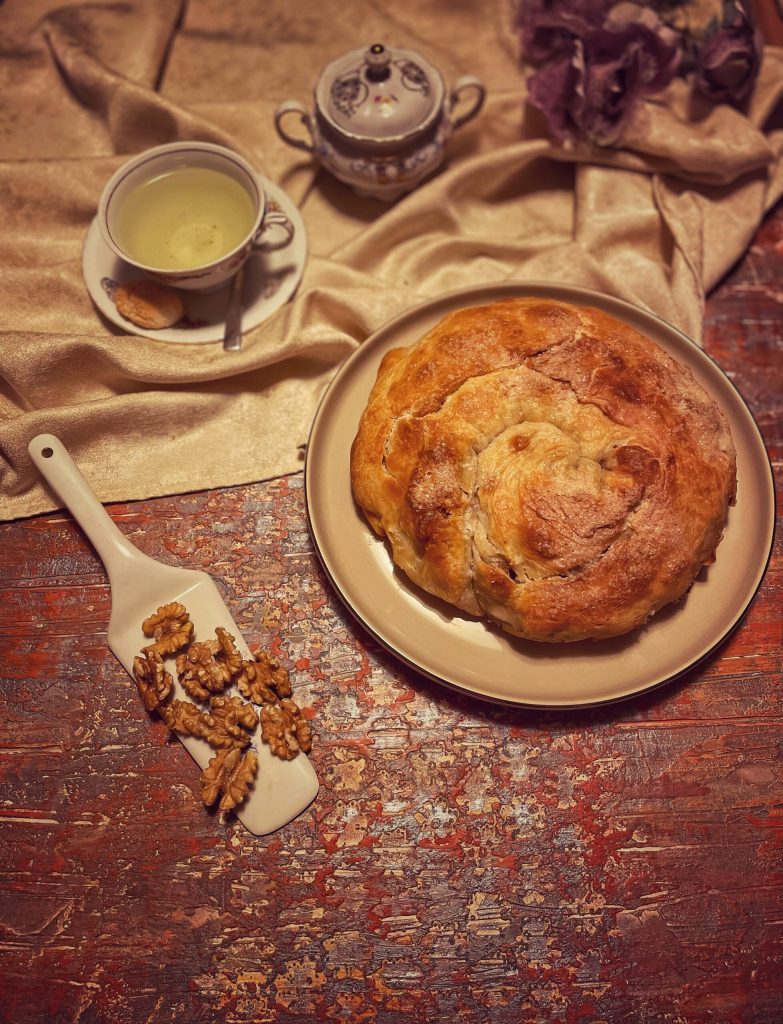
An undisputed symbol of the Valli del Natisone and the festivities of Cividale del Friuli, the Gubana is a sumptuous spiral of leavened dough enclosing a heart of dried fruits.
Its name, which comes from Slovenian guba (fold), perfectly describes its characteristic spiral shape, a spiral of leavened dough.
Born as a dessert for grand occasions — from weddings to historic festivals — gubana has roots deep in the rural border traditions.
It distinguishes itself from its Triestine “cousins” (like the presnitz) by using a soft brioche dough instead of puff pastry, maintaining an unbreakable bond with the Friulian territory’s identity.
The secret of its intensity lies in the contrast between the softness of the outer layer and the richness of the filling.
A mixture of walnuts, hazelnuts, pine nuts, and raisins is combined with crumbled cookies and the ingredient that defines its character: grappa.
This distillate does not only flavor the raisins and filling (about 1.5-1.7 oz), but often accompanies the serving, being poured directly on the slice to enhance its toasted and spicy notes.
Making the gubana requires double leavening to ensure its typical lightness and slow cooking.
- Difficulty: Medium
- Cost: Medium
- Rest time: 4 Hours
- Preparation time: 15 Minutes
- Portions: 6 People
- Cooking methods: Oven
- Cuisine: Italian
- Seasonality: All Seasons
Ingredients
- 3 3/4 cups flour
- 7 tbsp sugar
- 1 pinch salt
- 1 lemon zest
- 3 eggs
- 7 tbsp soft butter
- 1 1/4 tsp dry yeast
- 0.4 cups milk (+ for brushing)
- 1 tsp sugar
- 1 cup raisins
- 1.5 oz Friulian grappa (+ for serving)
- 3/4 cup walnuts
- 1/3 cup pine nuts
- 1/2 cup almonds
- 1/2 cup soft amaretti
- 1/3 cup breadcrumbs
- as needed butter
- 1/3 cup sugar
- as needed orange zest
Tools
- 1 Baking pan 8.5 inches
Steps
1. Preparing the Filling
(Traditionally, the filling rests for at least 12-24 hours to blend the flavors and stabilize the grappa’s alcohol. But you can skip this step).
Soak the raisins in the grappa.
Toast the breadcrumbs in a pan with butter until golden.
Coarsely chop walnuts, almonds, and pine nuts (you can leave the pine nuts whole).
Combine everything in a bowl with crushed amaretti, sugar, orange zest, and raisins (with their grappa). The mixture should be moist but compact.
2. Double Leavening
Phase 1 (Starter): Mix the yeast with warm milk and a teaspoon of sugar, let it activate for 10 minutes.
Phase 2 (Dough): Add the starter to the rest of the dough ingredients: flour, sugar, zest, salt, eggs, and soft butter. Knead thoroughly until smooth and elastic. Let rise covered until doubled (about 2 hours).
3. Forming the Spiral
Roll out the dough into a thin rectangle. Spread the filling evenly, leaving a 3/4 inch border.
Roll tightly to form a sausage shape.
Take one end and wrap it around itself in a spiral (like a snail shell – without a hole), tucking the end underneath the cake.
4. Third Leavening and Baking
Place the gubana in a greased mold and let it rise again for 2 hours (or until visibly puffy).
Brush with milk and sprinkle with granulated sugar.
Bake in a static oven at 340°F for about 40 minutes.The true Friulian tradition involves the so-called “corrective”:
Lightly warm the slice and pour a tablespoon of grappa (or Slivovitz) over it just before eating.
Alternatively, you can “drench” the gubana directly on the plate, allowing the dough to absorb its aroma.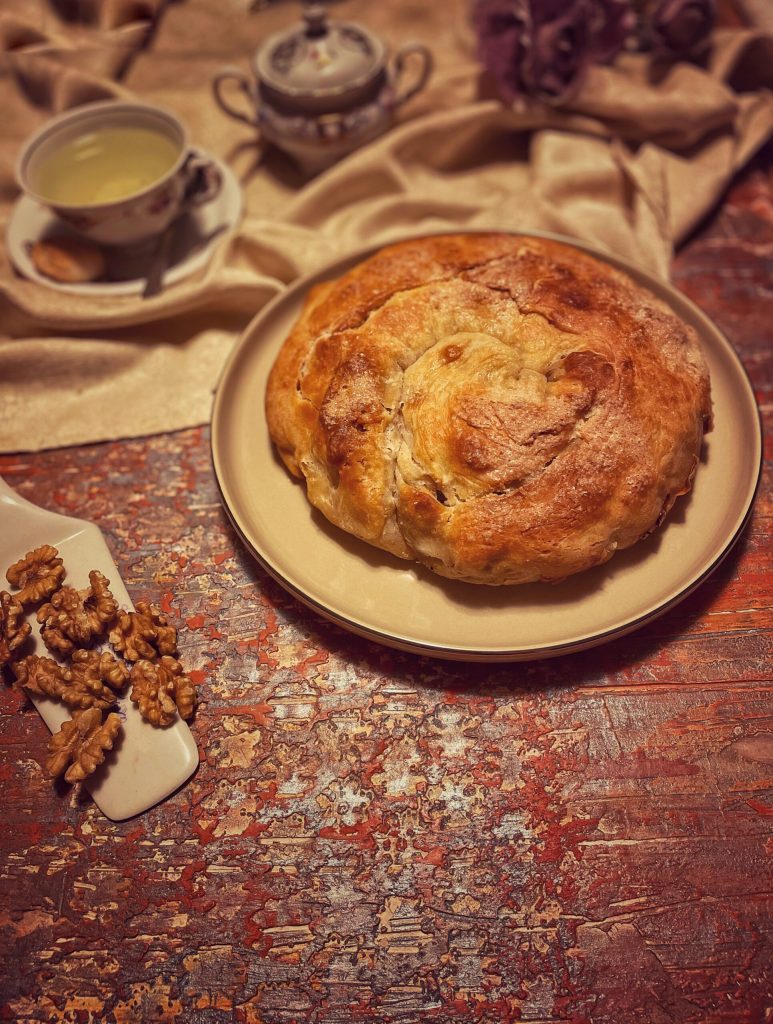
FAQ (Questions and Answers)
Which grappa is used for Gubana?
For the preparation and serving of gubana, two types of distillates are traditionally used, both deeply linked to the Friulian territory:
1. White Friulian Grappa
For the dough and filling, a young, white, and dry grappa is usually chosen. Being neutral and crystal-clear, it does not alter the color of the brioche dough but imparts that sharp and aromatic scent necessary to balance the sweetness of the dried fruits.
Tip: a grappa di Monovitigno (such as Moscato for those who love sweet or Friulano for those who prefer dry)
2. Slivovitz
Slivovitz is a plum brandy typical of the border areas and Valli del Natisone. It is considered the “connoisseurs'” pairing:
In the filling: it is often used instead of grappa to give a deeper fruity note to the raisins.
Final drench: It is the distillate of choice to pour over the slice just before enjoying it for a truly authentic experience.What is the difference between gubana, putizza, and presnitz?
Although they belong to the same “family” of rolled desserts from Friuli-Venezia Giulia and share a similar filling based on dried fruits, the technical differences between Gubana, Putizza, and Presnitz are distinct, mainly concerning the dough and geographical origin.
1. Gubana (Valli del Natisone and Cividale)
Dough: It is a leavened dough (like brioche), soft and tall.
Shape: Spiral (snail-like).
Distinctive features: It is the most “rich” and leavened. Often drenched with Grappa or Slivovitz directly on the slice. It is the emblematic dessert of the Friulian hinterland.
2. Putizza (Trieste and Slovenia)
Dough: This is also a leavened dough, but it is rolled much thinner than gubana.
Shape: Unlike gubana (which is a “free” snail), the Triestine putizza is often baked in a mold with a hole (like a bundt cake), resulting in a more compact form.
Taste: The filling is very similar to gubana but often includes chocolate or cocoa powder, making it darker and more intense.
3. Presnitz (Trieste)
Dough: Here the difference is total. Presnitz is not a leavened dough but made from pastry (or puff pastry) super thin.
Shape: A tight and flat spiral.
Consistency: Since there is no yeast, it is a much “lower” and denser dessert, where the filling is the absolute protagonist and the pastry serves only as a very light crispy envelope.
