
The Umbrian Easter Cheese Cake, also known as Pizza al formaggio, is the symbolic product of Easter gastronomy in Central Italy.
It is a savory leavened bread with ancient origins, historically linked to the cooking traditions of medieval monasteries, typical of the Easter period, traditionally eaten for Sunday morning breakfast together with cured meats and hard-boiled eggs.
The recipe’s origins date back to the Middle Ages and are connected to the monastic tradition of Central Italy. It was prepared between Maundy Thursday and Holy Saturday to use the eggs accumulated during Lent’s fasting.
Its tall, flared shape comes from the use of specific molds that allow the dough to develop vertically.
Technically, the preparation is based on a precise balance between flour, eggs, and a mixture of grated cheeses, usually Pecorino Romano and Parmigiano Reggiano.
The dough is then enriched with black pepper and lard, the fat that ensures the typical softness and extended preservation.
The variant I propose in this recipe is a gluten-free version made with sourdough starter.
Using natural leavening, in addition to improving digestibility and shelf life, adds aromatic complexity that perfectly balances the saltiness of the cheeses while maintaining the soft structure typical of the traditional recipe despite the absence of gluten.
Although it is often confused with the Marchigiana Crescia, the two specialties show differences rooted in their territories.
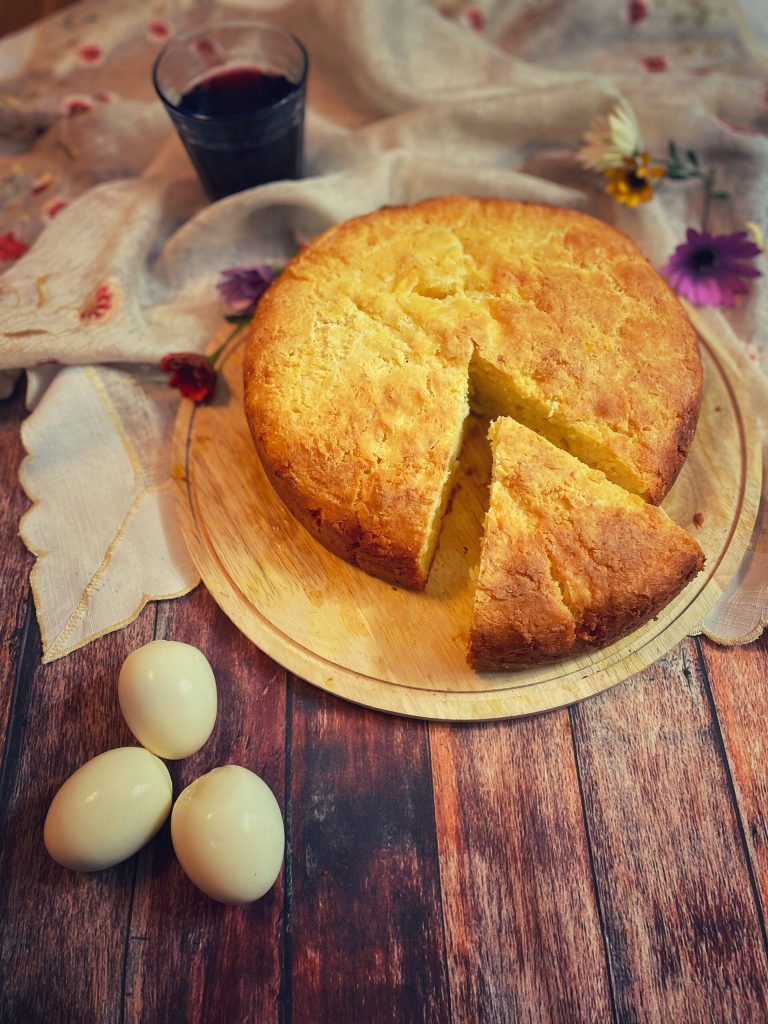
- Difficulty: Easy
- Cost: Very inexpensive
- Rest time: 12 Hours
- Preparation time: 10 Minutes
- Cooking time: 50 Minutes
- Portions: 6People
- Cooking methods: Oven
- Cuisine: Italian
- Seasonality: Easter, Spring
Ingredients
- 150 ml (about 5 fl oz / 2/3 cup) gluten-free sourdough starter (refreshed)
- 100 ml (about 3.4 fl oz / ~1/3 cup) milk
- 350 g (about 12.3 oz / ~2 3/4 cups) gluten-free flour blend
- 150 g (about 5.3 oz / ~1 cup) rice flour
- 80 g (about 2.8 oz / ~5 1/2 tbsp) lard (or butter)
- 250 g (about 8.8 oz / ~2 1/2 cups) mixed grated cheeses (Pecorino and Parmigiano Reggiano and/or Emmental)
- to taste black pepper
Tools
- 1 Pan 9 x 4 in
Steps
Activation: Dissolve the sourdough starter in warm milk until foamy.
Dough: In a stand mixer (recommended to handle the stickiness of gluten-free mixes), combine the flours, the eggs, and the starter mixture. Mix for about 10 minutes.
Adding Fat and Cheeses: Add the lard (or butter) a little at a time. Once absorbed, incorporate the grated cheeses and the pepper. Add the cheeses last.
First Proof: Transfer the dough to a greased bowl, cover with plastic wrap and let rest in a warm place (approx. 79-82°F) until doubled in size. With sourdough starter, about 6 hours.Shaping and Second Proof: Deflate the dough slightly, put it into the mold (it should occupy about 1/3 of the mold height) and let it rise until it reaches about one centimeter from the rim (another 4-6 hours).
Baking: Bake in a preheated static oven at 338°F for about 45-50 minutes.
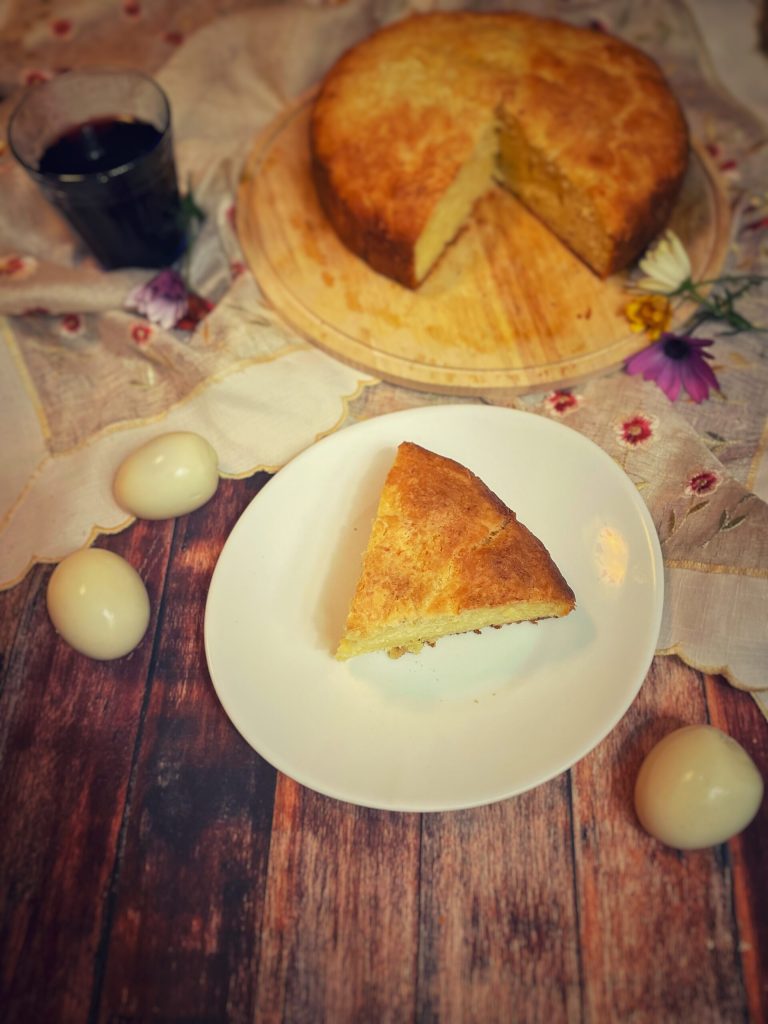
Difference between Umbrian Easter Cheese Cake and Marchigiana Crescia:
Although the two products are extremely similar and share the same origin, there are terminological and technical distinctions:
Name: In Umbria the term “Torta” or “Pizza” is predominant, while in the Marche it is called “Crescia” (from the verb to grow).
Texture: The Marchigiana version often has larger holes and a greater amount of cheese in pieces visible in the crumb, while the Umbrian one tends to have a more homogeneous and compact dough.
Pairings: In Umbria it is typically paired with capocollo, while in the Marche it is common to pair it with ciauscolo.
FAQ (Questions & Answers)
What usually accompanies the Umbrian Easter Cheese Cake?
In Umbrian tradition (and in the Marche), the Easter Cheese Cake is not a substitute for bread at lunch, but the absolute protagonist of the Easter Breakfast, an almost sacred ritual that breaks the Lenten fast.
Here is what it is traditionally eaten with:
Cured Meats: The typical companion is Umbrian capocollo (cured and peppered).
Hard-Boiled Eggs: Strictly blessed during Easter Mass. They are often served peeled and halved, sometimes dressed with a drizzle of new extra virgin olive oil.
Wine: Despite the early hour, tradition has it accompanied by a glass of full-bodied red wine (such as a Sagrantino or a Rosso di Montefalco) or, in some areas, a passito wine to contrast the saltiness of the cheese.
Chocolate: In some families it’s customary to finish breakfast alternating a bite of the cheese cake with a piece of chocolate egg, creating a much-loved sweet-salty contrast.
Curiosity: In the past, the breakfast also included lamb offal, but today the combination Cake + Capocollo + Hard-boiled Egg remains the untouchable trio.
