
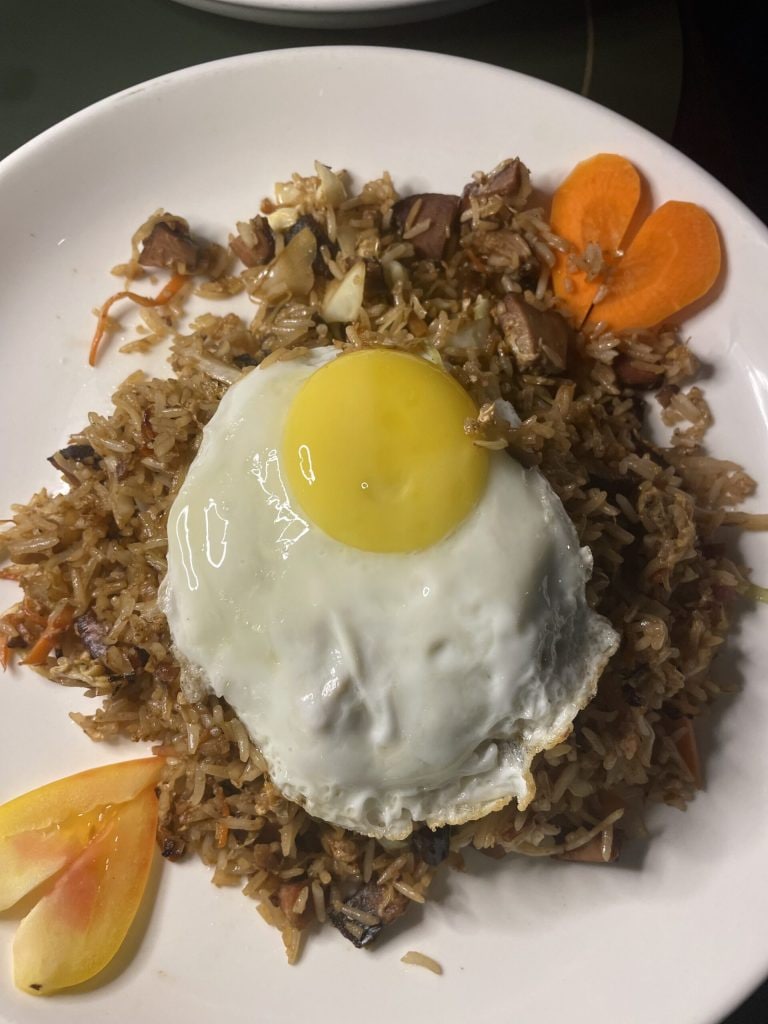
The Maldivian Valhomas Rice is stir-fried rice with Valho Mas (smoked and dried tuna), cut into small pieces.
It has a dark color due to the light soy or spiced sauce used in cooking.
It is prepared with julienned vegetables (carrots and onion) stir-fried together.
The whole dish is topped with a fried egg with a soft yolk, a typical finishing touch.
No strong spices or curry are used in the classic Valhomas Rice, only fresh flavors.
The Valho Mas is the heart of the dish: it provides a unique salty and smoky flavor.
What is Valho Mas?
• It is tuna (usually yellowfin) boiled, smoked, and then dried.
• It’s a traditional Maldivian product, similar to Japanese “katsuobushi” or the “Maldives fish” used in Sri Lanka.
• It appears as hard, dark, almost woody pieces, which are grated or broken up for use in cooking.
This is what we tasted during our stay in the Maldives in November 2025.
- Difficulty: Easy
- Cost: Economical
- Preparation time: 5 Minutes
- Portions: 2People
- Cooking methods: Stovetop
- Cuisine: Asian
- Seasonality: All seasons
Ingredients
- 4.2 oz long grain rice
- 2.8 oz valho mas (or katsuobushi)
- 2.8 oz onion
- to taste fresh ginger (chopped)
- 1 carrot
- 1 tablespoon soy sauce
- to taste salt
- 2 tablespoons coconut oil
- 2 eggs
Steps
Cook the rice in salted water, drain it and let it cool slightly (better if cooked in advance).
In a large pan, heat the oil.
Add thinly sliced onion and ginger (if used). Sauté until golden.
Add finely chopped or grated Valho Mas. Stir-fry for 1-2 minutes to release the aroma.
Add julienned carrot and mix for 2-3 minutes. Add the rice and mix well to combine everything, and finally, add the soy sauce.
Adjust salt to taste and turn off the heat.
In another pan, fry the eggs.
Serve the rice hot with the egg on top.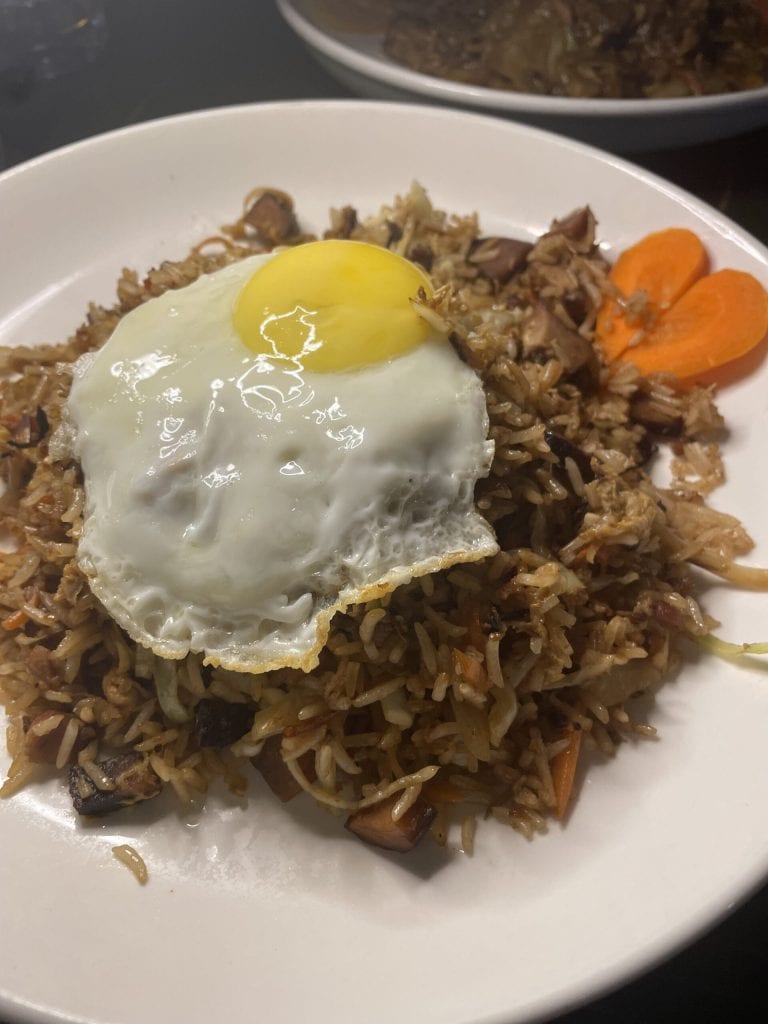
👨🍳 How Valho Mas is Traditionally Prepared
The tuna is cut into chunks, boiled with salt and light spices.
Then it is slowly smoked over coconut wood for hours/days.
Finally sun-dried, becoming hard and dark.
Valho Mas in the Maldives is found everywhere: in local markets, minimarkets, and even in resort shops.
Often families also prepare it at home, especially in villages.
Valho Mas in the Maldives is found everywhere: in local markets, minimarkets, and even in resort shops.
Often families also prepare it at home, especially in villages.
FAQ (Frequently Asked Questions)
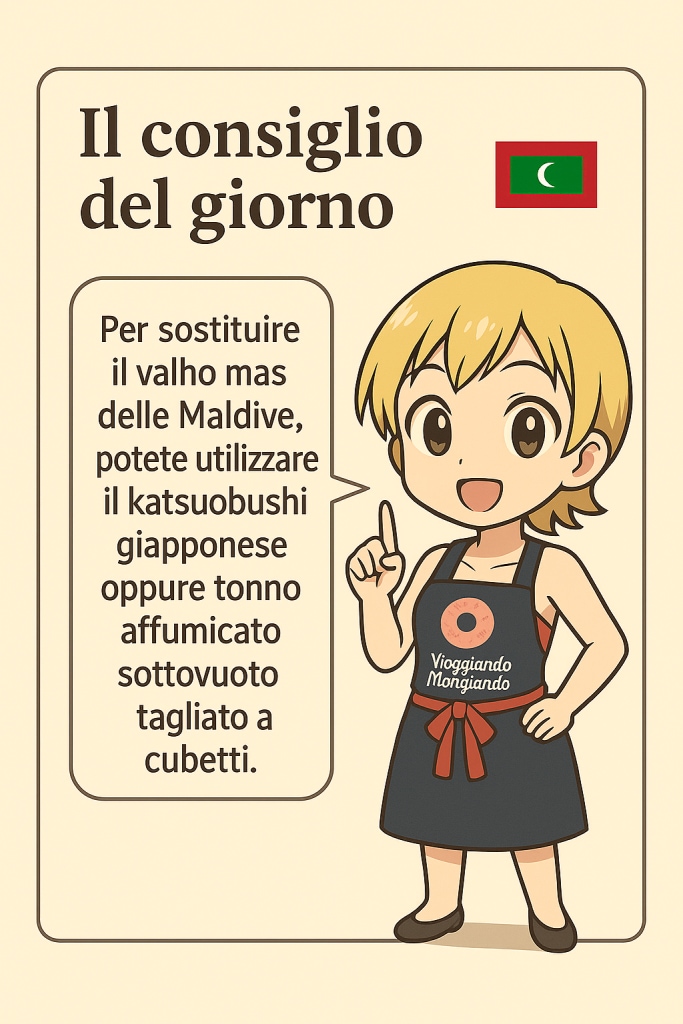
How to Replicate or Replace Valho Mas in Italy?
It is not easy to replicate the authenticity of Valho Mas, but you can use:
✅ Realistic alternatives:
1. Vacuum-packed smoked tuna (the kind to cut into cubes, NOT canned).
Slice it finely, dry it a bit in the oven at low temperature to make it drier.
2. Well-dried and broken-up smoked mackerel or salmon fillets (less traditional, but flavorful).
3. Japanese dried tuna (katsuobushi): similar in process, but with a different and milder taste.
❌ To avoid:
• Canned smoked tuna: too soft, not suitable for replicating the texture.
• Bresaola or speck: similar in process but completely different in taste.
✅ Practical advice:
If you want to get close to the original flavor, take a fresh tuna steak, steam or boil it with a little salt, then lightly smoke it (e.g., with applewood or cherrywood), and then dry it in a convection oven at low temperature (60-70°C) for several hours.What are the Eating Habits of Maldivians?
The eating habits of Maldivians are strongly influenced by island life, Islamic religion, and family traditions. Here’s a typical day’s overview:
🍽️ Breakfast (subuh – early morning, around 6:00-8:00)
• Very important in Maldivian culture.
• Often done at home, with family, just after morning prayer.
• Typical dishes:
Mas Huni with roshi and hot black tea.
Sometimes rihaakuru mixed with onion, lime, and roshi.
In urban or modern areas: bread, butter, biscuits, eggs, but always with tea.
🍛 Lunch (after noon, around 12:30-13:30)
• Traditionally the main meal of the day.
• Consumed with family (especially on the islands) or at home during work breaks.
• In resorts or cities, it may happen outside the home, but only with friends or colleagues, never alone.
• Common dishes:
Garudhiya (tuna broth) with rice.
Fish curry (mas riha) with rice.
Mas Baiy, Valhomas rice.
Accompanied by rihaakuru, roshi, sambol.
🌙 Dinner (after sunset, around 18:30-20:00)
• Often lighter than lunch, but varies.
• With family or friends.
• Common dishes:
Leftovers from lunch (curry + rice).
Roshi with mas huni or sambol.
Noodles or light Indian dishes.
☕ Snacks and tea (between 16:00-17:00)
• A social moment called “tea time,” very meaningful.
• Short eats (savory fried snacks) are consumed: gulha, bajiya, keemia.
• Always accompanied by sweet black tea.
