
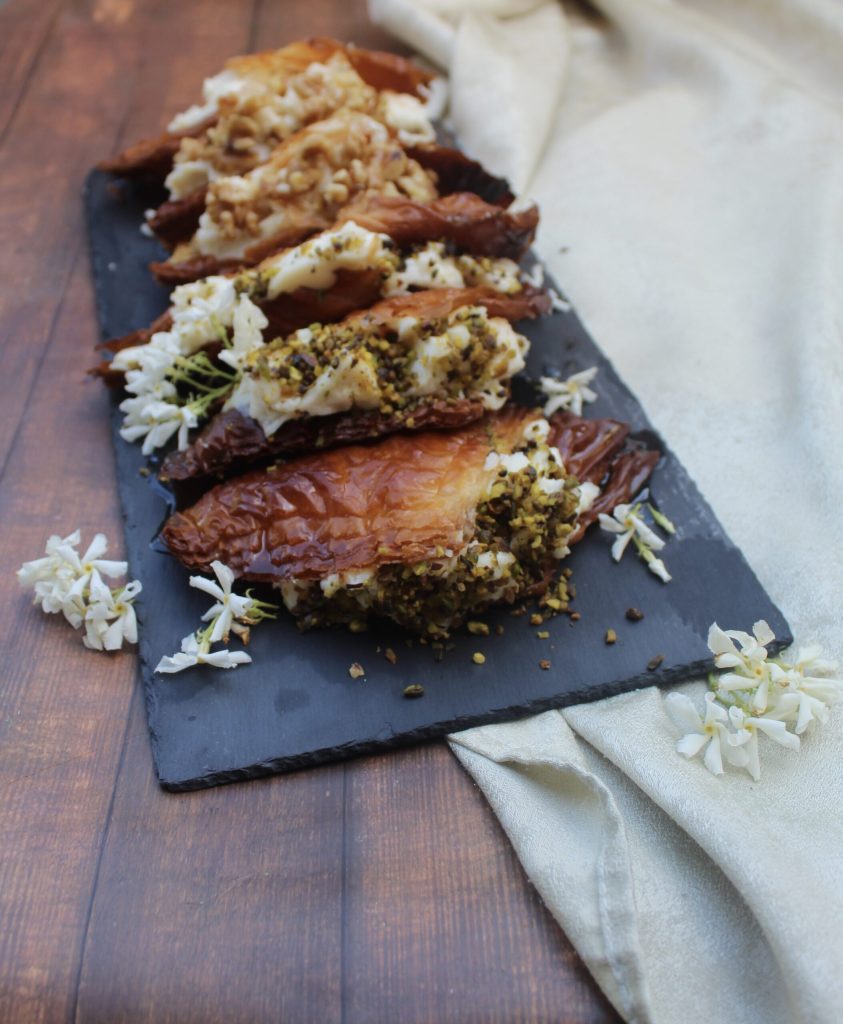
The Warbat bil Ashta is a dessert made with phyllo dough filled with ashta, a Middle Eastern milk cream scented with rose water or orange blossom water, and sprinkled with sugar syrup and nuts.
A kind of filled baklava.
The ashta was traditionally prepared by removing the layer of fat that forms when boiling milk, similar to the recipe for Russian Kasha, English clotted cream, or Turkish kaymak.
The home version (quicker): involves making a kind of sweet béchamel by thickening milk with starch and flavors.
Ashta is served as a filling or topping in many Middle Eastern desserts:
• Qatayef bil Ashta (small pancakes filled with cream and served with syrup)
• Osmalieh / Othmaliyeh (layers of kadayif pastry with cream)
• Aish as-Saraya (dessert with breadcrumbs and ashta cream)
- Difficulty: Medium
- Cost: Cheap
- Preparation time: 20 Minutes
- Portions: 10 pieces
- Cooking methods: Stovetop
- Cuisine: Arab
- Seasonality: All seasons
Ingredients for Warbat bil Ashta:
- 10 phyllo dough sheets
- 7 oz clarified butter
- 2 cups milk
- 1/3 cup sugar
- 2/3 cup cornstarch
- 1 to taste orange blossom or rose essence
- to taste nuts (chopped pistachios, walnuts, almonds…)
- 2/3 cup water
- 1/2 lemon (juice)
- 1 1/2 cups sugar
Preparation
Cut the phyllo dough into squares and brush each sheet with melted clarified butter.
Layer 5 sheets and fold the squares into triangles.
Bake in the oven at 482°F for 10 minutes.
For ashta: pour the milk into a large saucepan and add the sugar. Dissolve the cornstarch in a little cold milk in a separate bowl.
Add the dissolved starch to the hot milk, stirring constantly with a whisk to avoid lumps.
Cook over medium‑low heat, continuing to stir until the mixture thickens into a glossy and dense cream (about 8‑10 minutes).
Remove from heat and incorporate the orange blossom water (or rose water).Fill the triangles once cooled. Decorate the part of the cream that escapes with the chopped nuts.
For the syrup: boil the ingredients and pour the syrup, once cold, over the triangles.
Khaled Khalifa is among the most well-known Syrian writers, always critical of the Assad government. His works have often been banned in his homeland, and he has faced intimidation and violence, such as having his hand broken in 2012.
Author of four novels and several poetry collections, he received the 2013 Naguib Mahfouz Medal for Literature for No Knives in the Kitchens of This City, which you can also purchase online.
