
How to make soft, tall activated charcoal focaccia at home
Homemade Black Focaccia with activated charcoal: secrets for a perfect dough.
The main worry when deciding to prepare an “alternative” focaccia like the charcoal one is the fear that adding the vegetable powder could ruin the rise or make the dough too dry.
Often you find yourself with a hard black slab instead of the soft cloud we had imagined, ending up thinking charcoal is only an aesthetic coloring that harms the texture.
The truth is charcoal is a wonderful ingredient but it must be properly balanced with hydration and resting times so as not to compromise the gluten network and the final softness.
So before trying it myself I consulted my friend, food blogger Vanessa Gizzi, who revealed all the tricks from her experience.
And don’t forget that activated charcoal not only gives a deep black color that makes any topping stand out, but it also makes the focaccia extremely digestible.
The black focaccia, as my son nicknamed it, is the ideal solution for those who want something showy on the table without giving up the softness of classic Ligurian focaccia.
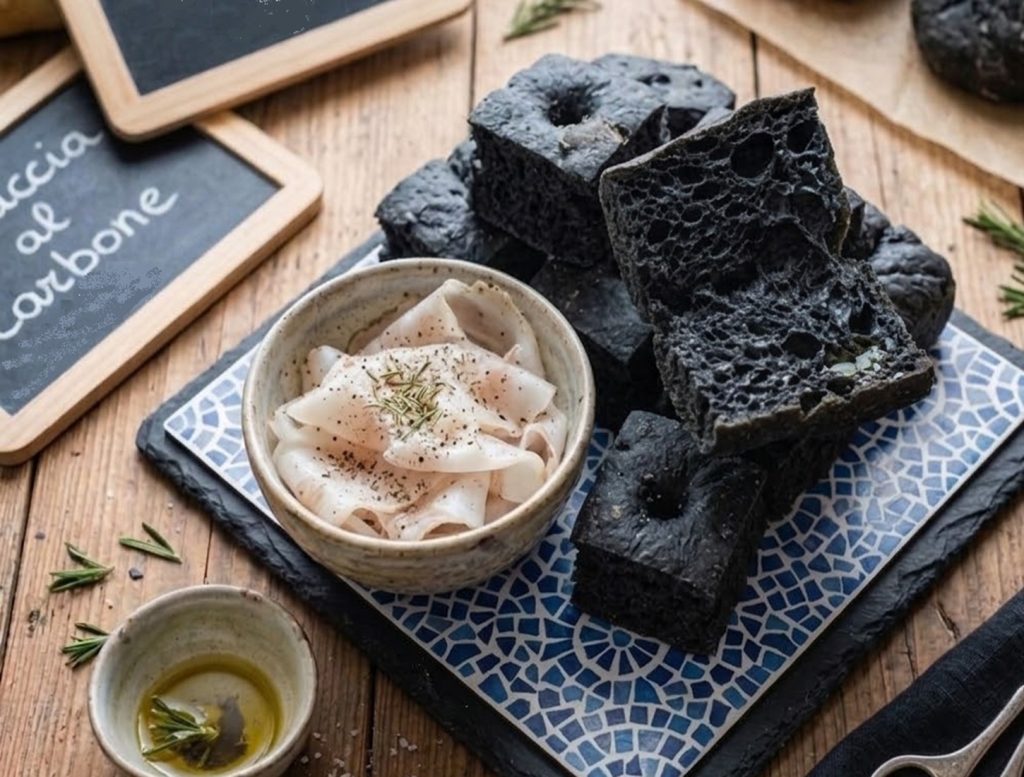
- Difficulty: Very easy
- Cost: Very inexpensive
- Rest time: 4 Hours
- Preparation time: 30 Minutes
- Cooking time: 25 Minutes
- Portions: rectangular baking pan
- Cooking methods: Oven
- Cuisine: Italian
Ingredients for Activated Charcoal Focaccia
- 2 cups Manitoba (high-gluten) flour
- 2 3/4 cups type 00 (all-purpose/bread) flour
- 1 tbsp activated charcoal (food-grade)
- 3 tbsp extra virgin olive oil
- 1 3/4 tsp fine salt
- 1 tsp active dry yeast
- 7 fl oz water
- 1 tbsp granulated sugar
Tools
- Digital kitchen scale
- Small bowl
- Mixing bowl
- Work surface (wooden board) 24 x 31.5 in
- Plastic wrap
- Baking tray
Activated Charcoal Focaccia: secrets for a perfect dough
Start by mixing the two flours and the activated charcoal powder in a large bowl. Add the dry yeast with one tablespoon of sugar and mix well to distribute the components evenly. Pour in half of the water and begin kneading; then add the remaining water, the oil, and finally the salt. Transfer the dough to the work surface and knead until you have a smooth, silky ball.
Cover the dough ball with a bowl and leave it on the table covered for 30 minutes. After the first 30 minutes perform the first folds: stretch it with your hands into a rectangle, fold the two sides over themselves and finally fold the two extreme sides up, shaping a nice round loaf. Cover again with the bowl and repeat the folding twice more, every 30 minutes.
Place the dough for the activated charcoal focaccia in a bowl, cover with plastic wrap and let it rise until doubled in a sheltered place. Prepare a rectangular or 11 in (28 cm) round baking tray, brush the inside with a little oil and place the dough inside. Cover with a cloth and let rise for another 30 minutes directly in the pan.
Use your fingers to make dimples across the base of the focaccia, drizzle with oil, add coarse salt and rosemary. Bake in a preheated oven at 482°F (250°C) for about 7 minutes on the bottom rack, then move the tray to the middle rack and continue for about another 15 minutes. Once baked, let it cool slightly before serving.
Notes on ingredients and substitutions
Flours: Manitoba flour is necessary for structure; alternatively use a type 0/strong all-purpose flour with at least 12% protein.
Charcoal: Use very fine, food-grade powder; it can be easily found at pharmacies or organic stores.
Yeast: If you use fresh yeast, the dose is about 10–12 g (approximately 3.5–4 tsp).
Tips and Variations
Color pop: Try adding yellow cherry tomatoes or raw burrata for a stunning visual contrast against the black base.
Hydration: If the dough resists too much while folding, wet your hands slightly to make the folds easier.
Storage
You can keep it for 2 days in a paper bag; reheat slightly before eating to bring back the fragrant oiliness.
FAQ (Questions & Answers)
Is activated charcoal harmful?
No, it is a natural supplement often used to aid digestion, but in these amounts it mainly serves an aesthetic function.
Can I skip the sugar?
Yes, but sugar helps the dry yeast “wake up” faster, ensuring a stronger rise.
Why the double bake (bottom then center)?
It mimics the heat of professional ovens, making the base crispy without burning the surface.
