
Eba and egusi soup are a typical pairing in Nigerian cuisine.
Ẹ̀bà or Ebe or Pinon (in Togo, Benin and southern Ghana) is a staple food of Nigeria, Togo and Benin, also consumed in the West African subregion and other African countries.
The term originates from the Yoruba, an ethnic group of West Africa, and refers to a starchy cooked plant food made from grated, dried cassava flour, commonly known as garri throughout West Africa.
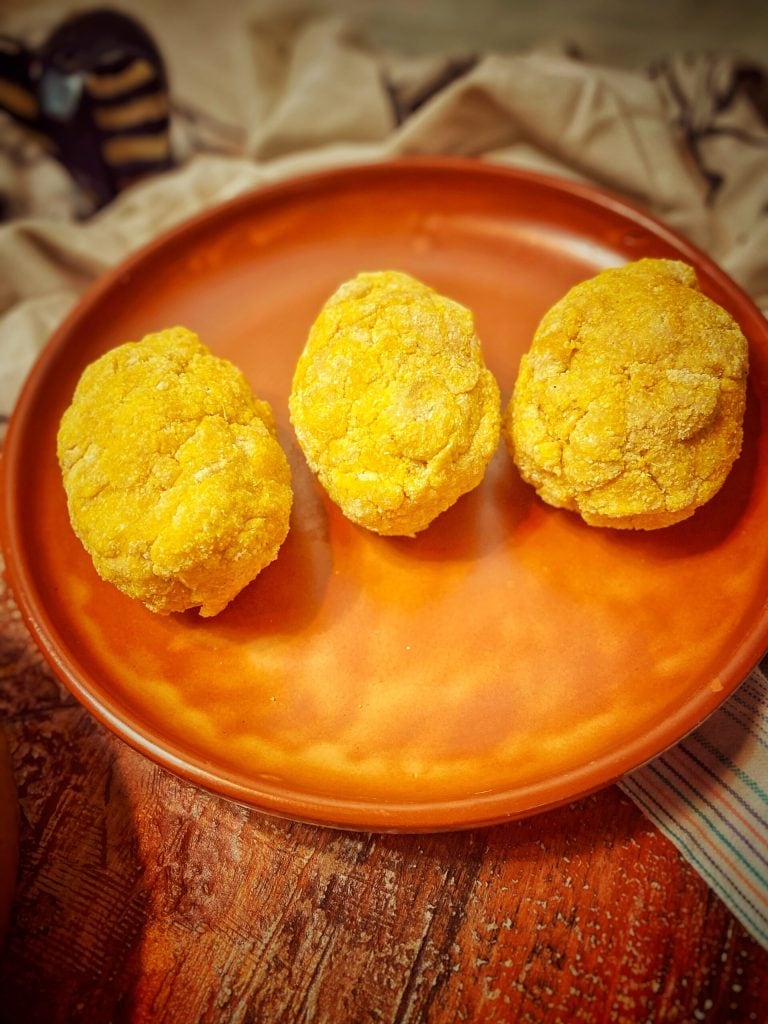
Depending on the type of garri used, its color can vary from deep yellow to off-white. Often palm oil is added during preparation, which gives garri a bright yellow color.
Not to be confused with ugali, which is prepared with white cornmeal.
Eba is eaten with the fingers, rolled into a small ball and dipped into thick soups such as okra soup, the chili paste in Togo, soups made with bitter leaves or okro, ọgbọnọ, or ewédú, with meat or fish, stewed vegetables or other sauces such as gbẹ̀gìrì, ofe akwu (banga soup) or egusi soup, i.e. a beef soup thickened with melon seeds called “egusi”.
Egusi (also known as agusi, egwusi, ohue, Ikpan, Ikon, agushi or mbíka) is the name for the protein-rich seeds of certain cucurbit plants (pumpkin, melon, yellow squash), which, after being dried and ground, are used as a main ingredient in West African cooking.
In addition to the seeds, water and oil, egusi soup typically contains leafy greens such as: Efo Tete, scentleaf, okazi/afang (wild spinach), bitterleaf (onugbu), pumpkin leaf (ugu), uziza leaf, celosia and spinach.
Another Nigerian soup eaten with eba:
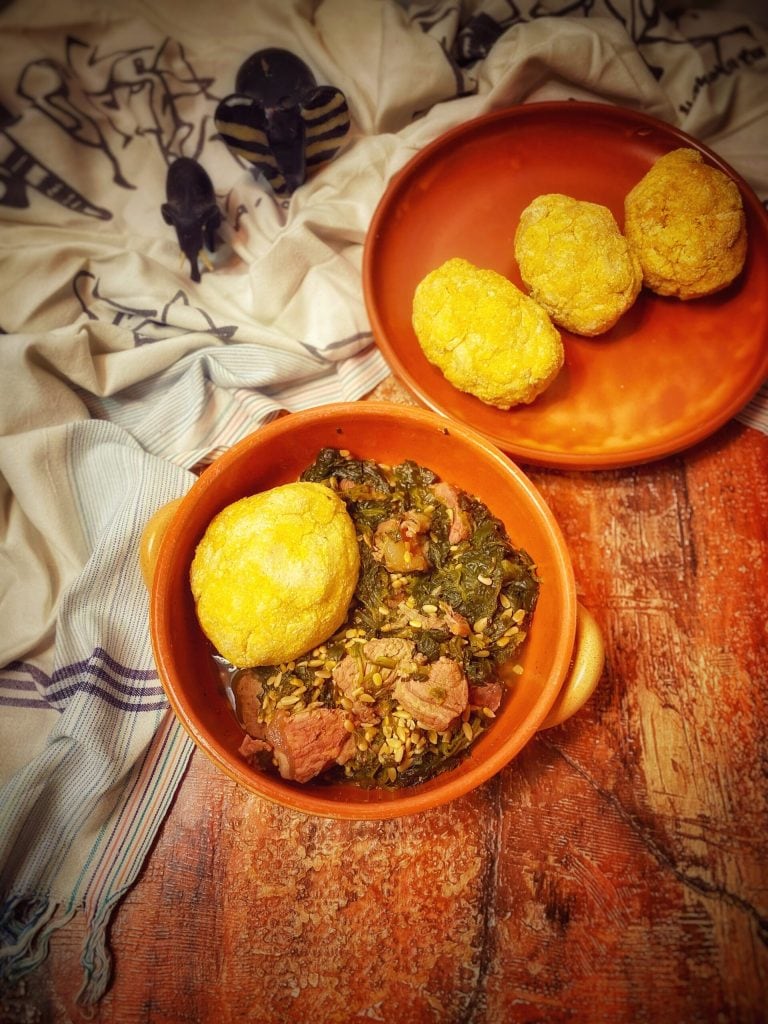
- Difficulty: Easy
- Cost: Inexpensive
- Preparation time: 10 Minutes
- Cooking time: 50 Minutes
- Portions: 4 Servings
- Cooking methods: Boiling, Stovetop
- Cuisine: African
- Seasonality: All seasons
Ingredients
- 1 kg garri (or cassava flour)
- 3 tablespoons palm oil (optional)
- 1 kg beef
- 2 onions
- as needed egusi (or dried melon seeds)
- 1 chili pepper
- 200 g spinach
- as needed salt
Steps
Bring 1 L of salted water to a boil (about 4 1/4 cups). Gradually pour in the garri, stirring constantly with a wooden spatula. If you like, add palm oil as I did for the yellow eba version.
Using paper, shape the mixture into elongated balls.
Cut the beef into 2 cm cubes (about 3/4-inch cubes).
Place the melon seeds in a bowl with 3 tablespoons of water and one chopped onion.
Cook the beef in 200 ml of water (about 3/4 cup) with the other chopped onion for 30 minutes, set aside and do not discard the broth.
In a large pot, sauté the melon seeds in the palm oil, add the broth, the chili, and the spinach. Season with salt and add the beef. Cook for another 20 minutes and, if necessary, add more broth or water.

FAQ (Questions and Answers)
What is garri?
In West Africa, garri (also known as gari, galli or gali) is the flour made from the root of cassava.
In the Hausa language, garri can also refer to flours made from corn, rice, yam, plantain and millet.
For example, garin dawa is obtained from maize, garin masara and garin alkama come from maize and wheat respectively, while garin magani is a powdered medicine.
There are two types of garri, white and yellow; yellow garri is prepared by frying it with the addition of palm oil to give it a yellow color.
White garri is fried without palm oil and is slightly more acidic with a stronger taste.
A variant of white garri is popularly known as garri-Ijebu. This is produced mainly by the Yoruba people of Ijebu in Nigeria.
Garri is similar to Brazilian farofa, used in many preparations, particularly in the state of Bahia.
