
Homemade pâte brisée (shortcrust pastry): basic recipe with 3 ingredients for savory tarts and quiches
Tired of buying ready-made pâte brisée? Making it at home is child’s play and the result is infinitely better!
This French-origin base, a cousin of puff pastry, is incredibly easy and quick to make, requiring only a few minutes of your time.
Forget the laborious puff pastry process: pâte brisée is the ideal solution if you want a handmade, authentic base that’s ready in no time.
With only 3 ingredients you probably already have in your pantry, you can create savory tarts (like the classic quiche Lorraine), tartlets for tasty appetizers, crispy pasta timbales, show-stopping crusted roasts and even bases for sweet recipes instead of shortcrust.
Once you try this foolproof recipe, I guarantee you won’t go back!
Pâte brisée — foolproof basic recipe: how to make it in 10 minutes
- Difficulty: Very easy
- Cost: Very inexpensive
- Preparation time: 10 Minutes
- Portions: 1 savory tart or 12 tartlets
- Cooking methods: No cooking
- Cuisine: Italian
Ingredients
- 100 g butter (cold)
- 200 g 00 flour
- 50 ml water (ice-cold)
- 1 pizzico salt
Tools
- Bowl
Pâte brisée — foolproof basic recipe: how to make it in 10 minutes
The Importance of Working Quickly: Whether you choose to mix by hand or use a food processor (recommended for speed), the secret to a perfect pâte brisée is not to overwork the dough. Overworking warms the butter (from your hands or the blades), making the dough sticky and hard to roll out, resulting in a less flaky final texture.
Put the flour, cold butter cut into cubes and a pinch of salt into the bowl of the food processor.
Pulse intermittently for a few seconds at a time until you obtain a sandy, crumbly mixture.
Add the ice-cold water in a thin stream and pulse again for a few seconds, until the dough starts to come together.In a large bowl, combine the flour, cold butter cut into cubes and a pinch of salt.
Work quickly with your fingertips to “rub” the butter into the flour until you get a sandy mixture. Avoid warming the dough.
Add the ice-cold water a little at a time, mixing quickly until a uniform dough forms.Remove the dough from the food processor or bowl, shape it into a flattened disk (not a ball — it will be easier to roll later), wrap in plastic wrap and refrigerate for at least 30 minutes. This resting time is essential to let the gluten relax and the butter firm up, ensuring a flaky, easy-to-handle pâte brisée.
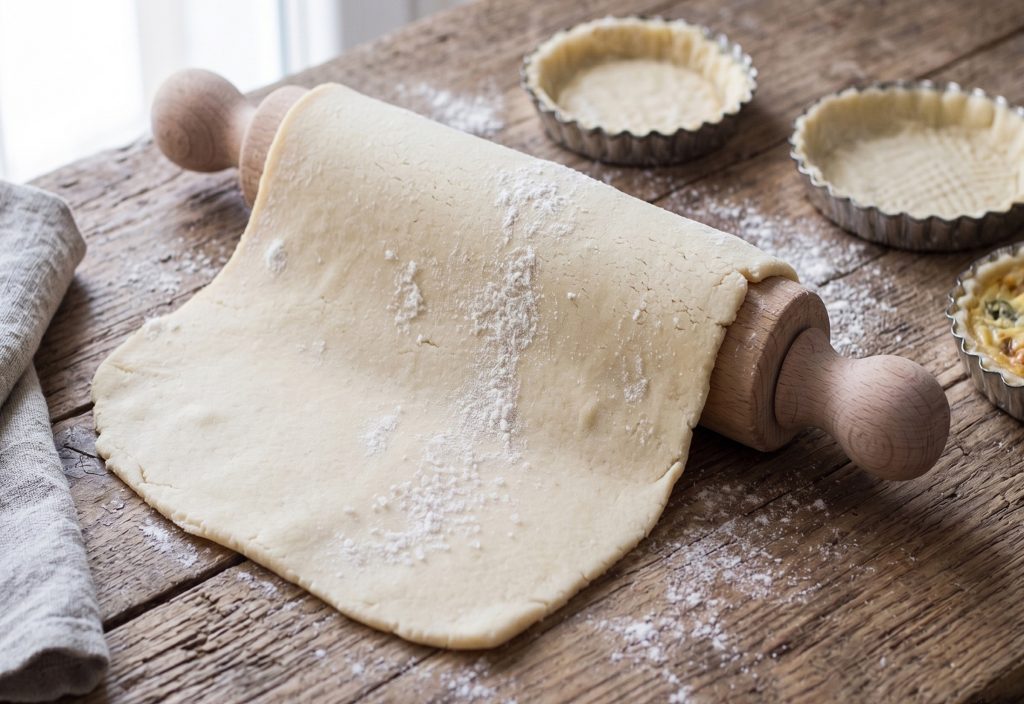
After 30 minutes, take the pâte brisée from the refrigerator and roll it out on a lightly floured surface with a rolling pin. The ideal thickness depends on the preparation: about 4–5 mm for savory tarts (about 3/16 inch) and 3 mm for tartlets or more delicate mini-tarts (about 1/8 inch).
Use this method when the pâte brisée base is baked together with the filling, such as for quiches and savory tarts.
Roll the pastry out to about 4–5 mm thick (about 3/16 inch).
Gently lay it into a buttered and floured tart pan, pressing it to fit the sides well.
Trim the excess by rolling the pin across the top of the pan.
Dock the bottom with the tines of a fork.
Add the filling and bake in a preheated conventional oven at about 356°F for approximately 40–50 minutes, until the edges are lightly golden.This method is ideal for tartlets or bases that will be filled cold, like fruit tarts or appetizers with Russian salad.
Roll the pâte brisée to the desired thickness.
Line the buttered and floured tart mold, making sure the pastry adheres well to the edges.
Trim the excess pastry.
Dock the bottom with a fork.
Cover the pastry with a sheet of parchment paper and fill it with baking weights (dried beans or rice).
Bake at 356°F for about 15–20 minutes.
Remove from the oven, discard the weights and parchment and let the base cool completely before filling.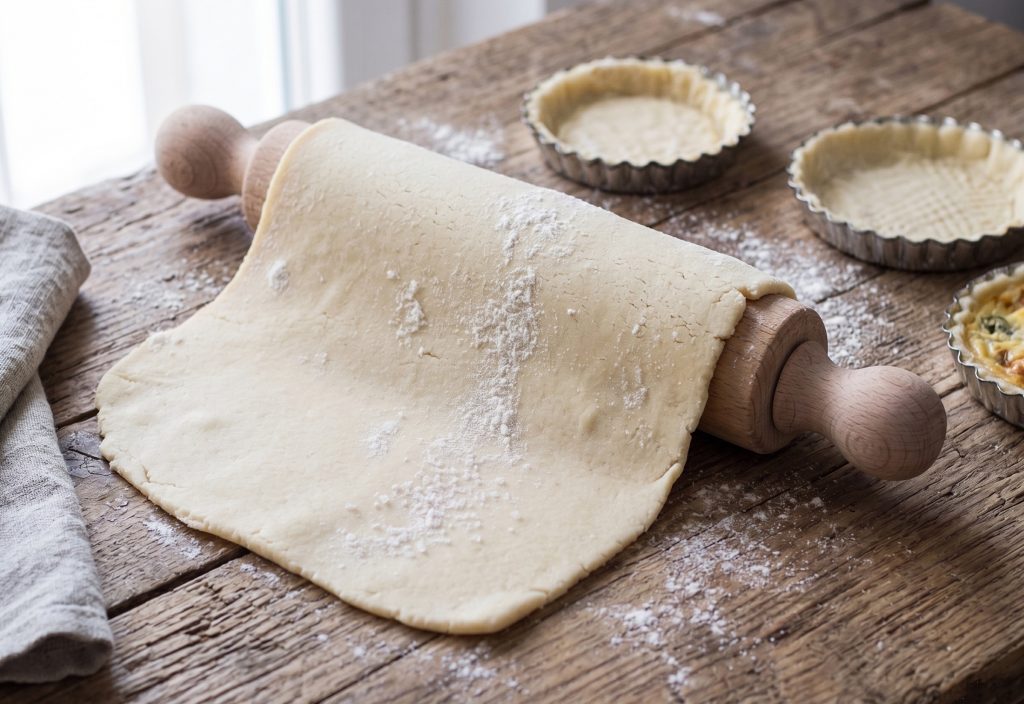
Customize Your Pâte Brisée:
Unleash your creativity! You can flavor the dough by adding finely chopped fresh herbs, spices (turmeric, saffron, paprika) or grated citrus zest (lemon, orange) for sweet versions.
‘A Tavola con Tea’ Tips for a Perfect Pâte Brisée:
Cold Butter and Water: The butter must be refrigerator-cold and the water ice-cold. This is the secret to the characteristic flakiness of pâte brisée.
Don’t Overwork: Heat is the enemy of pâte brisée. Work the dough quickly to avoid overheating it.
00 Flour: A weak flour with a low protein content is ideal for this preparation.
Use Quality Ingredients: Even though the recipe is simple, the quality of the butter and flour affects the final result.
Storage:
Raw pâte brisée keeps in the refrigerator wrapped in plastic for a couple of days. You can also freeze it for about a month. Let it thaw at room temperature before use.
Can I use oil instead of butter?
Although possible, oil will not guarantee the same flakiness as butter. Cold butter creates small layers of fat that melt during baking, producing the classic flaky texture of pâte brisée. If you decide to use oil, I recommend choosing a neutral-flavored one and slightly reducing the quantity compared to butter.
My pâte brisée is sticky — what can I do?
You’ve probably worked it too much or the butter has warmed up. Put it in the refrigerator for at least 30 minutes before rolling. If it’s still sticky, add a pinch of flour to the work surface and rolling pin while rolling out.
Why did my pâte brisée shrink during baking?
This can happen if the dough was overworked or not chilled enough. Make sure not to handle the pastry excessively and to respect the resting time. Docking the bottom before blind baking can also help.
Can I bake pâte brisée in a fan (convection) oven?
Yes, but I suggest lowering the temperature slightly (by about 18–36°F) and checking more frequently, because a fan oven tends to cook faster.
My pâte brisée is raw inside after conventional baking — how can I fix it?
Make sure the oven is preheated to the correct temperature and that the tart is positioned in the center. If the surface is already golden but the inside is raw, you can cover the tart with aluminum foil and continue baking for a few minutes. Also ensure the base isn’t too thick.
