
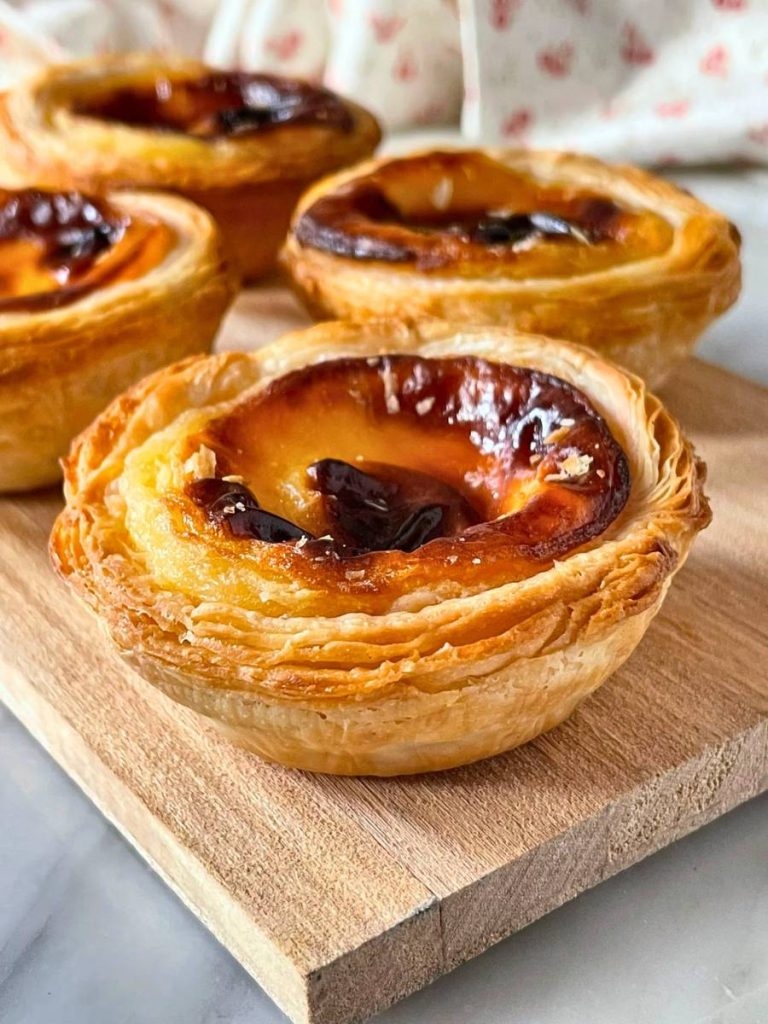
There are pastries that are more than something to be eaten: they take you by the hand and lead you elsewhere. The pastel de nata is one of them. Just look at it — that golden spiral of custard cracking on the surface, the puff pastry curling like a fan — and you already feel a distant call, as if it’s an invitation to catch the next flight to Lisbon. Because this pastry is not just a recipe: it’s a piece of the city, a fragment of light, a scent mingling with the ocean breeze and the uphill streets.
Anyone who’s been to Portugal knows: the pastel de nata is not tasted, it’s experienced. You bite into it standing at the counter of a tiny bakery while yellow trams pass outside and time seems to slow. It’s eaten hot, just out of the oven, with custard that still trembles and pastry that breaks into a thousand light flakes. And as you do, you realize it’s not just a pastry: it’s an everyday gesture, a habit the Portuguese keep with the same ease as greeting a friend on the street.
Yet, even without being in Lisbon, the pastel de nata can evoke all of this. Making it at home is like opening a window onto another place: as the custard thickens and the pastry browns, the kitchen fills with a scent of travel, sea, and luminous mornings. It’s a simple pastry with a strong character: the sweetness is never cloying, the custard is silky but not heavy, the pastry is flaky without being fragile. Every bite is a perfect balance, as if someone had found the exact formula to enclose the essence of an entire country in one mouthful.
So yes, perhaps it’s inevitable: while you prepare them, you’ll want to leave. To walk the streets of Belém, sit at a small outdoor table, watch the Tagus glint under the afternoon sun. To taste one pastel de nata after another, because in Portugal that’s how it is: you don’t eat just one, you eat two, three, until you find the “perfect” one — even though you later discover they’re all perfect, each in its own way.
This recipe is born from that desire: to bring a bit of Portugal home, but also to let the scent of these pastries push you, sooner or later, to really travel. Because the pastel de nata is a gentle invitation: it says “come visit me,” and as you taste it, you already begin to imagine when.
And when we go to Portugal we enrich the story around the world with delicious dishes. Here are a few of my favorite recipes.
- Difficulty: Medium
- Cost: Economical
- Rest time: 5 Hours
- Preparation time: 30 Minutes
- Cooking time: 10 Minutes
- Portions: 12 pastries
- Cooking methods: Oven, Stovetop
- Cuisine: Portuguese
- Seasonality: All seasons
- Energy 531.59 (Kcal)
- Carbohydrates 60.75 (g) of which sugars 28.94 (g)
- Proteins 11.15 (g)
- Fat 28.71 (g) of which saturated 17.07 (g)of which unsaturated 11.39 (g)
- Fibers 1.83 (g)
- Sodium 83.29 (mg)
Indicative values for a portion of 135 g processed in an automated way starting from the nutritional information available on the CREA* and FoodData Central** databases. It is not food and / or nutritional advice.
* CREATES Food and Nutrition Research Center: https://www.crea.gov.it/alimenti-e-nutrizione https://www.alimentinutrizione.it ** U.S. Department of Agriculture, Agricultural Research Service. FoodData Central, 2019. https://fdc.nal.usda.gov
Ingredients for pastel de nata
- 4 cups all-purpose flour
- 1 1/3 cups butter (cold)
- 1 1/4 cups whole milk
- 1/4 cup granulated sugar
- 0.9 oz fresh yeast (about 2 1/4 tsp active dry yeast)
- 1 egg
- 1 pinch salt
- 1 cup whole milk
- 1 cup water
- 1 1/4 cups granulated sugar
- 1/4 cup all-purpose flour
- 8 egg yolks
- 1 lemon zest
- 1 stick cinnamon stick
- 1 pinch salt
Tools
- Muffin tin
Preparation of pastel de nata
Dissolve the yeast in the milk and add the sugar, egg and salt. Gradually add the flour until you obtain a soft, uniform dough. Cover and let rest for 30 minutes at room temperature and then refrigerate for another 30 minutes.
Roll the dough into a rectangle about 12 x 16 inches, distribute the butter in thin slices on top and fold like a book, sealing the edges well. Roll out again and perform a series of “three-fold” turns, repeating the process four times, always resting the dough in the refrigerator for 30 minutes between folds.
This process creates the layered puff pastry typical of pastéis.Bring 200 ml (about 3/4 cup) of milk, the water, the sugar, the lemon zest and the cinnamon stick to a boil. In a bowl, mix the flour with the remaining cold milk, then pour the hot liquid over it and return to the heat until the custard thickens.
When it has cooled slightly, incorporate the egg yolks and mix well.Preheat the oven to 482°F.
Roll out half of the dough to a thickness of about 3/8 inch, roll it into a cylinder and cut into slices. Place each slice into the muffin tin, pressing with your fingers to form the shell.Keep the other half of the dough in the freezer for another occasion.
Fill with the custard and bake for about 10 minutes, until the surface becomes glossy and slightly charred, as in the Portuguese tradition.
Let cool before unmolding.
Follow me on social media
my Facebook page Facebook my Instagram profile Instagram my Pinterest page Pinterest
FAQ (Questions and Answers)
Where were pastéis de nata born?
Pastéis de nata were born in the Belém district of Lisbon, inside the Jerónimos Monastery. When the monasteries were closed in the 19th century, a monk took the secret recipe to a small nearby bakery, the Antiga Confeitaria de Belém, which still preserves the original version today.
Why is the original recipe considered secret?
The formula of the pastéis de Belém remained a monastic secret: it was passed down only to a few trusted people and even today it is protected. The pastry shop that produces it uses a laboratory closed to the public, accessible only to authorized confeiteiros (pastry chefs).
What is the difference between Pastéis de Belém and Pastéis de Nata?
Pastéis de Belém are the original version, produced exclusively by the historic Belém pastry shop. Pastéis de Nata are the version spread throughout Portugal and the world: similar in appearance but with recipes slightly adapted by each bakery.
