
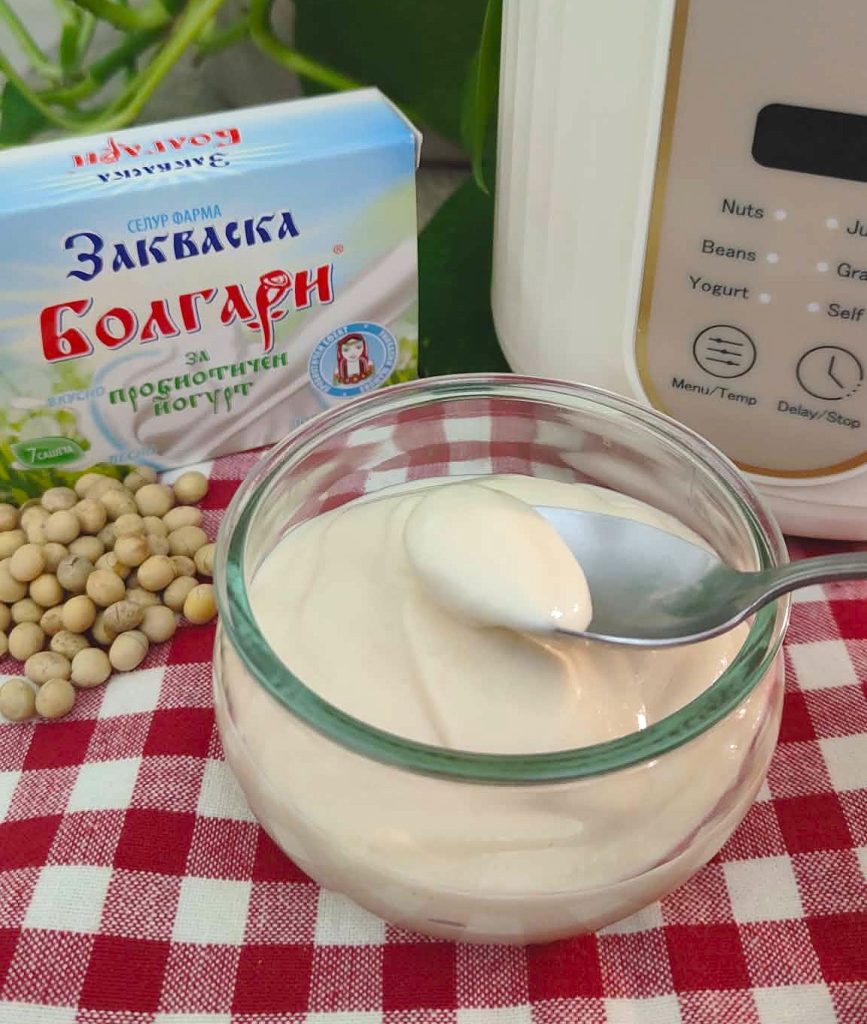
“This is one of the few truly effective methods to obtain thick and creamy homemade soy yogurt, avoiding the typical runny result common in online recipes.”
Obtaining thick and creamy homemade soy yogurt is one of the most frequent challenges in plant-based cooking. Those who, like me, have tried know: in most cases the result is a yogurt that is too liquid, poorly structured and often slightly grainy.
This happens because soy milk, unlike cow’s milk, does not naturally contain the same proteins and casein structures that allow traditional yogurt to thicken spontaneously.
This complete and tested method allows you to obtain a plant yogurt that is truly thick, creamy and stable, using either homemade soy milk or commercially available high-protein soy milk, with fermentation in a yogurt maker, Thermomix (Bimby) or Monsieur Cuisine.
Why does homemade soy yogurt turn out runny?
The majority of online recipes do not address the main issue:
Soy yogurt does not thicken naturally like dairy yogurt.
Even using yogurt as a starter, you may find that:
– fermentation happens and flavor develops, but the texture remains weak and unstable.
This happens because:
– soy proteins have a different structure
– there is no strong protein network
– acidification alone is not enough to create thickness
👉 Result: runny yogurt or separation (whey + solid part)
MY METHOD
To solve this problem I developed a method based on three key elements:
1. High protein concentration
Use:
– homemade soy milk (with a high ratio of soybeans)
or
– commercial soy milk with a high protein percentage (such as Cereal or similar)
👉 More protein = better structure
2- Balanced thickening system
I use a combination of:
– cornstarch → gives body and density
– agar-agar → stabilizes and creates structure
👉 Together they allow you to obtain a yogurt that is not runny but creamy and uniform.
3. Specific starter cultures
I use selected cultures:
– Lactobacillus bulgaricus
– Streptococcus thermophilus
👉 These strains ensure a balanced fermentation on a plant base
4 – Which soy milk to choose
✔ Homemade soy milk is more natural and gives you more control over the thickness.
👉 I recommend using at least 100 g of dry soybeans per liter of water.
✔ Commercial high-protein soy milk is more practical and speeds up production.
👉 Choose an unsweetened product without additives with a high protein percentage, at least between 10–15% (such as Cereal.)
IN CONCLUSION
👉 To obtain a thick and creamy soy yogurt, you must work on protein concentration, technique and the right cultures.
This is what makes the difference between a runny yogurt… and a perfect one.
- Difficulty: Easy
- Cost: Very inexpensive
- Rest time: 12 Hours
- Preparation time: 10 Minutes
- Cooking time: 20 Minutes
- Portions: 5Persone
- Cooking methods: Other, Cooking with kitchen machine
- Cuisine: Italian
Ingredients
VERSION WITH HOMEMADE SOY MILK
For the soy milk:
100 g dry soybeans (about 3.5 oz — roughly 1/2 cup), soaked for 8–10 hours
1 liter (about 4 1/4 cups) filtered water
For the yogurt:
1 liter (about 4 1/4 cups) freshly prepared soy milk (optional: with 2 tablespoons very finely ground okara fiber)
10–15 g sugar (about 2–3½ teaspoons) — used to feed the bacteria, not to sweeten
10 g cornstarch (about 1 1/4 tablespoons)
3 g agar-agar (about 1 teaspoon)
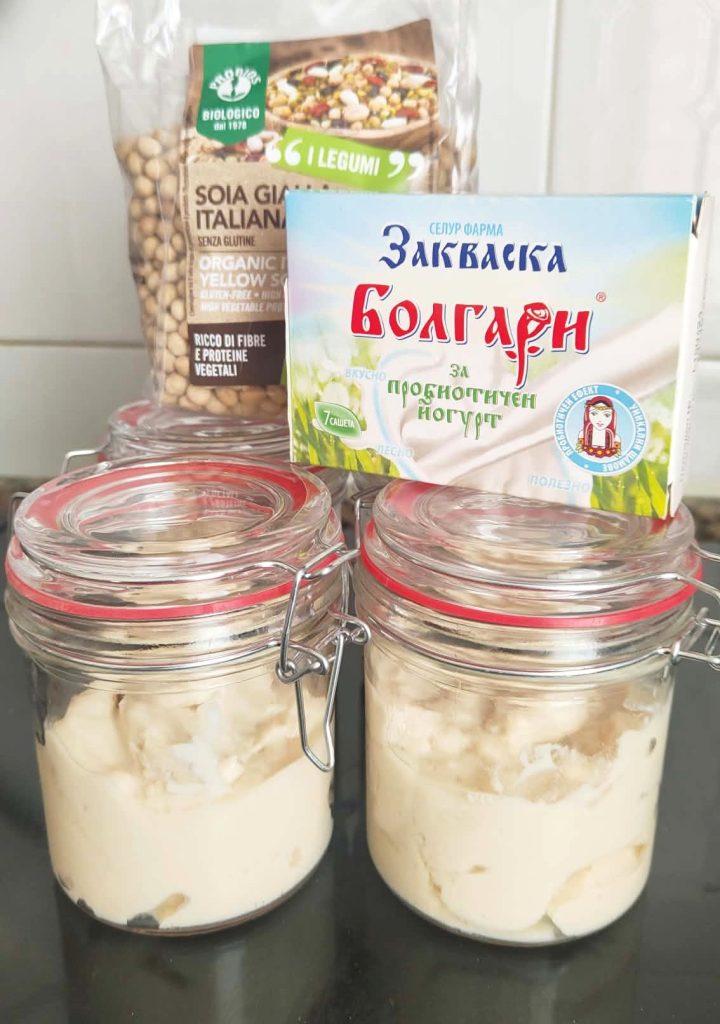
1 g yogurt starter cultures (Lactobacillus bulgaricus and Streptococcus thermophilus)
👉 Tip: leave a small portion of okara in the milk to increase fiber and creaminess.
VERSION WITH PURCHASED SOY MILK (high-protein types like Cereal or similar)
1 liter (about 4 1/4 cups) unsweetened natural soy milk with high protein percentage (choose one between 10–15%)
10–15 g sugar (about 2–3½ teaspoons) — used to feed the bacteria, not to sweeten
10 g cornstarch (about 1 1/4 tablespoons)
3 g agar-agar (about 1 teaspoon)
1 g yogurt starter cultures (Lactobacillus bulgaricus and Streptococcus thermophilus)
👉 Important: avoid soy milks with additives or preservatives; choose brands like Cereal.
Steps
1 – Preparation of the soybeans:
Rinse well 100 g of dry soybeans (about 3.5 oz — roughly 1/2 cup) and leave them to soak for at least 8–10 hours.
After soaking, rinse again and blend finely with the water (1 liter — about 4 1/4 cups) until you obtain a smooth soy milk.2 – Cooking the soy milk:
Bring the milk to a boil and cook it at about 185–194°F (85–90°C) for at least 20 minutes, stirring constantly.
At the end of cooking, strain the milk to separate the okara. As an optional step, you can reintegrate 1–2 tablespoons of okara into the milk to increase protein and fiber content.3 – Prepare the thickeners:
Add to the hot milk the sugar, the cornstarch and the agar-agar and mix well to avoid lumps.
If needed, briefly blend with an immersion blender to ensure smoothness.4 – Cooling:
Let the milk cool to about 108–113°F (42–45°C) before inoculating the cultures.
5 – Inoculation of the cultures:
Add the chosen yogurt starter cultures and mix well.
6 – Fermentation in a yogurt maker:
Pour the inoculated milk into the yogurt maker.
Leave to ferment for 12 hours at 104°F (40°C).7 – Final cooling:
Once the yogurt is ready, give it a light blend with an immersion blender to make it velvety and then refrigerate immediately for at least 2–3 hours: the texture will further stabilize and the yogurt will be even creamier.
1. Preparation
– Pour the high-protein soy milk (for example Cereal) into a pot.
– Add the sugar and stir.2. Thickeners
– Dissolve the cornstarch in a little cold milk
– Add it to the milk in the pot and also add the agar-agar.
👉 Mix all ingredients well to prevent lumps.3. Cooking
– Bring the milk to a boil, about 185–194°F (85–90°C)
– Cook for 3–5 minutes, stirring.
👉 This activates the thickeners.4. Cooling
– Let the milk cool to 108–113°F (42–45°C)5. Inoculation of the cultures
– Add the yogurt cultures and mix well.6 – Fermentation with yogurt maker
– Pour the milk into the yogurt maker
– Ferment for 12 hours– Once the yogurt is ready, lightly blend with an immersion blender to make it velvety, then refrigerate immediately for at least 2–3 hours: the texture will further stabilize and the yogurt will be even creamier.
The procedure and technique are the same, but you will use a single appliance. From producing homemade milk (if you want to make it yourself) up to preparing the final yogurt using the Fermentation program.
1
Preparation of purchased or previously homemade milk
Pour 1 liter of high-protein soy milk (or previously homemade soy milk) into the mixing bowl. Add 3 g agar-agar, 10 g cornstarch, 10–15 g sugar.2
Mix the ingredients selecting the program: Custom Cooking: 32°F – 10 seconds – Speed 5
 3
Bring to a boil and maintain for 2-3 minutes to activate the agar-agarCustom Cooking: 194°F – 15 minutes – Speed 24
Cooling
Open the lid and remove the mixing bowl from the appliance to let the milk cool until it reaches 113°F (45°C) (use a kitchen thermometer to check).5
Inoculation of the cultures
Add 1 sachet of specific yogurt cultures (1 g) and mix very well with a spoon. You can also briefly blend to help them dissolve better.6
Fermentation with the program available on Thermomix or Monsieur Cuisine Ferment: 104°F – 12 hours
 7
Brief blend and final cooling
When the yogurt is ready, give it a short blend immediately to make it silkier and then refrigerate for at least 2–3 hours: the texture will further stabilize and the yogurt will be even creamier.Custom Cooking: 32°F – 10 seconds – Speed 5
