
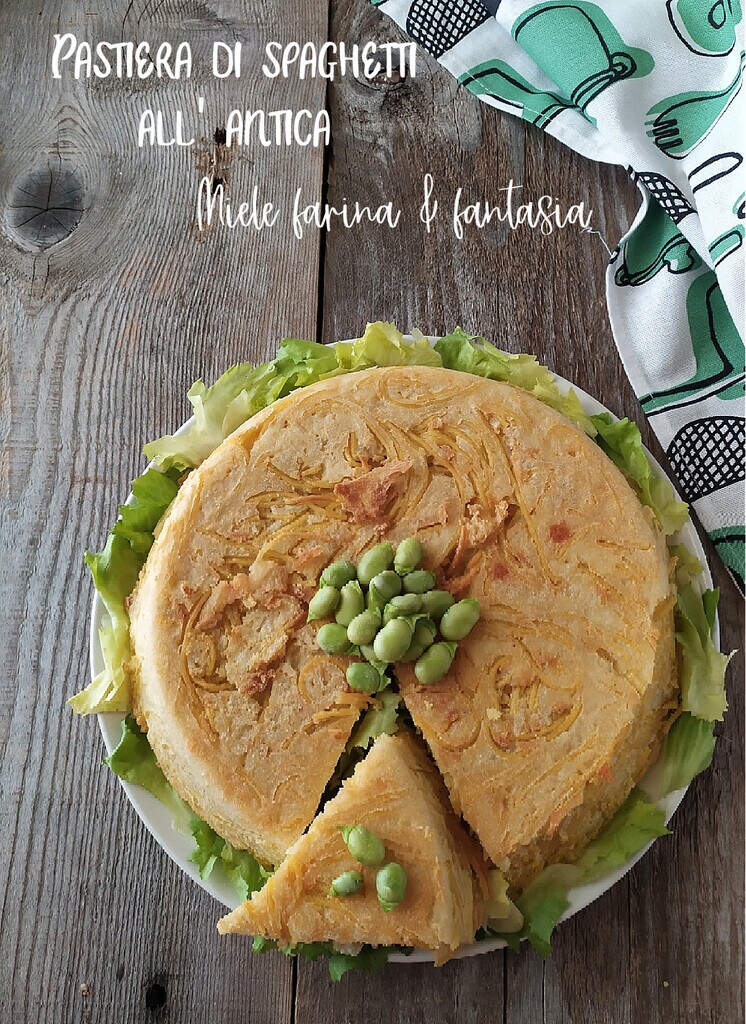
Today I’d like to tell you about the old-fashioned spaghetti pastiera, a savory peasant dish from the inland Caserta tradition and, specifically, from my mother-in-law’s family tradition — eaten at lunch on Holy Saturday, or among the Easter starters and for Easter Monday. It’s generally served with cured meats, cheeses and fresh fava beans. Despite the name, this recipe uses both spaghetti and rice together, combined with a filling of eggs, pepper and cheese, to be baked in the typical “ruoto” (that is, a flared round pan, which is also the usual mold for the far more famous Neapolitan pastiera) in the heat of a wood-fired oven or fireplace. The recipe I present below is a family one — as my mother-in-law made it — and, she says, every family made it their own way with what they had on hand, making it more or less rich in ingredients. This preparation can also be made gluten-free, using a specific gluten-free pasta in the mixture with rice and suitable flours in the batter.
At the links below you will find, respectively, Easter menus both gluten- and lactose-free and traditional ones.
- Difficulty: Very easy
- Cost: Budget-friendly
- Preparation time: 1 Hour
- Cooking time: 40 Minutes
- Portions: 10
- Cooking methods: Stovetop, Oven
- Cuisine: Italian
- Seasonality: Easter Monday, Easter
Ingredients
- 9 oz spaghetti (also available gluten-free)
- 9 oz Roma rice
- 5 medium whole eggs
- to taste ground black pepper
- 1 oz mix of grated Parmigiano and Pecorino Romano
- to taste fine salt
- to taste lard or soft butter
- 5 tablespoons all-purpose flour (or rice flour)
- as needed water
- 2 tablespoons grated Pecorino Romano
- to taste ground pepper
- 1 pinch fine salt
Tools
- 1 Aluminum pan
Steps
To prepare our old-fashioned spaghetti pastiera, start heating the water to cook the pasta. When the water comes to a boil, weigh the spaghetti, break them in half and put them into the water.
Cook them for the time indicated on the package and no longer, in already salted water.
Meanwhile, cook the rice in salted water for the time indicated on its package.
This way both the pasta and the rice will have roughly the same texture and we won’t need to add too many eggs to obtain a soft, well-blended mixture that doesn’t turn out dry.
Transfer the pasta and rice, perfectly drained, into a large mixing bowl.
Add the eggs lightly beaten, plenty of grated cheese, a generous grinding of pepper and mix well. Set aside for a moment.
Preheat the oven to 392°F
For the mold (after preparing the pasta and rice mixture).
Generally, for these quantities, a flared round “pastiera” aluminum pan is used, about 9 1/2–10 1/4 inches in diameter, for a spaghetti pastiera about three fingers thick; or a larger pan for a shallower pastiera.
-Grease the pan with a little lard or soft butter (you can also use seed oil or olive oil if you prefer).
Prepare the batter.
Mix the flour with a little water until a soft batter forms — not too runny but not too thick and stiff. Add the fine salt, the grated cheese, a pinch of pepper and stir the ingredients.
Pour half of the batter into the greased bottom of the pan, add the pasta and rice mixture and level it well with the back of a spoon.
Finally, cover it with the remaining batter, trying to distribute it evenly, and add a little more lard or a few small knobs of very soft butter here and there on the surface (the purpose of covering the rice and pasta mixture with the batter and adding some lard or butter is to prevent the pasta from curling up and becoming dry, hard or even slightly burnt during baking; same for the rice).
Bake the spaghetti pastiera immediately at 392°F on the middle rack. Bake for about 20 minutes or until it turns golden (it should not brown too much) on both the bottom and the surface. Be careful not to let it get too dark as it will become excessively dry.
You can eat it hot or cold, by itself or accompanied by cured meats — and the next day it will be even better.
Gluten-free version
To make this delight gluten-free, use spaghetti specially formulated for that purpose; for the batter, I recommend using a bread mix, an all-purpose gluten-free blend, or a binder such as psyllium, because otherwise it won’t be possible to make a proper batter.
You may also need to add one extra egg to the pasta and rice mixture compared to the gluten version. The procedure remains the same in both cases.
Enjoy
