
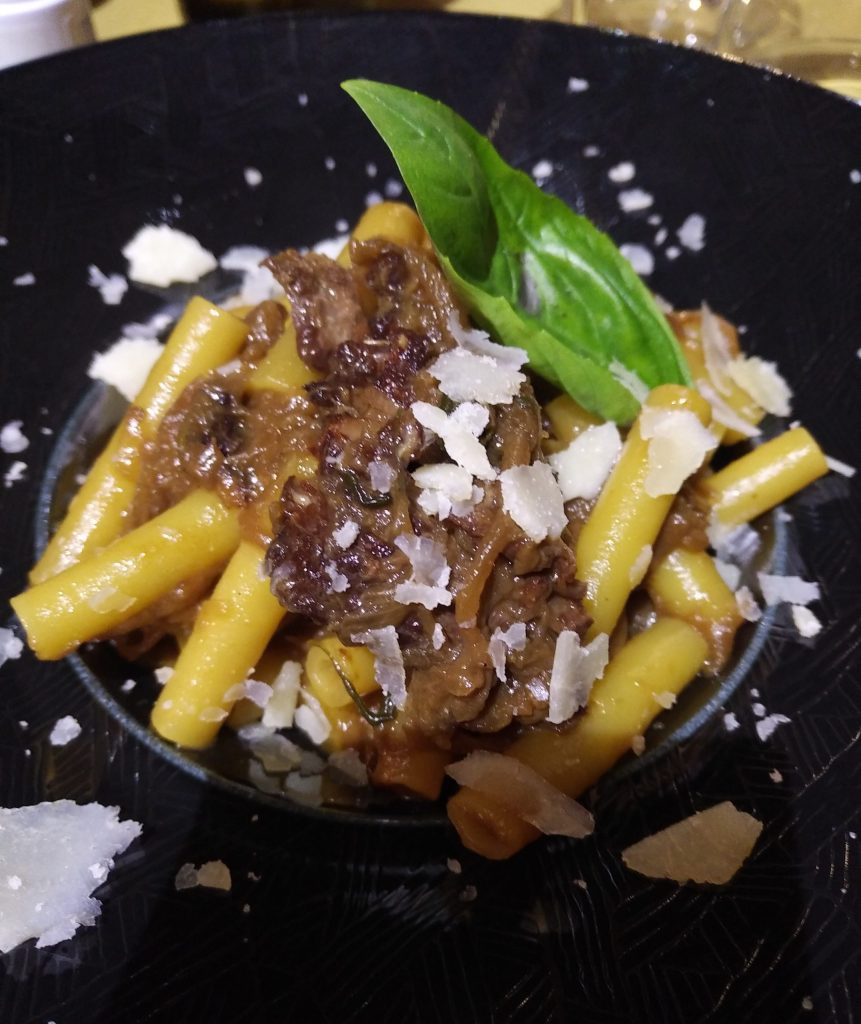
The last evening spent in Naples, we dined in the lively Spaccanapoli neighborhood, at the “La locanda del Gesù vecchio” restaurant with one of the most representative first courses of Neapolitan cuisine: ziti alla genovese.
Despite the name, the recipe is part of the culinary tradition with my region, Liguria. It is probably called this way because the sauce was spread by immigrants or Genoese traders, when Genoa and Naples were the two most important ports in Italy, or the name could simply refer to its inventor, as Genovese is a very common surname in Campania.
It is a white ragout with veal or beef and onions (lots of onions!), preferably copper ones, which requires long cooking.
The most suitable cut of meat is the veal shoulder which should be from annecchia (a calf no older than a year) or the priest’s hat, or the round of beef (which in Neapolitan is called lacierto), or the rump tip.
The most suitable pasta shape is ziti, which are macaroni traditionally used in weddings (zita means bride), to be broken by hand. If you can’t find them, you can use mezzani, sedani, or smooth penne, or paccheri from Gragnano.
Like every traditional recipe, every Neapolitan home has its version. The following is one of these. Some people add white wine during the long cooking process. At your discretion, if you notice that the sauce dries too much.
- Difficulty: Very easy
- Cost: Economical
- Preparation time: 5 Minutes
- Portions: 4 People
- Cooking methods: Stove
- Cuisine: Italian
- Seasonality: All Seasons
Ingredients for Ziti alla Genovese:
- 13.4 oz ziti
- 1.76 lbs veal meat (or beef)
- 2.76 lbs copper onions (or Tropea)
- 3.5 oz butter or lard
- 2 carrots
- 1 1/2 stalk celery
- to taste extra virgin olive oil
- to taste salt and pepper
- to taste Parmesan cheese (optional)
Preparation
Clean and chop the carrot and celery.
Prepare the meat, remove any excess fat, and cut it into large chunks.
In a pot, or a tall earthenware pan, brown the meat in extra virgin olive oil and butter (or lard), add the carrots and celery, and continue for a few minutes.
Add the finely sliced onions and a little water, and season with salt.
Cover and cook on a very low heat, stirring occasionally, for about 3 hours.
The sauce will be ready when the onion has taken on a brown color and a consistency similar to marmalade.
Cook the ziti, after breaking them, in salted boiling water and drain them al dente.
The broken ziti create small pieces that remain at the bottom of the plate, to be collected with the remaining sauce.
Toss the ziti with the sauce in the pan, adding cooking water if necessary.
Serve, if desired, with coarsely grated cheese.
Evolution of the Genovese
Although today the onion is the absolute protagonist that turns into cream, historically the dish originated as a meat and vegetable stew. Here are the key points of its evolution:
Sailor’s Dish: In the 15th century, in the seafaring villages of Naples, cooks prepared a thick soup with meat and lots of onions for sailors (often Genoese, hence the name).
Meat as a “second course”: Traditionally, the meat was cooked entirely in the onions and then served separately as a second course, while the creamy sauce was used to dress the ziti.
Poor Version: There was a “meatless” version (or with very little meat) popularly called “fake Genovese”, consumed by the lower classes who could not afford beef and used only onions and fat to flavor the pasta.
