
After reading “The Kite Runner” and “A Thousand Splendid Suns” by Khaled Hosseini, I became passionate about Afghanistan. Since then it has not been just a place of war (although sadly it still is today and this land has seen many wars), but also a fascinating, ancient place where children once played with kites (the national sport).
Afghanistan has an ancient history in which Islam probably played a key role in shaping Afghan society.
Despite the Mongol invasion of present-day Afghanistan at the beginning of the 13th century, not even a formidable warrior like Genghis Khan succeeded in uprooting Islamic civilization.
I will probably never visit Afghanistan, nor taste its cuisine.
Afghanistan is known for its high-quality pomegranates, grapes and sweets, rugby-shaped melons, but it is the customs of the Pashtun (the largest ethnic group in Afghanistan), the Tajiks and the Uzbeks that have most contributed to shaping today’s Afghan culinary offer.
There we also find the kebab (in Arabic كباب, kebāb, “roasted meat”; in Turkish kebap), but not the most famous Turkish one (the “döner kebab“*), nor the seekh kebab we have already discussed in relation to Indian cuisine. Instead there are other types of kebab:
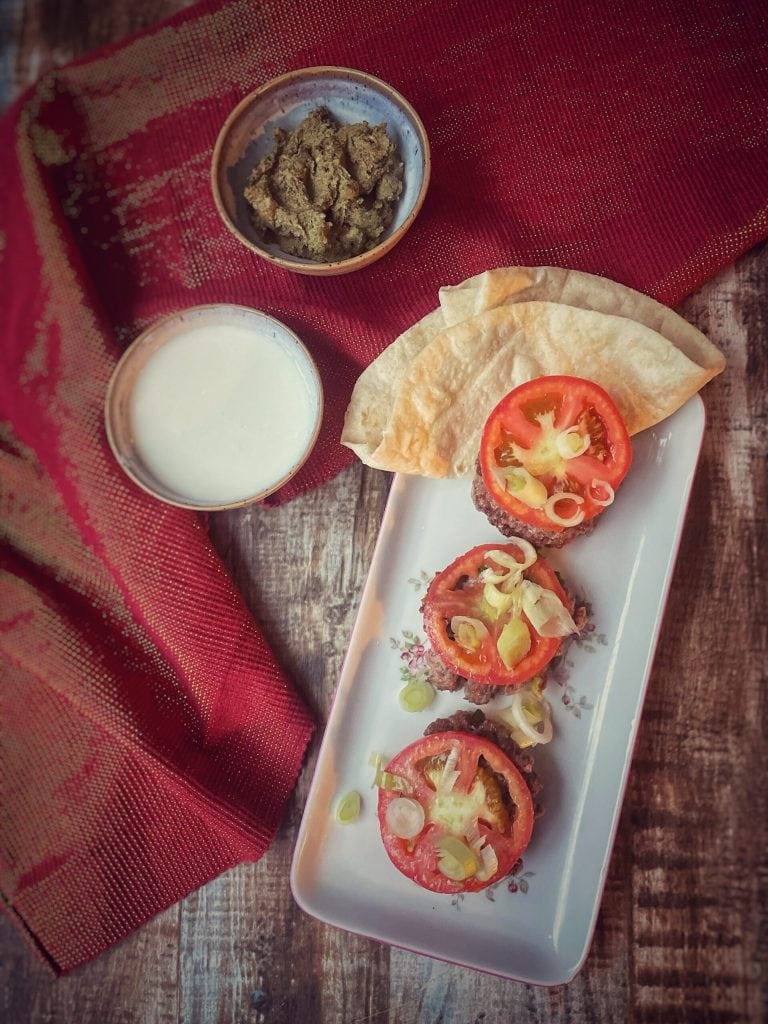
– The Chapli kebab, today’s recipe, typical of Pashtun cuisine, widely eaten in Kabul and throughout Afghanistan as well as in Pakistan (Peshawar). It consists of hand-chopped beef or lamb (traditionally chopped by knife), which is spiced and shaped into flattened patties and fried in a pan with oil or animal fat (often beef or lamb fat).
Traditional chapli kebab is prepared by frying the kebabs in lamb or cow fat over wood-fired stoves.
– In Afghanistan and Kabul the jujeh kabab is also consumed, made with grilled chicken cooked on skewers (also common in Iran), and the chenjeh kabab, originating from southeastern Afghanistan: lamb threaded on skewers after being marinated in herbs and flavored with various spices.
– Also the seena kabab, made with grilled chicken breast and thighs.
The word “kebab” is essentially of Persian origin: Arab tradition holds that the dish was invented in the Middle Ages by Persian soldiers who used their swords to grill meat over open fires while in the field.
Below is the Chapli kebab recipe (in the video with Magic Cooker). The term “chapli” comes from the Pashto word chaprikh, which means “flat” or “plate”, referring to the flattened, wide shape of these kebabs, but on the blog you can also find the recipe for:
- Difficulty: Very easy
- Cost: Budget
- Preparation time: 10 Minutes
- Cooking time: 10 Minutes
- Portions: 4 people
- Cooking methods: Frying
- Cuisine: Middle Eastern
- Seasonality: All seasons
Ingredients
- 1 lb ground beef (or lamb)
- 1 onion (finely chopped)
- 1 clove garlic
- 2 tomatoes
- to taste spices (cumin, coriander, chili pepper, ginger)
- 1 egg
- 2 tbsp cornmeal (or wheat flour)
- 1 tbsp dried pomegranate seeds (anardana) (crushed)
- to taste vegetable oil (or animal fat)
Preparation of the Chapli kebab:
In a large bowl, combine the ground meat with all the ingredients except the tomato slices and the oil.
Mix well with your hands to blend the flavors.
Refrigerate for 30 minutes to make the mixture firmer and more flavorful.
With wet hands, take portions of the mixture and shape into discs about 3/8 inch thick and 3–4 inches wide.
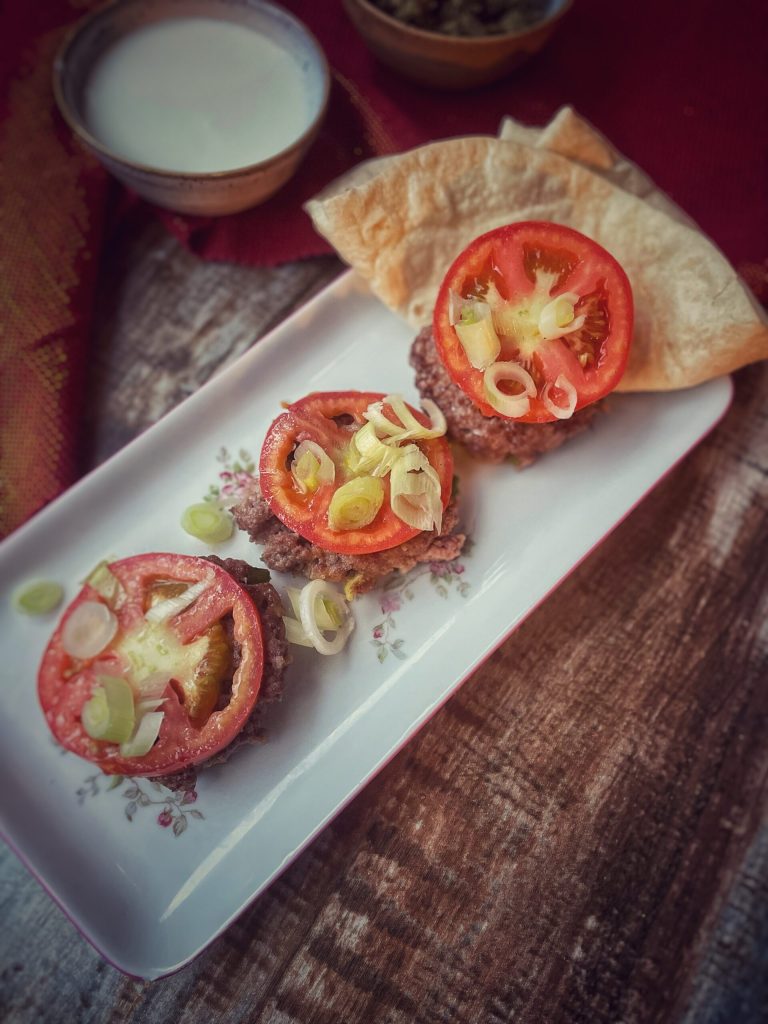
Gently press a slice of tomato onto each kebab.
Heat the oil or fat in a wide skillet over medium heat.
Fry the kebabs for 3–4 minutes per side, until golden brown.
Drain on paper towels.Chapli kebabs can be served and garnished with parsley, chopped onions and other accompaniments such as various chutney sauces, salad, yogurt, pickles or nuts.
Let’s dispel some myths about kebab…
Sometimes when talking about ethnic cuisine there is some hesitation and uncertainty about the quality and origin of the ingredients. Traditionally used in Turkey and Greece is lamb, beef or chicken.
Pork is never used, of course, since this animal is forbidden by the Muslim religion.
Meat is shaped with a knife until forming a large cylinder. The fattier parts of the meat melt with heat, making the final result tastier and preventing the meat from becoming too dry.
One of the criticisms most often directed at kebab is that it is not a quality product because it is made from butcher’s scraps including lungs, heart and other offal, and other scraps such as bones and hooves, seasoned with many spices and large amounts of animal fats, which make it tastier and more appetizing but are harmful to health.
But when did offal start being harmful? And I don’t think spices are harmful either; on the contrary.
Often these are frozen cylinders of meat, so the “kebab seller” is required to display the list of ingredients used, or anyone of us, not convinced about what we are eating, can ask for it.
The animal fats are not present only in kebab; what about cheeses??
Like any food, it should be consumed in moderation, but it cannot be stigmatized just out of fear of the “unknown” or for a good dose of “culinary racism”, and people who like to eat it should especially not be judged poorly.
What is the classic kebab we also eat in Italy?
The “classic” kebab, composed of thin slices of lamb, veal, chicken or turkey (spiced) roasted on a vertical spit (or pan-fried at home) and eaten as a sandwich in pita bread or flatbread, together with vegetables (onion, lettuce, tomato, cucumber) and sauces (tahini, yogurt), is known as: shawarma or döner kebab.
Would you like to try making the classic Kebab at home with a vertical kebab grill, instead of the Chapli kebab?
The Döner Kebab recipe:
Cut the chosen meat into thin strips (for 4 people, 2.2 lb of beef, chicken or lamb).
Season the meat with Turkish spices such as: parsley, cumin, dill, black pepper, paprika, mint, oregano and thyme.
Marinate the meat for 20 minutes.
Take a non-stick pan, pour a drizzle of oil and, as soon as it starts to heat up, add the meat with the marinade. Cook over high heat for 5 minutes, stirring often with a wooden spoon so that the meat is well browned on all sides.
Or add a sliced onion and bake at 356°F for 10 minutes
Cut the lettuce into strips and the tomato into cubes.
Heat the Arabic-style sandwich or pita on a griddle, open it on one side and fill it with the meat, lettuce, tomato, onion (if not already used) and yogurt sauce or tahina.
In the photo shawarma with shatta sauce – a variant of döner kebab with different spices – the recipe is already on the blog.
