
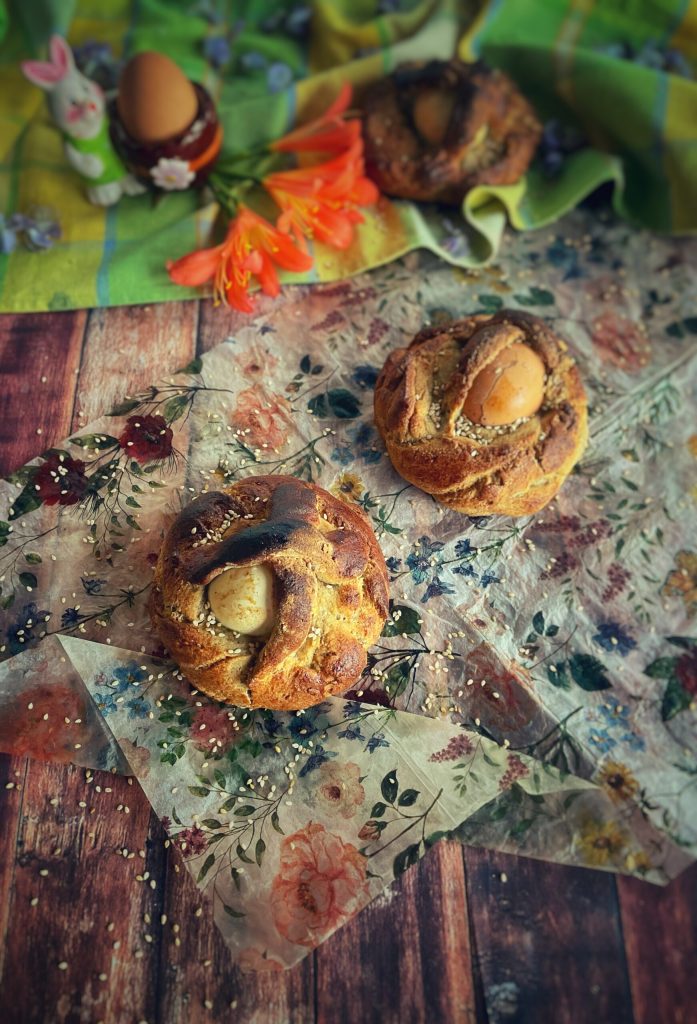
The Cuddura (or Cudduredda, or Pani cu l’ova) is one of the oldest symbols of Sicilian ritual baking.
The term comes from the Greek kollura and originally indicated a round loaf.
Born as a devotional gift and a symbol of prosperity, this preparation has evolved over time into different regional variants, all characterized by the presence of hard-boiled eggs placed into the dough with their shells.
Before the spread of chocolate eggs, cuddure were the main gift exchanged on Easter Sunday.
Although the most commercially widespread version today is the sweet one, made from a crisp shortcrust, the recipe has its roots in the leavened version.
In the past, Sicilian families prepared “cuddure di pane” using a home-style bread dough enriched with lard, creating symbolic shapes like baskets, bell towers or braids.
This recipe focuses on the savory variant, which differs from the classic sweet version by the absence of sugar and the use of ingredients that emphasize its rustic character.
Unlike shortcrust, this version requires natural fermentation, here obtained by using a sourdough starter.
The preparation takes place during Holy Week (often on Good Friday or Holy Saturday) and represents a moment of gathering where different generations of the family collaborate on the dough and decoration.
I decided to offer you a savory version, perfect to accompany the Easter lunch or the Easter Monday picnic (it is traditional to eat the cuddura and its hard-boiled eggs at breakfast on Easter Monday) made entirely gluten-free.
It undoubtedly shows many similarities with:
- Difficulty: Medium
- Cost: Very inexpensive
- Rest time: 6 Hours
- Preparation time: 15 Minutes
- Cooking time: 30 Minutes
- Portions: 4 pieces
- Cooking methods: Oven, Electric oven
- Cuisine: Italian
- Seasonality: Easter, Spring
Ingredients
- 1/2 cup fresh gluten-free sourdough starter (refreshed)
- 1 1/2 cups water
- 1 teaspoon sugar (or honey)
- 4 cups gluten-free flour mix
- 2 teaspoons salt (approximately 10 g)
- 3 1/2 tbsp lard (approximately 50 g)
- as needed milk (for brushing)
- 1 egg yolk (for brushing)
- 4 hard-boiled eggs
- as needed sesame seeds
Steps
Activation: Dissolve the gluten-free sourdough starter in lukewarm water with a pinch of sugar or honey to encourage fermentation.
Dough: Add the flour and work with a mixer or a wooden spoon until the mixture is homogeneous. Add the salt and the lard at the end.Note: Gluten-free sourdough doughs are stickier; oil your hands to handle them.
First Fermentation: Let rest covered in a warm place for about 3-4 hours, or until you see a clear increase in volume.
Shaping: Divide the dough and form ropes (each piece about 5–7 oz / 150–200 g). Braid them* around the hard-boiled eggs (already cooled and cleaned, still in their shells). Use thin strips of dough to secure the egg on top, just like in the sweet version.Note: Before embedding the hard-boiled egg into the bread, lightly brush the shell with a thin layer of oil. This creates a non-stick barrier between the shell and the dough, preventing the dough from “gluing” to the shell during fermentation and baking.
Second Fermentation: Cover with a cloth and let rise again for about 1-2 hours.
Baking: Brush the surface with a beaten egg yolk mixed with a little milk, sprinkle with sesame seeds and bake at 392°F for about 25-30 minutes.*How to form the braid (Step by step):
The Ropes: Divide the risen dough into pieces of about 5–7 oz (150–200 g). Create two “logs” (ropes) about 10–12 inches long.Pro Tip: Because gluten-free dough tends to crack, work it on a lightly oiled surface or dusted with rice flour.
The Cross: Lay the two ropes in a cross. Place the hard-boiled egg (well dried) right at the center of the cross.
The Braid: Fold the ends of the ropes upward, wrapping the egg, then braid the ropes over the egg itself. You can also create a simple two-strand braid and close it into a circle, inserting the egg into the central hole.
The Fastening: For security, roll two thin strips of dough and place them “crosswise” over the egg, fixing them to the base of the braid. This will prevent the egg from slipping out during baking.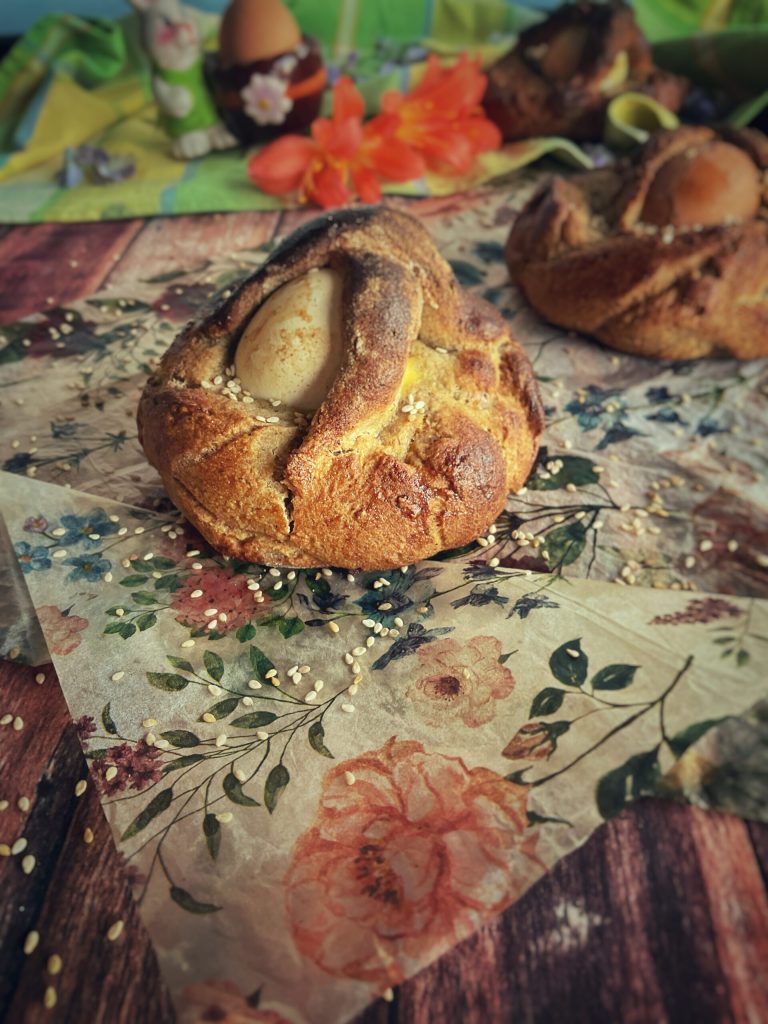
Other names for Cuddure di Pane:
Depending on the area of Sicily it may take different names that emphasize its nature as “bread”:
Pani cu l’ova (literally “bread with eggs”): This is the most common name for the leavened variant, used to distinguish it from the “Pupi cu l’ova” which are made from a crisp shortcrust.
Panaredda (or Panariddru): A name widespread especially in the Siracusa and Agrigento areas, referring to the basket-like (“panaro”) braided shape typical of this version.
Cudduredda: A smaller version or a crown-shaped one, often made with an enriched bread dough.
Pupi cu l’ova: Although also used for sweets, in some areas it generally indicates any anthropomorphic form of Easter bread that encloses an egg.
FAQ (Questions and Answers)
For cuddure di pane, originally was olive oil or lard used?
Originally, for cuddure di pane (the leavened, rustic version), the traditional ingredient was undoubtedly lard (a nzunza).
Softness and Preservation: Lard is an animal fat that makes the dough much softer and, above all, helps the bread not to harden quickly. This was essential because cuddure were prepared in advance to last throughout Easter week.
Rural Economy: In the past, olive oil was a precious commodity often intended for sale or for raw seasoning, while lard was the “home” fat obtained from the winter pig slaughter, always available in rural pantries.
Performance in Gluten-Free: Although oil is an excellent modern alternative, lard in gluten-free dough is technically superior: it helps provide structure and “elasticity” to a dough that lacks gluten, making it less crumbly.
Differences between Cuzzupa, Cuddura and Mona di Pascua:
