
Modenese Bensone: original recipe and the trick for a dough that stays soft even after baking
If this has happened to you too, a traditional pastry that looks simple—like the Modenese Bensone—ending up too dry or compact, or worse, so hard it seems like a cookie forgotten in the pantry, don’t worry: it happened to me too!
The main problem with this Emilian “ciambellone” is that the technique is often wrong, producing a dough that becomes excessively tough in the oven. I confess that before reaching this final version I collected several failed attempts, including some Bensones with jam leaking everywhere because they weren’t sealed properly.
The secret to fix this issue is not only the quantities, but how you manage the fats. To achieve that melt-in-your-mouth crumbly texture, the butter must be at “creamed” consistency, meaning soft but not melted; this lets you incorporate it quickly without warming the dough too much.
Also, the refrigeration rest is essential: it stabilizes the structure and lets you roll it out without adding too much flour, which is the main cause of post-bake hardness.
In this guide I’ll show you how to close it with the “three-fold” method, a foolproof technique to seal the heart of blueberry jam (or plum jam, as tradition prefers) and avoid oven disasters.
Get ready to rediscover the true taste of the Emilian snack: a cake scented with lemon and vanilla, perfect for dunking in milk or Lambrusco!
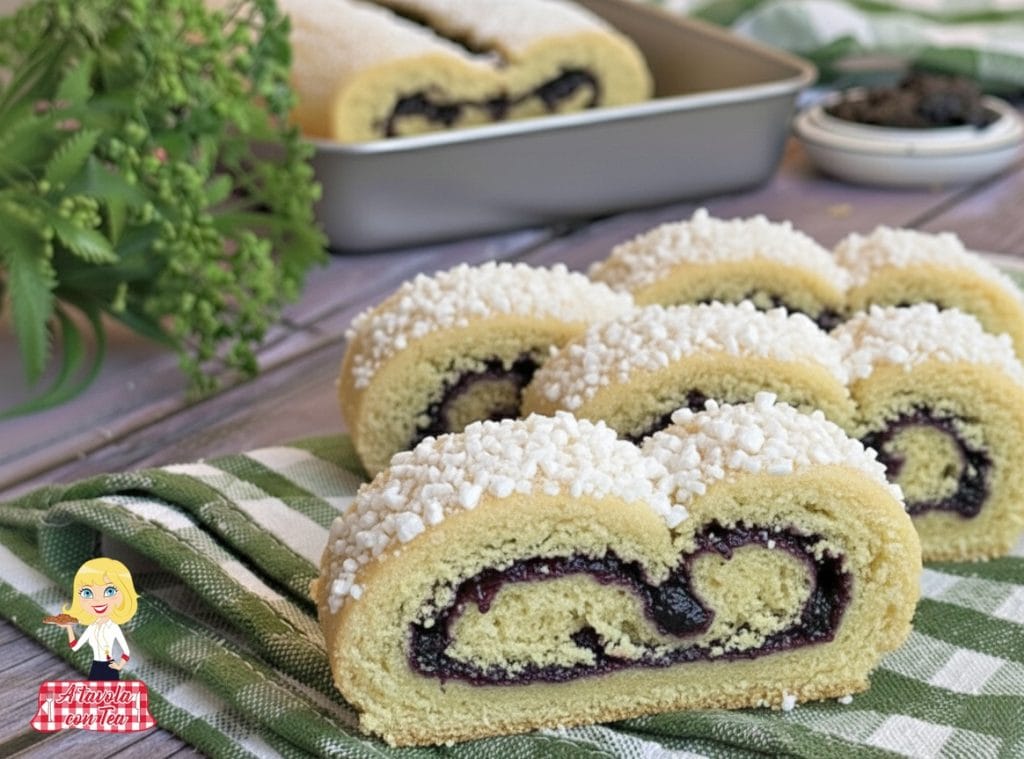
- Difficulty: Very easy
- Cost: Budget-friendly
- Rest time: 40 Minutes
- Preparation time: 20 Minutes
- Cooking time: 30 Minutes
- Portions: 8
- Cooking methods: Oven
- Cuisine: Italian
Ingredients for Modenese Bensone (8-10 servings)
- 4 cups all-purpose flour (00 flour)
- 3/4 cup sugar
- 7 tbsp butter
- 2 eggs (+ 1 yolk)
- 1 packet baking powder (about 4 tsp)
- 1 lemon zest
- 1/2 tsp vanilla extract
- 3 tbsp milk
- 1 pinch salt
- 2/3 cup blueberry jam
- as needed coarse sugar (pearl sugar)
Tools
- Kitchen scale
- Stand mixer
- Parchment paper
- Baking tray
Modenese Bensone (or Modenese Ring Cake): the original recipe and the trick to keep it very soft
Combine the dry ingredients: In the bowl of the stand mixer (or on the work surface), quickly mix the sifted flour with the sugar, the baking powder and a pinch of salt.
Add the fats: Incorporate the soft butter in small pieces. Work with your hands or the paddle of the mixer until you get a “sandy” texture (similar to a crumble).
Add the wet ingredients: Add the 2 whole eggs and the yolk, the lemon zest, the vanilla and 3 tablespoons of milk. Work just enough to obtain a homogeneous dough. If the dough is too stiff, add the last tablespoon of milk.
Rest: Wrap the dough in plastic wrap and let it rest in the refrigerator for half an hour. This stabilizes the butter and makes the dough easier to roll out.Roll out the dough: Briefly work the rested dough to warm it slightly. Roll it out on a sheet of parchment paper, forming a rectangle of about 10–12 inches.
Filling: Spread the blueberry jam in the center, leaving a 1–2 cm border free all around.
The three-fold (to seal): Using the parchment paper to help, fold one long side of the dough over the jam, then fold the other side over it, like closing a package. The seam should be underneath. This way, the top of the cake will be smooth.Prepare the surface: Transfer the Bensone to the baking tray. Make a light central cut almost the whole length (this helps even baking and lets the filling peek through).
Brush and decorate: Lightly beat the remaining egg. Brush the surface evenly and sprinkle with pearl sugar.
Bake: Bake in a preheated conventional oven at 356°F (180°C) for about 40 minutes. It should be well golden.
Cool: Remove from the oven, let cool completely and serve.
Ingredient Notes and Substitutions
Butter: It should be at room temperature and worked briefly. If it’s too cold, the dough will be hard to handle. If it’s melted, it will make the dough too sticky.
Milk: Use it sparingly. Add the initial 3 tablespoons and the optional fourth tablespoon only if the dough struggles to come together. Too much milk will make it gummy.
Jam: Traditionally plum or sour cherry jam is used, but blueberry jam creates a perfect contrast.
Storage
The Bensone keeps perfectly for 4-5 days at room temperature, covered with a glass dome or in an airtight container.
My tip: If you store it for too long, a short pass in a ventilated oven at 212°F (100°C) for 5 minutes will make it fragrant again as if just baked.
Recipe Alternatives and Variations
Cocoa Bensone: Replace 30 g of flour with 30 g of unsweetened cocoa for a dark dough that pairs very well with citrus fillings (e.g. orange marmalade).
Spiced Bensone: Add a pinch of cinnamon and nutmeg to the dough for a more autumnal, aromatic version.
Uses and Recommended Pairings
Ideal moment: Great for breakfast, but its true vocation is to accompany afternoon coffee or tea.
Traditional pairing: In Emilia it is often served with a glass of dry Lambrusco, which by contrast enhances the sweetness of the jam.
Origins and History of the Recipe
The Bensone is the quintessential baked good of the Modenese and Emilian tradition. It was born as a poor, ritual dessert, often prepared for religious festivals, and its loaf-like shape lends itself well to sharing. Originally, the dough did not include fillings, only a dusting of sugar, while the jam-filled variant became established over time. It is a cake that tells the story of home and rural cooking.
Why Does Refrigeration Make a Difference?
Half an hour in the refrigerator is not a step to skip. When we work a dough with butter, the heat from our hands tends to melt the fat. Chilling it lets the butter firm up, making the pastry more stable and less sticky. This means when you roll it out you won’t need to add more flour, thus avoiding unnecessarily hardening the dough. The result: an easier-to-handle Bensone and a softer texture after baking.
FAQ (Questions and Answers)
1. My Bensone turned out too hard/dry. What did I do wrong?
The main reasons are two: 1) Too much flour during rolling out (added to handle a dough that was too warm/sticky). 2) Overworking the dough with the butter, which made it too elastic. Always work the minimum necessary.
2. The jam leaked out during baking. How do I avoid that?
The key is the Three-Fold (step 6): make sure the edges are well sealed and that the final seam is under the cake, in contact with the parchment. The central cut should be light and not reach the edges.
3. Can I replace butter with oil?
You can substitute the 100 g of butter with about 80 ml of neutral oil (sunflower or rice oil). Note that the texture will be different: more like a pound cake and less crumbly. If you want the classic crumbly texture, use butter.
