
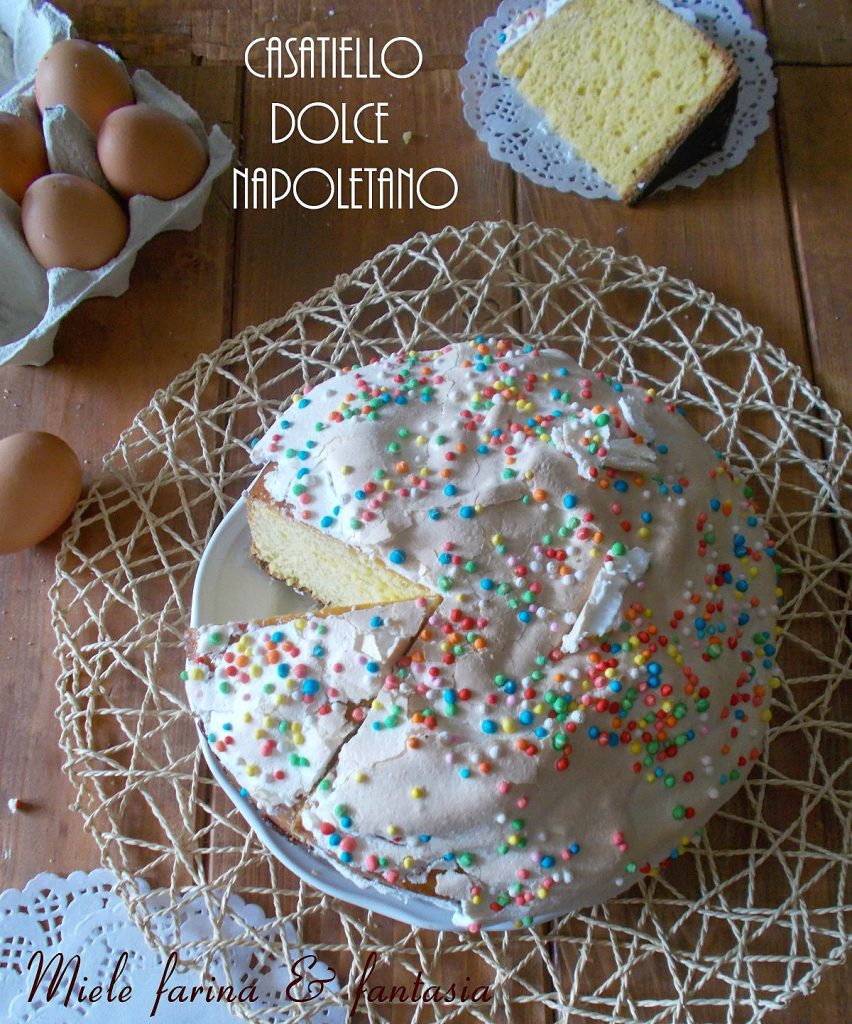
Today I will tell you about another typical recipe from my land, the sweet Neapolitan casatiello. Yes, there is also a sweet version of the casatiello, although, in terms of dough type and ingredients, it has little to do with its savory “cousin.” At my house it is tradition to prepare it for both Christmas and Easter. It is a pastry made with sourdough starter, sugar, eggs, lard (or butter) and flavorings. All topped and decorated with a delicious and crunchy royal icing and colored sprinkles. The interior of the sweet casatiello has a soft texture but, at the same time, is more compact and with a tighter crumb than a Christmas panettone (if you want to make a comparison). In my family’s tradition sweet casatielli must be tall and narrow; for this reason the molds used have a circumference of about 22/24 cm (about 8 2/3″ / 9 1/2″) in width and at least 12/14 cm (about 4 3/4″ / 5 1/2″) in height. You can still use the molds you already have at home; bundt cake pans work well too. The only two modifications made to my grandmother’s original recipe concern the use of a stand mixer instead of hands and the type of flour. My grandmother used weak flour and had enormous problems managing fermentation, because weak flour has weak gluten and therefore cannot withstand very long rises. However, thanks to her long experience with this type of cake and to her very, very strong sourdough starter, she managed—though with some concern and “races against time”—to create wonderful casatielli, until she “discovered” Manitoba flour. Enjoy reading and enjoy your sweet casatiello.
Many of you have been writing to me and I thank you very much for your trust. At the end of the recipe, in the notes section, I included the procedure to properly replace the sourdough starter with a preferment made with baker’s yeast (also called a “lievitino”), to obtain an equally excellent result.
- Difficulty: Medium
- Cost: Medium
- Preparation time: 12 Hours
- Cooking time: 1 Hour
- Portions: 1 sweet casatiello weighing over 2.2 lb (about 1 kg)
- Cooking methods: Oven
- Cuisine: Italian
- Seasonality: Easter Monday, Easter
Ingredients
- 500 g Manitoba flour (about 4 cups / 500 g)
- 100 g Sourdough starter (about 3.5 oz / 100 g)
- 7 Whole eggs (medium)
- 200 g Sugar (about 1 cup / 200 g)
- 50 g Lard (about 3.5 tbsp / 50 g) — can be replaced with very soft butter
- 1 bustina Packet of vanillin (vanilla powder)
- 1 Vial of orange blossom water
- 1 cucchiaio Strega liqueur (1 tablespoon)
- 1 cucchiaio Rum or limoncello (1 tablespoon)
- Zest of 1 lemon
- 1 g Fine salt (about 1/4 tsp / 1 g)
- 1 Egg white
- 100 g Sugar for icing (about 1/2 cup / 100 g)
- 1 cucchiaino Lemon juice (1 teaspoon)
Tools
- 1 Mold
Preparation
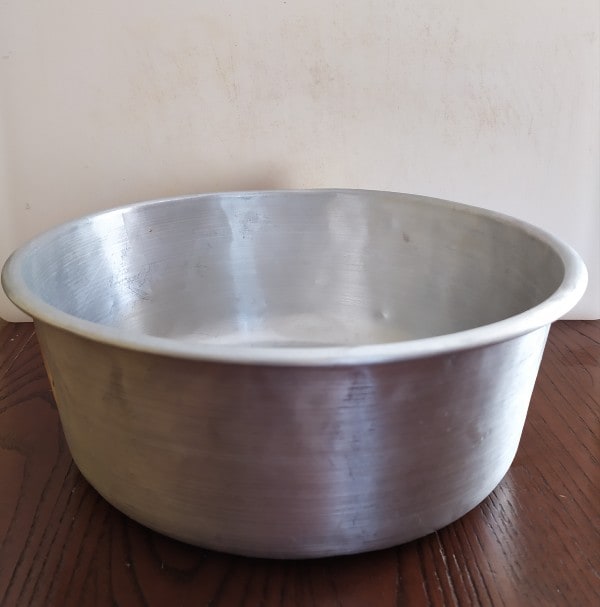
With these quantities we can prepare a sweet casatiello weighing slightly over one kilogram. The mold I used is the traditional aluminum one, round, 25 cm in diameter and 10 cm high (about 9 7/8″ diameter and 4″ high).
Refresh the sourdough starter (which must be strong and lively) as you are used to doing; however, I recommend hydrating it a little more to make it softer and to facilitate the absorption of the strong flour and eggs. If you don’t do that, don’t panic. You can simply add a second egg to the mix if needed.
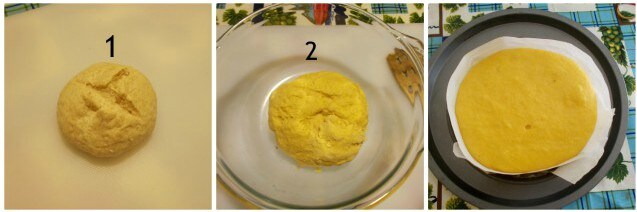
When the sourdough starter has risen, take 100 grams of it and mix it with 100 grams of flour and 1 whole egg. As soon as the egg and flour have been fully absorbed, briefly work it with your hands to shape it into a ball. Make a cross cut on the surface, cover the first dough well and let it proof until doubled (at room temperature it takes about 10–12 hours). It will not be necessary to work the three doughs for long; stop the stand mixer as soon as the ingredients are perfectly combined.
When the first dough has doubled, mix it with another 200 grams of flour and 2 whole eggs. As soon as the ingredients are combined, briefly work the dough by hand (as described above). Put the second dough back to rise until doubled (about 10–12 hours).
Proceed with the third and final dough. Add to the second dough the remaining flour (i.e. 200 grams), the remaining eggs (one at a time), the sugar, the salt, the lard (which you can replace with 50 grams of very soft butter creamed with a fork), the flavorings and the liqueur. Because not all eggs are the same size and not all flours absorb liquids in the same way, it may be necessary to use more or fewer eggs than I indicated. In my case the dough absorbed a total of 7 medium eggs. The final consistency of the dough should be very, very soft, almost liquid.
As soon as all the ingredients have been fully absorbed, pour the dough into the well-buttered and floured mold(s) you have prepared. Let it rise until it nearly reaches the rim of the mold.
Bake the sweet casatiello at 356°F (180°C) for about 60–70 minutes in a preheated oven. It should become an even amber color. To check doneness, poke the casatiello with a skewer; it should come out dry. During the last 5 minutes of baking, prepare the royal icing.
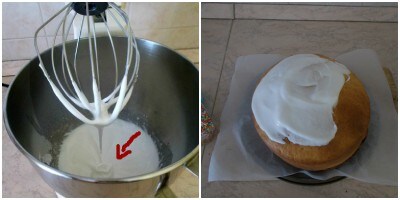
In a stand mixer pour one egg white and start whipping it at high speed for about 15 seconds. At this point begin adding the sugar little by little until the mixture looks glossy, bright white and fairly thick; the icing, when falling from the whisk, should “write” on the bottom, i.e. leave clear marks. If necessary, add a little more sugar. Flavor it with a teaspoon of lemon, orange or tangerine juice. As shown in the photo on the right, once spread the icing does not run off the casatiello. Turn off the oven and immediately remove the cake from the oven. With a spatula immediately cover the casatiello with the icing (entirely or only on the top). Sprinkle with colored sprinkles and put the cake back in. In this way the residual heat of the oven will dry and pasteurize the icing. The icing is ready as soon as it is hard to the touch and has lost its shine (this takes about 10 minutes). The sweet casatiello keeps for days and days; in fact it can also be made up to a week before the holidays and then stored in a cake box or in a bread bag. It will become better with time.
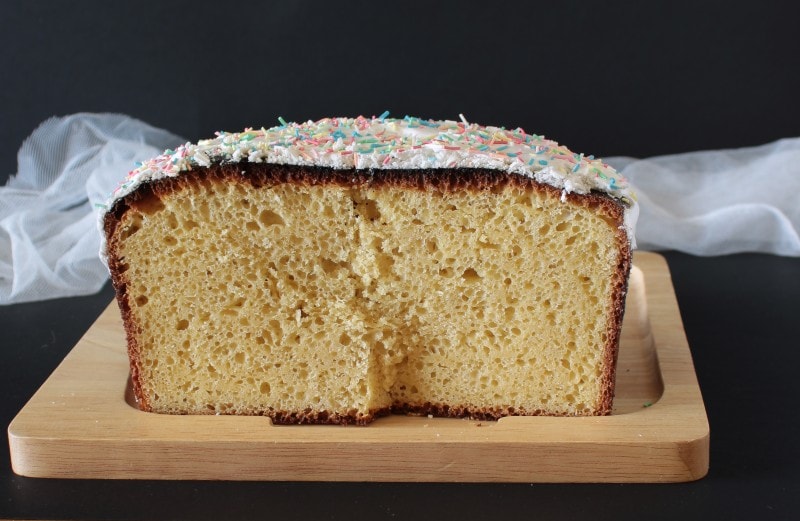
Many of you asked: here is my mold, 25 cm diameter by 10 cm height (about 9 7/8″ diameter by 4″ high), but there are also narrower and taller ones or smaller ones depending on your needs.
For those who do not have sourdough starter
You can also use fresh baker’s yeast by preparing a preferment (lievitino) with 5 grams of fresh baker’s yeast (about 1 2/3 tsp / 0.18 oz), 100 grams of Manitoba flour (about 3/4 cup plus 1 tbsp / 100 g) and 70 ml of water (about 1/3 cup / 70 ml). Mix in a bowl and form a soft dough. Seal the bowl with plastic wrap. Let it double in volume before joining it with the other ingredients as if it were sourdough starter, exactly as described above. The lievitino will have a greater weight compared to the amount of sourdough starter I indicated, but this is not a problem.
