
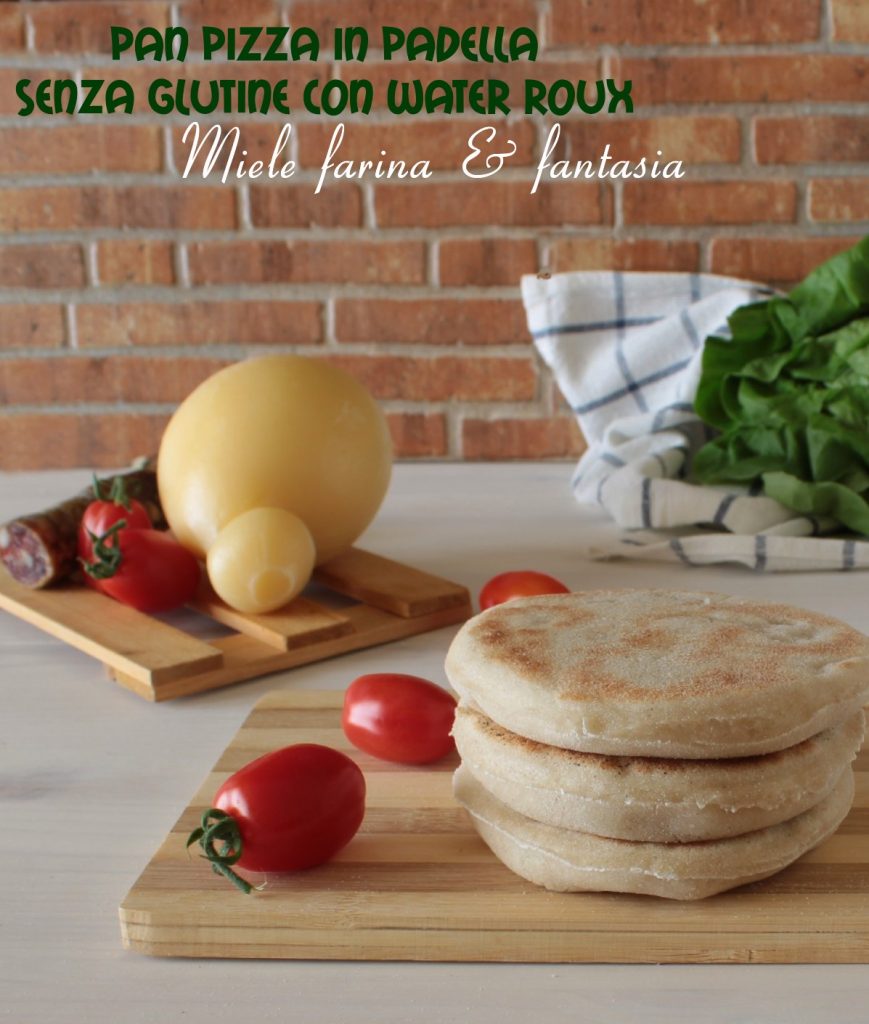
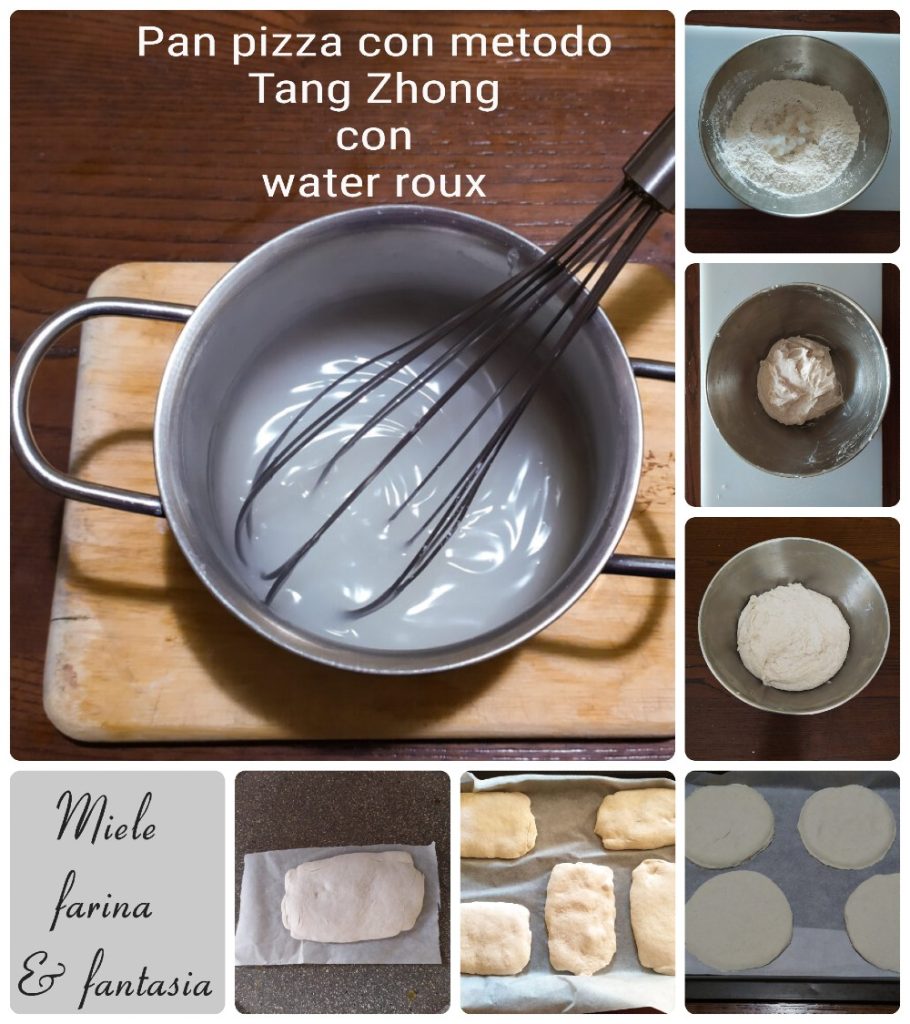
Today we’re talking about gluten-free pan pizza cooked in a skillet, a very soft leavened bread made with a method called “Tang Zhong.” Don’t be put off by the grandiose name — it’s a simple technique to reproduce, although at first it can seem a bit confusing because some calculations are required. This pan pizza cooks very quickly and, as I said above, it is cooked in a simple nonstick skillet or on a smooth-surfaced griddle. It’s versatile, suitable for both sweet and savory fillings, and the softness lasts over time. At the bottom of the photo with the various steps, you’ll find the general Tang Zhong procedure detailed. I had been wanting to experiment with this technique for quite some time, also called water roux, which “consists of making bread soft and elastic without adding preservatives or additives, but simply using a starter made with the same flour and water, used in a 1:5 ratio (for 1 gram of flour add 5 grams of water), and bringing them to a temperature of 149°F and then cooling them before incorporating them into the dough” (cit. Wikipedia).
- Difficulty: Very easy
- Cost: Medium
- Rest time: 5 Hours
- Preparation time: 15 Minutes
- Cooking time: 5 Minutes
- Portions: 5
- Cooking methods: Stovetop
- Cuisine: Italian
Ingredients
- 1 tbsp cornstarch (maizena) gluten-free
- 5 tbsp water
- 2 cups gluten-free all-purpose flour
- 1/2 cup room-temperature water
- 1 tsp fine salt
- cold water roux
- 1/2 tsp fresh baker's yeast (gluten-free)
- as needed rice flour (for the work surface)
Tools
- 1 Griddle
- 1 Lid
- 1 Thermometer
Steps
Let’s prepare the water roux. Pour the water into a small saucepan, add the cornstarch and stir immediately. Place the saucepan on the smallest burner over the lowest heat, and using a kitchen thermometer, continue stirring until the mixture reaches 149°F (about 5 minutes). If you don’t have a suitable thermometer, turn off the heat as soon as the mixture begins to thicken and lose its shine, turning a pearly white as shown in the photo. Be careful: it should not become hard, but remain very soft, like a semi-transparent, very soft gelatin.
Turn off the heat immediately, put the saucepan in contact with cold water to lower the temperature; finally let it cool, covered with plastic wrap placed directly on the surface.
As soon as the water roux is cold, prepare the dough for the pan pizzas.
In a bowl pour the flour and add the water roux. Dissolve the yeast in the water and combine everything with the flour, mixing roughly. Add the fine salt and knead just enough to perfectly combine all the ingredients. The dough will be rather sticky. Cover it and let it rise until doubled in size.
When the dough has well risen, gently turn it out onto a cutting board or work surface dusted generously with rice flour.
Roll the dough onto itself to form a ball; repeat this operation twice to give additional structure to the final result.
Now gently stretch the dough until you form a rectangle, without pressing it too much (the ideal thickness is about 5/8–3/4 inch). Using a small coffee saucer, cut out round pan pizzas; or cut them into rectangles if that’s more convenient.
Place the pan pizzas, spaced about two finger-widths from each other, on a tray or baking sheet dusted with rice flour, cover and let rise again.
Let’s move on to cooking. Heat a nonstick skillet or a smooth-bottom griddle very well. When it’s very hot, place a disk of pan pizza on the griddle, immediately cover it with a lid (necessarily dome-shaped if you’re cooking on a griddle) of glass or metal and let cook for about a couple of minutes per side, checking after about one minute. You can also cook the pan pizzas on scraps of parchment paper but it’s not essential. The cooked pan pizza should be puffy and light.
Now I’ll explain how and why I used these exact quantities, that is, the percentage of water roux to use in doughs (including those made with traditional flours) and the amounts of starch and water required to make the so-called water roux. Since this is a gluten-free recipe, I will focus exclusively on the Tang Zhong proportions for a water roux made with pure starches like potato starch or cornstarch (as in this case).
a) For a cornstarch water roux: the ratio between cornstarch and water should be 1:10 — that is, for every gram of cornstarch add 10 grams of water.
b) The percentage of water roux to add to doughs is 30% relative to the weight of the flour used in the recipe.
c) In practice, using the quantities from this recipe as an example, this means that 30% of 250 grams of flour equals 75 grams (i.e., the water roux should weigh 75 grams, about 2.6 oz). Finally, to understand how much starch and how much water you need to reach 75 grams, divide 75 by 11 (the sum of 1+10 from the starch:water ratio) and you get 7 grams of cornstarch (rounded up; approximately 1 tablespoon) and 70 ml of water (also rounded up; about 5 tablespoons). Obviously the total does not add up exactly to 75 but to 77 grams, but the result will not be compromised; the important thing is to keep the 1:10 ratio intact.
If the quantity of flour used in the dough had been 500 grams, then the water roux would have been 150 grams; using the calculations I’ve shown you, you can adjust the amounts of starch and water accordingly each time. I write all this not to give you a headache, but for the sake of precision. Don’t worry though — following the amounts I’ve indicated will make everything much simpler.
