Escarole Pizza
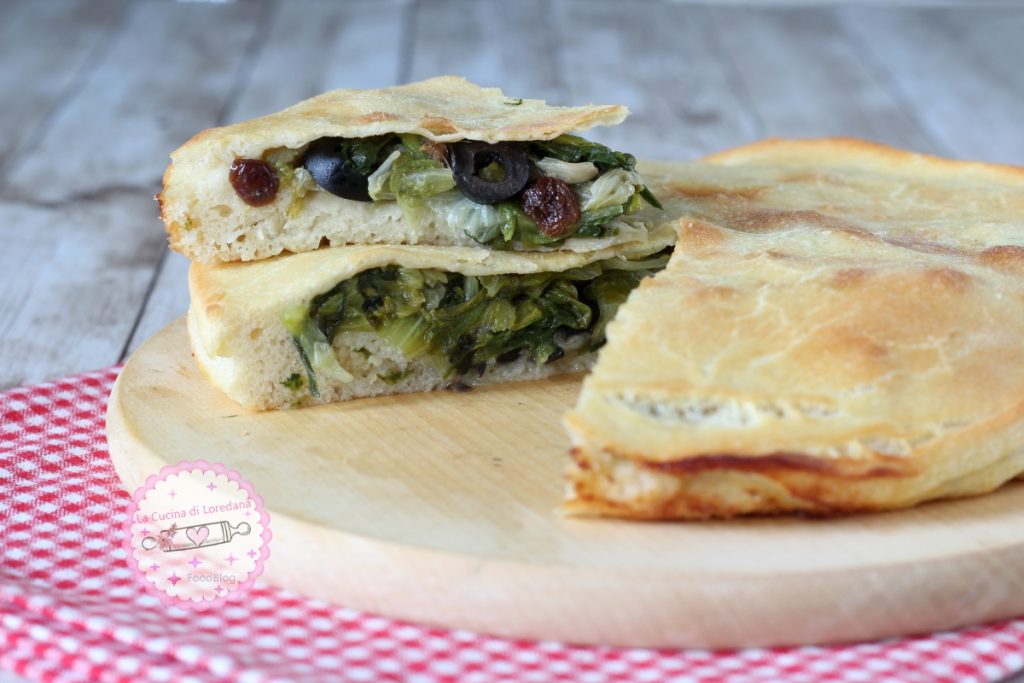
The Escarole Pizza is an ancient dish of the Campanian culinary tradition, served as a second course or as an appetizer according to the custom for the Christmas Eve lunch. A soft shell of long-fermented pizza dough that encloses a tender center of braised escarole, olives, anchovies and raisins. These are the main ingredients that stuff this flavorful savory pie prepared with pizza dough but sometimes also with shortcrust pastry. Escarole pizza has humble origins, belonging to popular tradition, but in 1773 the great gastronome Vincenzo Corrado introduced it to the courts of European nobility by writing this recipe in his famous work. Making Neapolitan escarole pizza at home requires just a few steps and every family has its own version; I tell you mine which may not be perfect but I swear it is very very good! With vegetables I also recommend not missing the recipe for my Phyllo spirals with spinach and ricotta, the recipe for Fennel flatbread and Savory pastries with turnip tops. Escarole pizza is not just a recipe: it is memory, tradition and conviviality. It is the scent of the holidays in Naples or in southern Italian homes, the story of a cuisine that knows how to transform simple ingredients into something extraordinary. Because escarole pizza is not only cooking: it brings back memories and aromas, it is family gathering, it is love taking shape… and it smells like home.
AND DON’T MISS THESE RECIPES TOO:
- Difficulty: Easy
- Cost: Economical
- Rest time: 5 Hours
- Preparation time: 30 Minutes
- Cooking time: 50 Minutes
- Portions: 6 servings
- Cooking methods: Oven, Stovetop
- Cuisine: Italian
- Seasonality: Fall, Winter
- Energy 270.62 (Kcal)
- Carbohydrates 47.54 (g) of which sugars 4.89 (g)
- Proteins 8.48 (g)
- Fat 6.40 (g) of which saturated 0.85 (g)of which unsaturated 2.86 (g)
- Fibers 3.11 (g)
- Sodium 226.27 (mg)
Indicative values for a portion of 150 g processed in an automated way starting from the nutritional information available on the CREA* and FoodData Central** databases. It is not food and / or nutritional advice.
* CREATES Food and Nutrition Research Center: https://www.crea.gov.it/alimenti-e-nutrizione https://www.alimentinutrizione.it ** U.S. Department of Agriculture, Agricultural Research Service. FoodData Central, 2019. https://fdc.nal.usda.gov
Ingredients for Escarole Pizza
- 3 1/4 cups all-purpose flour (type 0)
- 2 tsp fresh brewer's yeast
- 7/8 cup water
- 1 tbsp extra virgin olive oil
- 1 tsp salt
- 1.1 lb escarole (endive)
- 1/4 cup raisins
- 1/2 cup black olives (pitted)
- 1/4 cup pine nuts
- 5 fillets anchovy fillets in oil
- 1 clove garlic
- to taste extra virgin olive oil
- to taste salt
How to prepare Escarole Pizza
First of all prepare the dough. You can make it by hand or with a stand mixer. Dissolve the yeast in the lukewarm water, then add the flour. As soon as the dough begins to come together, incorporate the oil and salt. Knead well for a long time. Transfer the dough to a bowl, cover with plastic wrap and let it rise in a warm place for 3-4 hours.
While the dough is rising prepare the filling. Remove any damaged outer leaves. Separate the escarole into leaves and cut out the core. Chop the leaves into 3-4 pieces. Place the escarole in a colander and wash under running water. Let it drain very well.
Pour 2–3 tbsp of extra virgin olive oil into a large skillet. Add the garlic clove, the raisins, the anchovy fillets cut into small pieces and the olives. Let sauté over low heat for one minute. Add the escarole, a pinch of salt and the pine nuts. Mix and cover the pan with a lid.
In this way the escarole will gradually release its water and cook without the need to add other liquids. After 8-9 minutes of cooking remove the lid and continue cooking for a few more minutes to evaporate all the water. At the end of cooking remove the garlic clove.
After the rising time, take the dough. Divide it into 2 parts. Roll out one part on a floured work surface and line the base and sides of an oiled pan 9½–10¼ in (24–26 cm) in diameter. Arrange inside the cooked escarole, draining it well if there is liquid in the pan.
Roll out the other piece of dough and use it to cover the pizza. Seal well all around. Use the tines of a fork to make holes on the surface. Brush the surface with some oil. Let the Escarole Pizza rise for one hour. Bake in a preheated convection oven at 374°F for 30-35 minutes.
See you tomorrow with a new recipe, hugs, Loredana
Loredana’s Tips
Escarole Pizza is even better the next day
It is excellent hot, warm or at room temperature
For a strong and slightly spicy flavor you can add small chopped hot chili peppers when cooking the escarole
Don’t miss the recipe for the Rustic pie with pumpkin and speck
Your Questions
Can escarole pizza be frozen?
Yes, you can freeze it already cooked and cooled. Just reheat it in the oven to restore crispness and flavor.
When is escarole pizza traditionally eaten?
In Naples it is typical of Christmas Eve, but today it is prepared throughout the winter season.
Can it be prepared in advance?
Yes, in fact it is even better the next day. The flavors blend more and the texture becomes firmer and tastier.
Which type of escarole is used for escarole pizza?
For Neapolitan escarole pizza the smooth escarole (batavian endive) is preferably used, as it is more tender and less bitter than other varieties.
How can you avoid the escarole pizza opening during baking?
Seal the edges well by pinching the dough and make only small holes on the surface. Do not overload the filling.
Can you make a lighter escarole pizza?
Yes, you can: reduce the oil in the filling, decrease the amount of raisins, use a whole wheat dough, or prepare it with a lighter shortcrust pastry.